


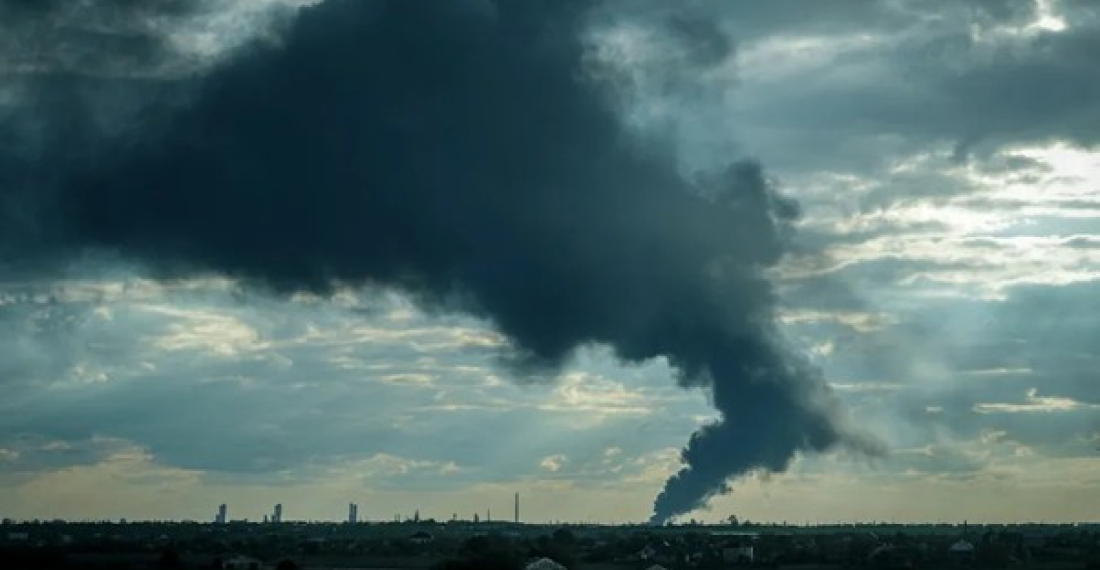
Four Indian Seafarers Killed in Missile Strike on Cargo Ship Leaving Odessa

Four Indian nationals were among 10 people killed after the cargo vessel MV Golden Leo was struck by missiles while departing Ukraine's southern port of Odessa on July 19, prompting India to summon a senior Russian diplomat and condemn the attack on commercial shipping.

According to Ukraine's Navy, the Guinea-Bissau-flagged vessel, owned by a Turkish company, was hit by three Russian cruise missiles shortly after leaving Odesa through Ukraine's Black Sea maritime corridor with a cargo of grain. The ship was carrying 17 crew members, including five Indian nationals. Ukrainian authorities said the strikes ignited a fire after hitting the vessel's starboard side.

Ukraine's Sea Ports Authority said 10 people, including a Ukrainian pilot, were killed in the attack. Rescue operations continued overnight into July 20, with emergency services extinguishing the fire and rescuing survivors. India's Ministry of External Affairs confirmed that four Indian crew members died, while the fifth was critically injured and remains hospitalized.

In a statement released on X on July 21, the ministry described the incident as "deplorable" and stressed that targeting civilian seafarers and commercial shipping was unacceptable. "India condemns such attacks," the ministry said, adding that attacks endangering "innocent civilian crew members" and obstructing freedom of navigation "should be avoided." New Delhi subsequently summoned Russia's chargé d'affaires, Vladimir Ladanov, to convey its "grave concerns," stating that attacks on commercial vessels undermine "the safety, security, and stability of international maritime commerce."

Ukraine's acting Foreign Minister Andrii Sybiha also condemned the strike, noting that it followed Russia's large-scale overnight missile and drone attack on Kyiv. "While the world is still responding to Russia's brutal overnight attack on Kyiv, Moscow continues its campaign of terror throughout the day," he wrote on social media.

The incident highlights the growing risks facing civilian shipping operating in and around the Black Sea. India, one of the world's largest suppliers of merchant seafarers with more than 300,000 citizens employed in the industry, has seen multiple nationals killed this year in attacks linked to ongoing conflicts in both Ukraine and the Middle East. 

Source: commonspace.eu with The Economic Times (Mumbai) and The Independent (London).



Related articles

Editor's choice
News
Mecca Joint Defence Agreement is a historic development that may change the face of the Wider Middle East

Mecca Joint Defence Agreement is a historic development that may change the face of the Wider Middle East

The Mecca Joint Defence Agreement, signed on 7 August 2026 in Mecca, by Saudi Crown Prince Mohammed bin Salman, Turkish President Recep Tayyip Erdoğan, and Pakistani Prime Minister Shehbaz Sharif, establishes a collective defence arrangement under which an armed attack against any one of the three states is to be regarded as an attack against all three. This is a historic step, and the agreement is a landmark event, that will change the future of the wider Middle East. Saudi Arabia, Turkiye and Pakistan are different countries with many particular features. But there is enough common ground between them to make the new situation created by the Mecca Defence Agreement significant, and their efforts credible. They are also complimentary in terms of what they can bring to the process that they are about to start.Pakistan and Turkiye have large and developed standing armiies; Pakistan has nuclear weapons; Turkiye has a dynamic and expanding arms industry; Saudi Arabia has financial resources, and extensive diplomatic kudos in the Islamic world and beyond. The official statement announcing the new agreement said: “Guided by the longstanding historical ties among the three states, based on the enduring bonds of brotherhood and Islamic solidarity that unite them, and building upon their shared strategic interests and longstanding defense cooperation, HRH the Crown Prince, the President of Türkiye, and the Prime Minister of Pakistan signed the Makkah Joint Defence Agreement, reflecting the three states' shared commitment to further strengthening their collective security and to promoting peace, security, and stability in the region and beyond, in pursuit of a secure and prosperous future. The agreement is intended to strengthen collective deterrence against any act of aggression, and stipulates that any armed attack against any one of the three states shall be regarded as an attack against them all. It further provides for the enhancement of all aspects of defense cooperation among the three states”. Turkish foreign minister Hakan Fidan said that the pact would function similar to NATO, with a minister's committee, political and military committees, and a permanent secretariat to oversee the implementation of decisions. The permanent general secretariat is expected to be based in Saudi Arabia.

Popular

Editor's choice
Interview
Thursday Interview: Murad Muradov

Thursday Interview: Murad Muradov

Today, commonspace.eu starts a new regular weekly series. THURSDAY INTERVIEW, conducted by Lauri Nikulainen, will host  persons who are thinkers, opinion shapers, and implementors in their countries and spheres. We start the series with an interview with Murad Muradov, a leading person in Azerbaijan's think tank community. He is also the first co-chair of the Action Committee for a new Armenian-Azerbaijani Dialogue. Last September he made history by being the first Azerbaijani civil society activist to visit Armenia after the 44 day war, and the start of the peace process. Speaking about this visit Murad Muradov said: "My experience was largely positive. My negative expectations luckily didn’t play out. The discussions were respectful, the panel format bringing together experts from Armenia, Azerbaijan, and Turkey was particularly valuable during the NATO Rose-Roth Seminar in Yerevan, and media coverage, while varied in tone, remained largely constructive. Some media outlets though attempted to represent me as more of a government mouthpiece than an independent expert, which was totally misleading.  Overall, I see these initiatives as important steps in rebuilding trust and normalising professional engagement. The fact that soon a larger Azerbaijani civil society visits to Armenia followed, reinforces the sense that this process is moving in the right direction." (click the image to read the interview in full)


