


European Court of Human Rights orders Russia to compensate Georgia for violations committed after 2008 war

The European Court of Human Rights (ECHR) has ordered Russia to pay Georgia over €250 million for violations committed after the brief war between the two countries in 2008. Russia has stated that it will not comply with the decision of the ECHR. The Court decided on Tuesday 14th October that Russia had stopped people from crossing freely into Abkhazia and South Ossetia, Georgian regions that Moscow recognised as independent after the 16-day war. According to the Court, Russia committed violations including excessive use of force, ill-treatment, unlawful detention and unlawful restrictions on day-to-day movement across the administrative boundary line between Georgian-controlled territory and the Russian-backed breakaway regions.

The Strasbourg-based court linked to the Council of Europe, ordered Moscow to pay just over €253 million for the harm suffered by more than 29,000 victims. The court said it was up to the Georgian government to set up an "effective mechanism" to distribute the sums awarded to the individual victims within 18 months of payment by Russia.

Russia invaded Georgia in August 2008 after Tbilisi launched a surprise offensive against pro-Moscow separatist forces that it said were shelling Georgian villages. Since then, it has occupied areas of northern and western Georgia comprising almost one-fifth of the country and supported friendly governments that have prevented the return of ethnic Georgian citizens, according to Tbilisi. It has also blocked the teaching of Georgian in schools, Georgia says.

Moscow left the the Council of Europe, of which the ECHR is part, in 2022 in the wake of its invasion of Ukraine but the court says it remains liable for violations committed before then. The country has repeatedly defied ECHR rulings, including ones given while it was still a member of the Council of Europe.

Only a few nations followed Russia's lead in recognising South Ossetia and Abkhazia. The wider international community and Georgia still regard them as Georgian territory. The Georgian authorities said that people have been killed while trying to enter or exit Abkhazia or South Ossetia, while others have been arrested, detained and ill-treated for "illegally crossing" the boundary lines.

Children had been forced to choose between learning Russian or making long and perilous journeys to Georgian-controlled territory to attend school, it said.

In an initial 2024 judgment, the court already found "that the incidents alleged were not isolated and were sufficiently numerous and interconnected to amount to a pattern or system of violations."


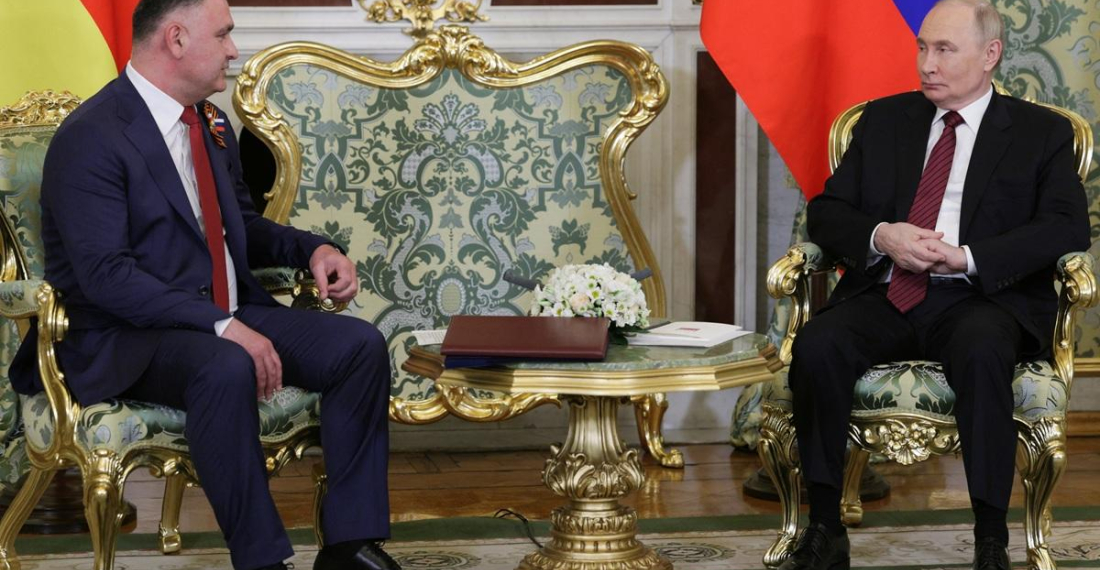
Source: commonspace.eu with AFP, Le Monde and agencies. Photo: Russia's President Vladimir Putin (R) attends a meeting with the leader of the breakaway Georgian region of South Ossetia Alan Gagloev (L) in Moscow on May 10, 2025/AFP

Related articles

Editor's choice
News
Borrell tells the European Parliament that the situation in Afghanistan was critical, but the EU will remain engaged

Borrell tells the European Parliament that the situation in Afghanistan was critical, but the EU will remain engaged

Borrell underlined that the European Union will make every effort to support the peace process and to remain a committed partner to the Afghan people. "Of course, we will have to take into account the evolving situation, but disengagement is not an option.  We are clear on that: there is no alternative to a negotiated political settlement, through inclusive peace talks.
Editor's choice
News
Mystery surrounds the crash of a Turkish airline in Georgia which resulted in the death of 20 Turkish Airforce personnel

Mystery surrounds the crash of a Turkish airline in Georgia which resulted in the death of 20 Turkish Airforce personnel

​ Twenty Turkish Airforce personnel died when a military plane crushed on the Georgian side of the Azerbaijan - Georgia border on Tuesday (11 November). The C130 took off from Ganja and was heading to Merzifon, transporting service members that had participated in Azerbaijan's Victory Day celebrations. Half an hour after takeoff, the aircraft lost altitude and broke apart in mid-air over a mountainous area on the Georgian border. Lockheed C130 Hercules have been in service with Turkey since the 1960s and are considered among the most reliable in their class. However, some of these aircraft are 50–60 years old. In October, the Turkish Ministry of Defense announced plans to replace them with new C130J Super Hercules models, with deliveries expected to begin in the coming years. All aircraft fragments have already been collected for technical examination. The cause of the crash has not yet been officially determined. A Turkish expert and retired military officer Coşkun Başbuğ noted on CNN Türk, a technical malfunction "should be ruled out" as the cause of the crash. "Various possibilities should be considered, but the first thing to consider is that the C-130 is a time-tested military transport aircraft, the last known incident involving which occurred in 1982." "A technical malfunction should be ruled out as the cause of the crash. The same applies to weather conditions, as the relevant authorities would have reported bad weather. The remaining theories include a mid-air collision, sabotage, or an attack," he emphasized. Former Turkish Armed Forces Logistics Commander and retired Army General Erdoğan Karakuş stated in an interview with Turkish television that although the C-130 aircraft are old, they have undergone a complete modernization in Turkey, and their technical condition is thoroughly inspected before each flight. The Turkish Air Force is expected to operate the C-130 aircraft until 2040. ​

Popular

Editor's choice
News
Mystery surrounds the crash of a Turkish airline in Georgia which resulted in the death of 20 Turkish Airforce personnel

Mystery surrounds the crash of a Turkish airline in Georgia which resulted in the death of 20 Turkish Airforce personnel

​ Twenty Turkish Airforce personnel died when a military plane crushed on the Georgian side of the Azerbaijan - Georgia border on Tuesday (11 November). The C130 took off from Ganja and was heading to Merzifon, transporting service members that had participated in Azerbaijan's Victory Day celebrations. Half an hour after takeoff, the aircraft lost altitude and broke apart in mid-air over a mountainous area on the Georgian border. Lockheed C130 Hercules have been in service with Turkey since the 1960s and are considered among the most reliable in their class. However, some of these aircraft are 50–60 years old. In October, the Turkish Ministry of Defense announced plans to replace them with new C130J Super Hercules models, with deliveries expected to begin in the coming years. All aircraft fragments have already been collected for technical examination. The cause of the crash has not yet been officially determined. A Turkish expert and retired military officer Coşkun Başbuğ noted on CNN Türk, a technical malfunction "should be ruled out" as the cause of the crash. "Various possibilities should be considered, but the first thing to consider is that the C-130 is a time-tested military transport aircraft, the last known incident involving which occurred in 1982." "A technical malfunction should be ruled out as the cause of the crash. The same applies to weather conditions, as the relevant authorities would have reported bad weather. The remaining theories include a mid-air collision, sabotage, or an attack," he emphasized. Former Turkish Armed Forces Logistics Commander and retired Army General Erdoğan Karakuş stated in an interview with Turkish television that although the C-130 aircraft are old, they have undergone a complete modernization in Turkey, and their technical condition is thoroughly inspected before each flight. The Turkish Air Force is expected to operate the C-130 aircraft until 2040. ​

