


EU and Armenia hold first meeting of Partnership Council

Federica Morgherni said she was pleased to hear from the Armenian Foreign Minister the determination of the Armenian government on the reform agenda, on the partnership with the EU, and on the perspective of working even more closely together in the months and years to come.

The first EU-Armenia partnership council was held in Brussels on Thursday, 21 June. For the European Union, the delegation was headed by the High representatove for Foreign and Security Policy, Federica Morgherini. The Foreign Minister of Armenia Zohrab Mnatsakanyan, led the Armenian delegation

Speaking after the meeting, Federica Morgherini said:

Relations between the European Union and Armenia have gone from strength to strength in recent weeks and months. The most visible illustration of this is our new bilateral agreement - the Comprehensive and Enhanced Partnership Agreement.

I heard from the Minister [Zohrab Mnatsakanyan] today a very strong commitment to further implement the agreement, which was ratified - I would like to stress this - unanimously in the Armenian Parliament and has been provisionally applied now since June 1.

The EU-Armenia Comprehensive and Enhanced Partnership Agreement is an ambitious agreement that can play a very important role in particular in bringing benefits to Armenian citizens, but also to the European Union citizens.

Through approximation with EU rules and standards, this will help attract EU investments to Armenia, stimulate trade with the European Union, and develop and modernise infrastructure.

Coming to our Partnership Council, we discussed obviously all of this - the state-of-play and the way forward for the implementation of the Agreement; we addressed a range of different topics.

First of all, we agreed on the importance of combatting corruption, and the Minister [Zohrab Mnatsakanyan] stated a very strong new and clear government's commitment to this that I appreciate, and the concrete action that is already taken by the government in this field.

More broadly on reforms, I was glad to hear about the government's determination and very ambitious agenda, with a focus on public administration and on the judiciary, which is an agenda that has our full support, and I reassured the Minister [Zohrab Mnatsakanyan] on the EU intention and readiness to accompany this process, every single step of the journey.

The European Union is ready to continue supporting Armenia's reform process across a range of issues, including, not only fight against corruption or the reform of public administration and the judiciary as I mentioned, but also the related and interconnected issues of economic development and business environment, as well as the promotion of human rights and measures to restore trust in elections.

With this in mind, the European Union has earmarked more than €160 million in financial assistance for Armenia for the years 2017-2021. Upcoming visits of our European Union teams to Armenia will discuss now how the European Union can support the reforms in the country. The Partnership Priorities that we signed last February guide the provision of EU financial assistance for Armenia over the coming years.

We focussed today and we want our common work first and foremost to bring tangible benefits for the citizens of the country and also for the European Union citizens.

Let me also commend Armenia for the positive contribution it gives to our Eastern Partnership and also the positive role played by the country at the last summit of the Eastern Partnership, but now and in the months to come on the implementation of the decisions we took during the summit.

Our common commitment is to advance cooperation based on the 20 deliverables for 2020 that we defined together. They will shape our common work for the next couple of years. The implementation of the 20 deliverables depends ultimately on the reform work of the partner countries across the different areas of good governance and market economy, but the European Union is fully determined to accompany this process with all our instruments.

We also discussed in our restricted sessions this morning other issues that are less related to the reform agenda. We discussed obviously the need to get to a peaceful resolution for the Nagorno-Karabakh conflict that we see as a conflict that needs an early political settlement. We continue to fully support the mediation efforts and proposals of the OSCE [Organisation for Security and Co-operation in Europe] Minsk Group Co-Chairs, and we will continue to accompany the process with all our determination.

We also discussed a number of regional issues.

On Turkey, the European Union supports the normalisation of relations between Armenia and Turkey and we encourage both sides to continue to engage in this process without preconditions.

We also discussed the implementation of the nuclear agreement with Iran. I was pleased to hear the Minister's support to our work to preserve the nuclear deal with Iran. We discussed ways to work together in that direction.

We also addressed the situation in Syria that is of high concern for both of us, and I would like here to recognise and commend the hospitality and the protection that Armenia is giving to Syrian refugees that we also support financially.

For the future, from what I have seen today - but I had no doubt - I have high hopes that the European Union-Armenia relations will make even greater progress, in a spirit of partnership that is the word we used to name our meetings and our agreement today. So, we will work very closely together to ensure a successful implementation of our new agreement.

I was really pleased, Mr Minister [Zohrab Mnatsakanyan] to hear from you the determination of your government on the reform agenda, on partnership with the European Union, and on the perspective of working even more closely together in the months and years to come.

 source: commonspace.eu with the press service of the European External Action Service

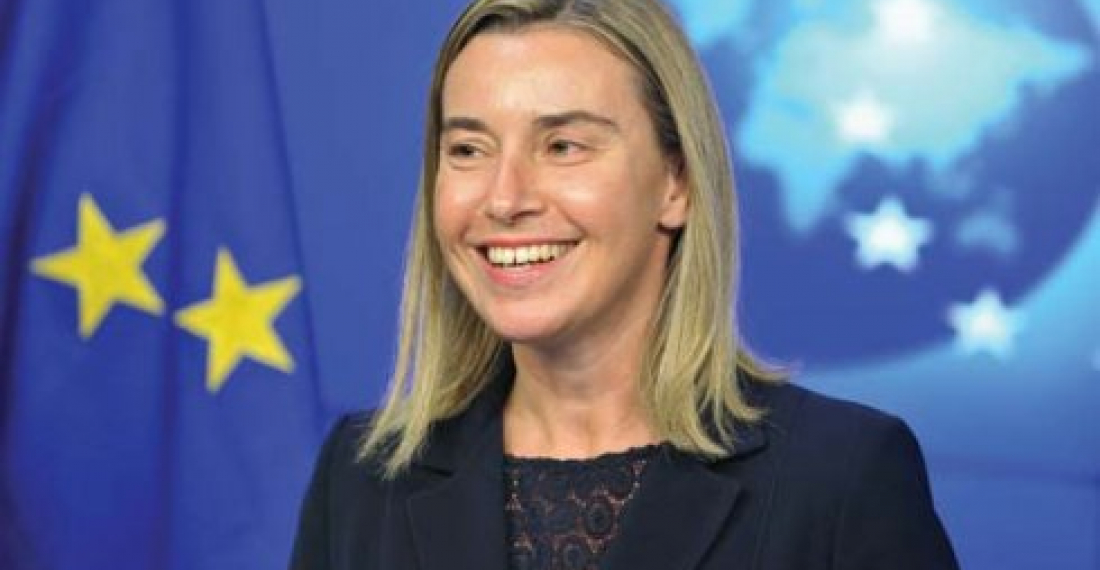
Photo: Federica Morgherini (archive picture)

Related articles

Editor's choice
News
Germany accuses Russia of cyberattacks and disinformation campaign

Germany accuses Russia of cyberattacks and disinformation campaign

The German government holds Russia responsible for a cyberattack on German air traffic control, and for targeted disinformation campaigns before the last federal election. According to the German Foreign Office in Berlin, the incidents could be clearly attributed to the Russian military intelligence service, the GRU. In response, the Russian ambassador to Berlin was summoned to the Foreign Ministry. "We have been observing a massive increase in threatening hybrid activities by Russia for some time now," a spokesperson for the Foreign Ministry stated. These range from disinformation campaigns and espionage to cyberattacks and sabotage attempts. The aim is to divide society, sow distrust, and undermine confidence in democratic institutions. The spokesperson added that with these actions, Russia is "very concretely threatening our security, not only through its war of aggression against Ukraine, but also here in Germany."  The Foreign Ministry spokesperson explained that the cyberattack on air traffic control in August 2024 was clearly attributed to the hacker collective "APT28," known as "Fancy Bear," and to the responsibility of the Russian military intelligence service, the GRU. Furthermore, it could now be "conclusively stated" that Russia had attempted "to influence and destabilize both the last Federal election and the ongoing internal affairs of the Federal Republic of Germany." There was "absolutely irrefutable evidence" for this". The so-called "Storm 1516" campaign, which has been running since 2024, is allegedly backed by "reliable information" that the Moscow-based think tank "Center for Geopolitical Expertise" is behind it. The Center is also said to be supported by Russian military intelligence. Its primary aim is to influence democratic elections in the West. (Click the image to read more).
Editor's choice
News
NATO Chief says war is on Europe's doorstep, and warns against complacency

NATO Chief says war is on Europe's doorstep, and warns against complacency

Russia could attack a NATO country within the next five years, the Secretary General of NATO, Mark Rutte, said in a stark new warning. "NATO's own defences can hold for now," Rutte warned in Berlin, but conflict was "next door" to Europe, and he feared "too many are quietly complacent, and too many don't feel the urgency, too many believe that time is on our side. "Russia is already escalating its covert campaign against our societies," Rutte said in a speech in Germany. "We must be prepared for the scale of war our grandparents or great-grandparents endured." Earlier this month, Russia's President Vladimir Putin said his country was not planning to go to war with Europe, but it was ready "right now" if Europe wanted to - or started a war. But similar reassurances were given by Moscow in 2022, just before 200,000 Russian troops crossed the border and invaded Ukraine. Putin has accused European countries of hindering US efforts to bring peace in Ukraine - a reference to the role Ukraine's European allies have recently played in trying to change a US peace plan to end the war, whose initial draft was seen as favouring Russia. But Putin was not sincere, Nato's secretary-general said in the German capital, Berlin. Supporting Ukraine, he added, was a guarantee for European security. "Just imagine if Putin got his way; Ukraine under the boot of Russian occupation, his forces pressing against a longer border with Nato, and the significantly increased risk of an armed attack against us." Russia's economy has been on a war footing for more than three years now - its factories churn out ever more supplies of drones, missiles and artillery shells. According to a recent report by the Kiel Institute for the World Economy, Russia has been producing each month around 150 tanks, 550 infantry fighting vehicles, 120 Lancet drones and more than 50 artillery pieces. The UK, and most of its Western allies, are simply not anywhere near this point. Analysts say it would take years for Western Europe's factories to come close to matching Russia's mass-production of weapons. "Allied defence spending and production must rise rapidly, our armed forces must have what they need to keep us safe," the Nato chief said.

Popular

Editor's choice
News
Germany accuses Russia of cyberattacks and disinformation campaign

Germany accuses Russia of cyberattacks and disinformation campaign

The German government holds Russia responsible for a cyberattack on German air traffic control, and for targeted disinformation campaigns before the last federal election. According to the German Foreign Office in Berlin, the incidents could be clearly attributed to the Russian military intelligence service, the GRU. In response, the Russian ambassador to Berlin was summoned to the Foreign Ministry. "We have been observing a massive increase in threatening hybrid activities by Russia for some time now," a spokesperson for the Foreign Ministry stated. These range from disinformation campaigns and espionage to cyberattacks and sabotage attempts. The aim is to divide society, sow distrust, and undermine confidence in democratic institutions. The spokesperson added that with these actions, Russia is "very concretely threatening our security, not only through its war of aggression against Ukraine, but also here in Germany."  The Foreign Ministry spokesperson explained that the cyberattack on air traffic control in August 2024 was clearly attributed to the hacker collective "APT28," known as "Fancy Bear," and to the responsibility of the Russian military intelligence service, the GRU. Furthermore, it could now be "conclusively stated" that Russia had attempted "to influence and destabilize both the last Federal election and the ongoing internal affairs of the Federal Republic of Germany." There was "absolutely irrefutable evidence" for this". The so-called "Storm 1516" campaign, which has been running since 2024, is allegedly backed by "reliable information" that the Moscow-based think tank "Center for Geopolitical Expertise" is behind it. The Center is also said to be supported by Russian military intelligence. Its primary aim is to influence democratic elections in the West. (Click the image to read more).

