Ethiopians celebrate second filling of controversial Nile dam

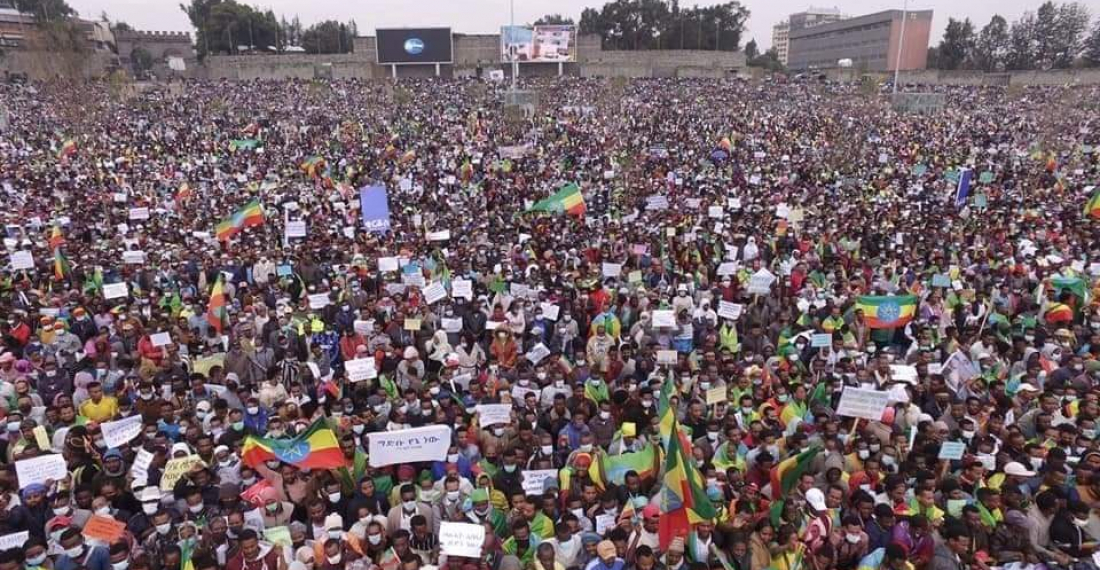
Thousands of Ethiopians gathered at Meskel Square in Addis Ababa on Thursday (22 July) to celebrate the announcement of the completion of the second filling of the Grand Ethiopian Renaissance Dam (GERD).  

In the rally held in Addis Ababa, people also expressed support for the military while denouncing the TPLF in Tigray. Recently, the TPLF made several gains in Tigray against the government forces and the situation is yet worrisome considering the security and humanitarian implications of the Tigray crisis. Meanwhile, the Ethiopian air force says it is keeping an eye round the clock on the dam and is ready to act. 

Egypt and Sudan were active on media and diplomatic channels to warn against the second filing of GERD without an agreement. It is believed that Ethiopia quickly ended the second filling to a level lower than what the Egyptians had anticipated thus defusing the crisis. The dam is yet under construction and once additional 30 metres are added, it can store more cubic litres of water. 

Addis Ababa has attributed the accelerated timetable of the filling to the “extreme rainfall” in the Blue Nile basin and the fact that the dam wall has not been built as high as first planned. Construction experts say that building the last 30 metres could take some time thereby postponing confrontation and providing room for trilateral negotiations between Egypt, Sudan and Ethiopia. 

The GERD crisis is due to be further discussed by the UN Security Council. Sudan recently took a more pro-Egypt stance while mobilising several government resources to mitigate any potential ramifications from the second filling. Speaking to Al Jazeera, a Sudanese government official said that Sudan bore a heavy economic burden to mitigate potential ramifications of the second filling and Sudan is not willing to bear the burden again. The unnamed official said that if sufficient political will exists, an agreement could be reached in 6 months.

In response, Ethiopian Foreign Ministry spokesman Dina Mufti said that "as for the binding agreement, Ethiopia does not mind a win-win agreement on the filling and operation of the Renaissance dam, but we cannot sign a final agreement in the absence of a comprehensive legal agreement," Mufti added. 
 

source: commonspace.eu with Al Jazeera (Doha) and other sources. 
photo: View of rally celebrating the second filling of GERD (Twitter: @AiInformer). 

Related articles

Editor's choice
News
Situation in South Yemen strains relations between Saudi Arabia and UAE

Situation in South Yemen strains relations between Saudi Arabia and UAE

The relations between Saudi Arabia and the United Arab Emirates (UAE) are increasingly strained as a result of the different approach of the two countries towards Yemen. Whilst both countries were initially together in resisting the Houthi take over in Yemen, the UAE subsequently focused on the South of the country, backing the Southern Movement (STC), which seeks to restore the independence of South Yemen. South Yemen became an independent country in 1967, at the end of British rule, and only unified with the north in 1990. The Saudi-led “Coalition to Support Legitimacy in Yemen” on Tuesday, 30 December, said it conducted a “limited” airstrike targeting two ships “that smuggled weapons and other military hardware into Mukalla in southern Yemen”. The ships originated in the UAE port of Furjeirah. In a statement carried by the Saudi Press Agency (SPA), the Coalition Forces spokesman, Major General Turki Al-Maliki, said that two ships coming from the port of Fujairah in the United Arab Emirates entered the Port of Mukalla in Hadramaut without obtaining official permits from the Joint Forces Command of the Coalition. He stressed the Coalition's "continued commitment to de-escalation and enforcing calm in the governorates of Hadramawt and Al-Mahra, and to prevent any military support from any country to any Yemeni faction without coordination with the legitimate Yemeni government and the Coalition. The Southern Transitional Council (STC), launched a sweeping military campaign early in December, seizing the governorates of Hadramaut along the Saudi border and the eastern governorate of Al-Mahra in Yemen’s border with Oman. The UAE-backed STC forces captured the city of Seiyun, including its international airport and the presidential palace. They also took control of the strategic PetroMasila oilfields, which account for a massive portion of Yemen’s remaining oil wealth. (click the image to read the article in full).

Popular