


Decisive day for Armenia (Update 3)

Update 3 at 18.00 GMT

Nikol Pashinyan, the leader of the mass popular movement that has swept Armenia over the last weeks, joined thousands of supporters in the centre of the country's capital Yerevan, immediately after his candidature for prime minister was voted down by the Armenian parliament, which is dominated by the current ruling party, the Republican Party.

Pashinyan told thousands of cheering supporters that packed the large square and adjoining streets, that the Republican Party had declared an open confrontation with the people, and called for a general strike to start tomorrow, Monday, 2 May at 8.15 am. Pashinyan called on his supporters to close all roads, railways and airports.

Pashinyan however insisted that protests must remain completely peaceful.

Update 2 at 17.00 GMT

The Armenian Parliament failed to elect Nikol Pashinyan as prime minister after a long session during which the ruling Republican Parliament declared it will not support his candidature which was supported by all the other factions in the parliament. The vote was 56 against and 45 in favour with one abstension. The vote dissapointed thousands of people who had filled Yerevan's main square since the morning.

The situation increases the deadlock in the current political situation, and street protests are now likely to continue.

Update 1 at 11.00 GMT

Nikol Pahsiyev has been formally nominated for the post of Armenian Prime Minister at a special session of the country's parliament. Pashinyan laid down the main policy directions he proposes to follow. Pashinyan said he was against a system that gave absolute power to the prime minister, and said that the time when one person held all the power in Armenia was over.

Pashinyan gave a long exposition on the country's future foreign policy

He said many are surprised that the new government declares that it will not make major changes in the foreign policy course. "In case of my election to the post of prime minister, Armenia will continue to be a member of the Eurasian Economic Union and CSTO. This position does not come from the taste or changed position of the individual, but from the logic of the popular movement that won in the country.

Pashinyan said that as a result of this movement, the people of Armenia came to power, demanding numerous changes in the internal life of the country. This did not require and does not require changes in the foreign policy course. We as obedient servants of the people are obliged to reckon with this reality.

We considered and consider Russia a strategic ally of Armenia, and this nation-wide movement does not create any threats to the Armenian-Russian cooperation. We attach special importance to Armenia-Georgia and Armenia-Iran relations, and there is no doubt that this movement will give a new impetus to our relations with our neighbors. We will strengthen relations with the EU and the EU member states. We will do our best to liberalize the visa regime with the EU. We look forward to the beginning of negotiations on this issue in the very near future. The speedy ratification and application of the Armenia-EU comprehensive and expanded partnership is based on our relations.

Friendly relations with the United States need a new impetus, and we intend to give new impetus to the development of mutually beneficial Armenian-American cooperation in various fields. We will continue to deepen relations with China, and we consider this to be one of the most important directions of foreign policy, "

At the same time, he stressed that they attach great importance to the holding of the Francophonie summit in the fall and all measures will be taken for its proper conduct.

At the same time, the deputy stressed the commitment to international recognition and condemnation of the Armenian Genocide in the Ottoman Empire, because he believes that only by recognizing this fact can new crimes against humanity be prevented. The oppositionist stressed that Armenia will continue its efforts to prevent further crimes against humanity.

Speaking about the Karabakh conflict, Pashinyan said that for them stereotypes in this matter are not important. "We are committed exclusively to a peaceful settlement of the Nagorno-Karabakh conflict, based on the right of self-determination and equality of peoples. We need to give a new impetus to the international recognition of Nagorno-Karabakh. This should become one of the most important areas of the Diaspora's activities, "the opposition leader said.

At the same time, he stated that the most important part of the Armenian demand for this movement is justice and freedom, and their government intends to fully implement both of these requirements.

The session of the National Assembly continues

--------------

The Armenian Parliament is meeting this morning in an effort to elect a new prime minister, after street protests last week resulted in the resignation of Serzh Sargsyan from the post.

The only candidate is Nikol Pashinyan, the leader of the protest movement, and a member of parliament from the Yelk Group. Pashinyan is the only candidate that has been formally proposed, and also has the support of two other parliamentary factions, Prosperous Armenia and Armenia Revolutionary Federation. But the majority in the parliament is in the hands of the Republican Party, and whilst initially they indicated they will not hinder the election of Pashinyan, overnight reports suggest they may resort to filibustering tactics to prevent it happening.

Thousands of Pashinyan supporters have filled Yerevan's main square in a festive mood, but the next hours will be decisive both for Pashinyan's prospects, and for Armenia in general.

(This story will be updated throughout the day)

source: commonspace.eu

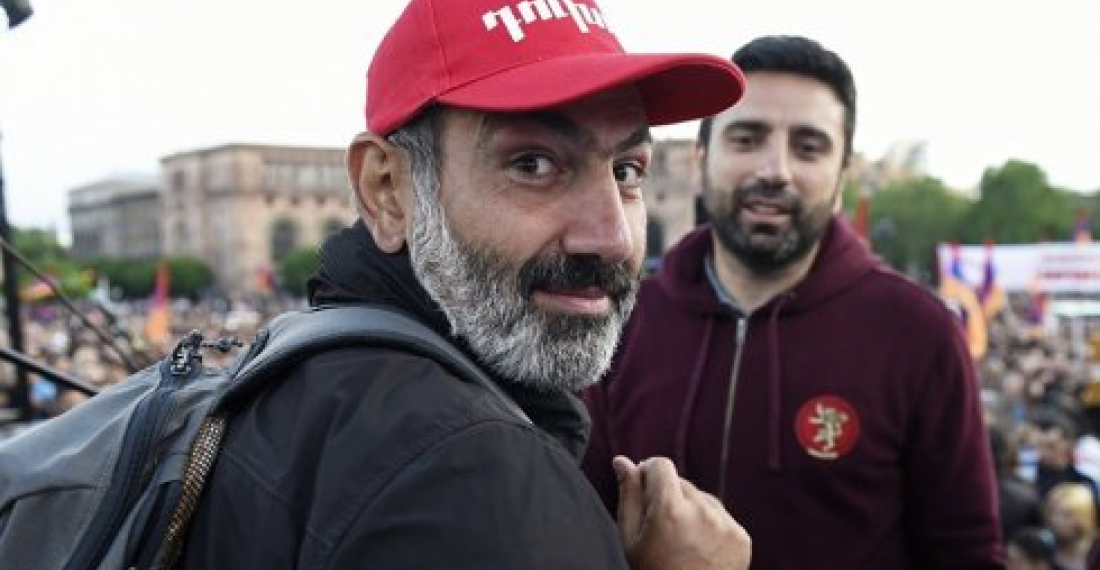
photo: Nikol Pashinyan (archive picture)

Related articles

Editor's choice
News
Israeli parliament votes to bring back the death penalty, but only for Palestinians

Israeli parliament votes to bring back the death penalty, but only for Palestinians

srael’s parliament approved a bill on Monday that would allow the execution of Palestinians convicted on terror charges for deadly attacks, a move that has been criticized as discriminatory and immediately drew a court challenge. Sixty-two lawmakers, including Prime Minister Benjamin Netanyahu, voted in favor and 48 against the bill, championed by far-right National Security Minister Itamar Ben Gvir. There was one abstention and the rest of the lawmakers were not present. Ben Gvir in the run-up to the vote had worn a lapel pin in the shape of a noose, symbolising his support for the legislation. “We made history!!! We promised. We delivered,” he posted on X after the vote. The bill would make the death penalty the default punishment for Palestinians in the Israeli-occupied West Bank found guilty of intentionally carrying out deadly attacks deemed “acts of terrorism” by an Israeli military court. The bill says that the sentence may be reduced to life imprisonment under “special circumstances.” Palestinians in the West Bank are automatically tried in Israeli military courts. Meanwhile, under the bill, in Israeli criminal courts anyone “who intentionally causes the death of a person with the aim of harming an Israeli citizen or resident out of an intention to put an end to the existence of the State of Israel shall be sentenced to death or life imprisonment.” Criminal courts try Israeli nationals, including Palestinian citizens and residents of east Jerusalem. The bill sets the execution method as hanging, adding that it should be carried out within 90 days of the sentencing, with a possible postponement of up to 180 days. - ‘Parallel tracks’ - The bill appears to conflict with Israel’s Basic Laws, which prohibit arbitrary discrimination, and shortly after it was passed, a leading human rights group announced that it had filed a petition with the Supreme Court demanding the legislation’s annulment. “The law creates two parallel tracks, both designed to apply to Palestinians,” the Association for Civil Rights in Israel said in a statement. “In military courts — which have jurisdiction over West Bank Palestinians — it establishes a near-mandatory death sentence,” the rights group said. In civilian courts, the law’s stipulation that defendants must have acted “with the aim of negating the existence” of Israel “structurally excludes Jewish perpetrators,” the group added. The association argued the law should be annulled on both jurisdictional and constitutional grounds. During the debate in parliament, opposition lawmaker and former deputy Mossad director, Ram Ben Barak, expressed outrage at the legislation. “Do you understand what it means that there is one law for Arabs in Judea and Samaria, and a different law for the general public for which the State of Israel is responsible?” he asked fellow parliamentarians, using the Israeli name for the West Bank. “It says that Hamas has defeated us. It has defeated us because we have lost all our values.” - ‘Discriminatory application’ - Lawmaker Limor Son Har-Melech from Ben Gvir’s party, who years ago survived an attack by Palestinian militants in which her husband was killed, urged fellow parliamentarians to approve the bill. “For years, we endured a cruel cycle of terror, imprisonment, release in reckless deals, and the return of these human monsters to murder Jews again ... And today, my friends, this cycle has come full circle.” The Palestinian Authority condemned the law’s adoption, saying that “Israel has no sovereignty over Palestinian land.” “This law once again reveals the nature of the Israeli colonial system, which seeks to legitimize extrajudicial killing under legislative cover,” it added. In February, Amnesty International had urged Israeli lawmakers to reject the legislation, citing its “discriminatory application against Palestinians.” On Sunday, Britain, France, Germany and Italy expressed “deep concern” over the bill, which they said risked “undermining Israel’s commitments with regards to democratic principles.” While the death penalty exists for a small number of crimes in Israel, it has become a de facto abolitionist country — the Nazi Holocaust perpetrator Adolf Eichmann was the last person to be executed in 1962. Israel has occupied the West Bank since 1967 and violence there has soared since Hamas’s October 7, 2023 attack on Israel triggered the Gaza war. (read more by clicking the image above).

Popular

Editor's choice
Interview
Thursday Interview: Murad Muradov

Thursday Interview: Murad Muradov

Today, commonspace.eu starts a new regular weekly series. THURSDAY INTERVIEW, conducted by Lauri Nikulainen, will host  persons who are thinkers, opinion shapers, and implementors in their countries and spheres. We start the series with an interview with Murad Muradov, a leading person in Azerbaijan's think tank community. He is also the first co-chair of the Action Committee for a new Armenian-Azerbaijani Dialogue. Last September he made history by being the first Azerbaijani civil society activist to visit Armenia after the 44 day war, and the start of the peace process. Speaking about this visit Murad Muradov said: "My experience was largely positive. My negative expectations luckily didn’t play out. The discussions were respectful, the panel format bringing together experts from Armenia, Azerbaijan, and Turkey was particularly valuable during the NATO Rose-Roth Seminar in Yerevan, and media coverage, while varied in tone, remained largely constructive. Some media outlets though attempted to represent me as more of a government mouthpiece than an independent expert, which was totally misleading.  Overall, I see these initiatives as important steps in rebuilding trust and normalising professional engagement. The fact that soon a larger Azerbaijani civil society visits to Armenia followed, reinforces the sense that this process is moving in the right direction." (click the image to read the interview in full)


