


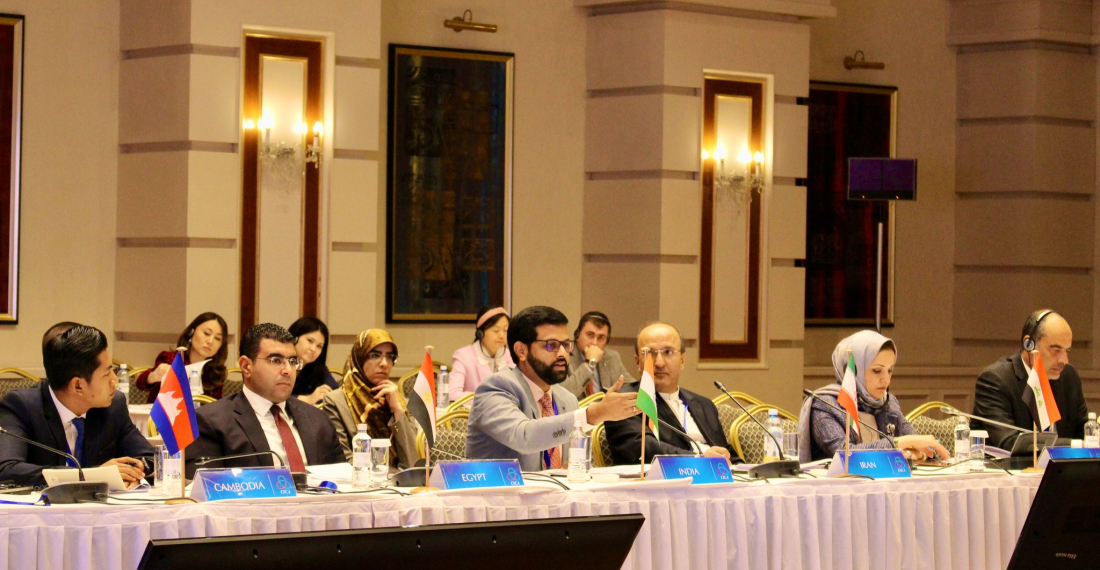
CICA set to become an international organisation at this month's Astana summit

The Conference on Interaction and Confidence Building Measures in Asia (CICA) is set to become a fully fledged international organisation during a summit of leaders of its members to be held in Astana, Kazakhstan on 12-13 October.

A Special Working Group (SWG) meeting held on 28-29 September, has made a major advance in preparing draft documents to be adopted at the upcoming sixth CICA Summit.

The main document includes a draft Astana Statement on CICA Transformation, which is designed to transform CICA into a full-fledged international organization. Other draft documents include a draft of the CICA Leaders’ Statement on Cooperation in the Field of Security and in the Use of Information and Communications Technologies and draft the CICA Plan of Action on the Implementation of the United Nations (UN) Global Counter-Terrorism Strategy.

“A two-day intensive discussion among CICA member states resulted in a tangible step forward in the drafting of the CICA Summit 2022 outcome documents,” said Executive Director of CICA, Kairat Sarybay on Twitter. “Hope ‘CICA spirit’ based on consensus will prevail at the resumed online SWG meeting on Oct. 4.”

CICA is a multinational forum that unites 27 member states that cover over 90 percent of Asia, generating around two-thirds of the global GDP. Kazakhstan holds the chairmanship in CICA for the 2020-2022 years.
source: commonspace.eu with Astana Times
photo: A CICA working Group met in Astana on 28-29 September 2022 (picture courtesy of CICA Secretariat)

Related articles

Editor's choice
News
Armenian and Azerbaijani officials seek to defuse tension

Armenian and Azerbaijani officials seek to defuse tension

Armenian and Azerbaijani senior officials have moved to reduce tensions that erupted following an outcry in Armenia after a visit by foreign diplomats to Karabakh and surrounding regions, and a subsequent reaction in Azerbaijan. Armenia’s Security Council Secretary Alen Simonyan has said that following the events that took place at Gandzasar Monastery, he spoke by phone with Azerbaijani President Ilham Aliyev’s Assistant Hikmet Hajiyev. Responding to a question about whether he plans to publicly respond to Hajiyev’s statements regarding Gandzasar, Simonyan said at a press briefing that not all statements necessarily need to receive a public response. “I think everything has been said, and not everything that is said always needs a response. We need to realize whether this will change something or not. I can say something sharp now, respond in some way, we can all feel good for 15 minutes, but by doing so I could harm the negotiations,” Simonyan said. He stressed that the peace process requires a cautious approach. (click image to read more)

Popular

Editor's choice
Interview
Thursday Interview: Murad Muradov

Thursday Interview: Murad Muradov

Today, commonspace.eu starts a new regular weekly series. THURSDAY INTERVIEW, conducted by Lauri Nikulainen, will host  persons who are thinkers, opinion shapers, and implementors in their countries and spheres. We start the series with an interview with Murad Muradov, a leading person in Azerbaijan's think tank community. He is also the first co-chair of the Action Committee for a new Armenian-Azerbaijani Dialogue. Last September he made history by being the first Azerbaijani civil society activist to visit Armenia after the 44 day war, and the start of the peace process. Speaking about this visit Murad Muradov said: "My experience was largely positive. My negative expectations luckily didn’t play out. The discussions were respectful, the panel format bringing together experts from Armenia, Azerbaijan, and Turkey was particularly valuable during the NATO Rose-Roth Seminar in Yerevan, and media coverage, while varied in tone, remained largely constructive. Some media outlets though attempted to represent me as more of a government mouthpiece than an independent expert, which was totally misleading.  Overall, I see these initiatives as important steps in rebuilding trust and normalising professional engagement. The fact that soon a larger Azerbaijani civil society visits to Armenia followed, reinforces the sense that this process is moving in the right direction." (click the image to read the interview in full)

