Back to basics: Ajika becomes a Georgian national heritage

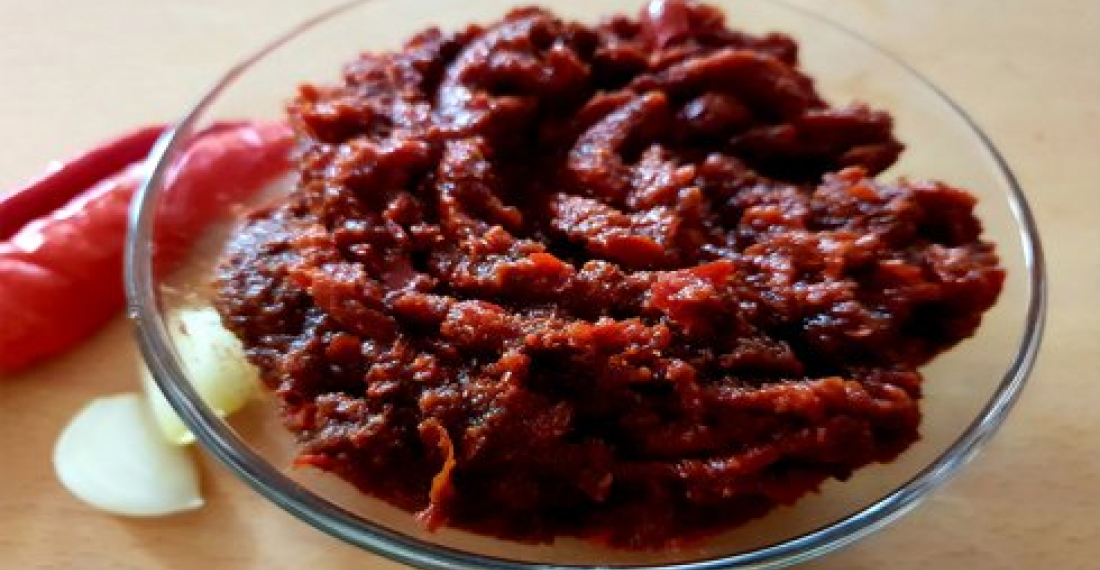
The traditional Megrelian and Abkhazian receipe of spicy sauce, ajika, has received the status of "Intangible Cultural Heritage of Georgia".

The National Agency for Cultural Heritage Preservation granted the sauce the status in the framework of the project Georgian Taste Heritage, the website agenda.ge reported.

Ajika originates in the Western parts of Georgia, in the Samegrelo and Abkhazia regions.

The main ingredients are red pepper, garlic and dried spices. There are numerous variations of the sauce spread all over Georgia.

Legend has it that ajika dates back to the 15th century when the land owners began adding pepper to salt given to livestock, thinking that adding pepper would keep the shepherds from taking the salt from them. However, the shepherds mixed the salt and pepper with garlic and mountain herbs and thus, ajika was created.

Project organizers report that they have collected 140 recipes of well-known and unknown Georgian meals. All of them will be granted the status of of Intangible Cultural Heritage of Georgia step by step, agenda.ge says

Georgia is at the moment going through a nasty presidential election campaign, with activists of different camps trading insults against each other. But on some things Georgians are united. The love of Ajika is nationwide.

source: commonspace.eu with agenda.ge

 

Related articles

Popular

Editor's choice
Interview
Thursday Interview: Murad Muradov

Thursday Interview: Murad Muradov

Today, commonspace.eu starts a new regular weekly series. THURSDAY INTERVIEW, conducted by Lauri Nikulainen, will host  persons who are thinkers, opinion shapers, and implementors in their countries and spheres. We start the series with an interview with Murad Muradov, a leading person in Azerbaijan's think tank community. He is also the first co-chair of the Action Committee for a new Armenian-Azerbaijani Dialogue. Last September he made history by being the first Azerbaijani civil society activist to visit Armenia after the 44 day war, and the start of the peace process. Speaking about this visit Murad Muradov said: "My experience was largely positive. My negative expectations luckily didn’t play out. The discussions were respectful, the panel format bringing together experts from Armenia, Azerbaijan, and Turkey was particularly valuable during the NATO Rose-Roth Seminar in Yerevan, and media coverage, while varied in tone, remained largely constructive. Some media outlets though attempted to represent me as more of a government mouthpiece than an independent expert, which was totally misleading.  Overall, I see these initiatives as important steps in rebuilding trust and normalising professional engagement. The fact that soon a larger Azerbaijani civil society visits to Armenia followed, reinforces the sense that this process is moving in the right direction." (click the image to read the interview in full)