


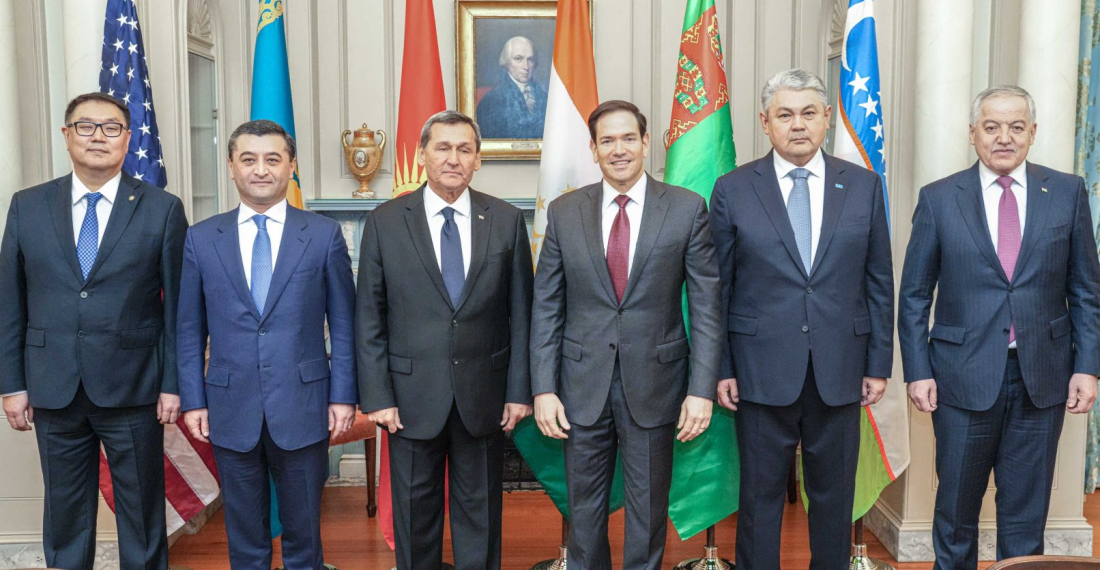
Rubio plans to visit all five Central Asian countries as Trump hosts their leaders in Washington

US Secretary of State Marco Rubio said on Wednesday 5th November that he planned to visit the five Central Asian countries in the coming year, as he met their foreign ministers as part of a Trump administration charm offensive aimed at the resource-rich region. The presidents of Kazakhstan, Kyrgyzstan, Tajikistan, Turkmenistan and Uzbekistan are set to meet US President Donald Trump in Washington on 6th November for talks that are likely to include discussions of rare earths minerals and other resources in the Central Asian nations.

According to Reuters, Mr Rubio told a reception at the State Department that US interests and those of the Central Asian states were aligned when it comes to working together to develop the countries' natural resources. "You are looking to take the resources ... that God has blessed your nations with, and turn them into responsible development that allow you to diversify your economies," Mr Rubio said.

“I personally intend to visit in the coming year," he added. "All five (countries)," he said, "so I know it would probably be a week-long trip. So we’ve got to work on that and make that happen together.”

Rich in minerals and energy, the five overwhelmingly Muslim countries of Central Asia remain closely tied economically to Russia, which ruled the region as part of the Soviet Union until 1991. Neighbouring China also enjoys significant commercial influence.

Deputy Secretary of State Christopher Landau, who spoke before Mr Rubio, said Mr Trump had invited the five leaders to Washington as part of a personal push by the president to engage more actively with the region.

Mr Landau and Mr Sergio Gor, the US ambassador to India and Mr Trump's special envoy to Central Asia, visited Kazakhstan and Uzbekistan last week to prepare agreements to be announced during the leaders' visit, Reuters reported. "The opportunities are amazing - business opportunities. Many ways to partner there," Mr Landau said.

Senator James Risch, a Republican, who also spoke at the reception, announced he would introduce a bill to Congress this week aimed at repealing the Jackson–Vanik trade rules introduced during the Cold War era that restrict US trade with non-market economies. 

The meeting in Washington between President Trump and the five Central Asian republics known as the C5 marks the tenth anniversary of the C5+1 format. Established in 2015, the C5+1 is the main platform through which the United States engages collectively with the five countries of Central Asia.

Source: commonspace.eu with Reuters and agencies. Photo: US Secretary of State Marco Rubio meeting Foreign Ministers of CA nations on Wednesday 5th November/Secretary Marco Rubio/X

Related articles

Editor's choice
News
European leaders set out their plan for Ukraine

European leaders set out their plan for Ukraine

The leaders of Germany, Denmark, Finland, France, Italy, Netherlands, Norway, Poland, Sweden, and United Kingdom, together with the President of the European Council, and the President of the European Commission, o  Monday (15 December) issued a statement, outlining their plan for Ukraine. In their statement, Chancellor Merz, Prime Minister Frederiksen, President Stubb, President Macron, Prime Minister Meloni, Prime Minister Schoof, Prime Minister Støre, Prime Minister Tusk, Prime Minister Kristersson, Prime Minister Starmer, as well as President Costa and President von der Leyen spoke about "Peace for Ukraine". The Leaders welcomed significant progress on President Trump’s efforts to secure a just and lasting peace in Ukraine. They also welcomed the close work between President Zelenskyy’s and President Trump’s teams as well as European teams over the recent days and weeks. They agreed to work together with President Trump and President Zelenskyy to get to a lasting peace which preserves Ukrainian sovereignty and European security. Leaders appreciated the strong convergence between the United States, Ukraine and Europe. Leaders agreed that ensuring the security, sovereignty, and prosperity of Ukraine was integral for wider Euro-Atlantic security. They were clear that Ukraine and its people deserved a prosperous, independent, and sovereign future, free from fear of future Russian aggression. Both the US and European leaders committed to work together to provide robust security guarantees and economic recovery support measures for Ukraine in the context of an agreement on ending the war. This would include commitments to: Provide sustained and significant support to Ukraine to build its armed forces, which should remain at a peacetime level of 800,000 to be able to deter conflict and defend Ukraine’s territory. A European-led ‘multinational force Ukraine’ made up from contributions from willing nations within the framework of the Coalition of the Willing and supported by the US. It will assist in the regeneration of Ukraine’s forces, in securing Ukraine’s skies, and in supporting safer seas, including through operating inside Ukraine. (Click the image to read the statement in full).

Popular

