

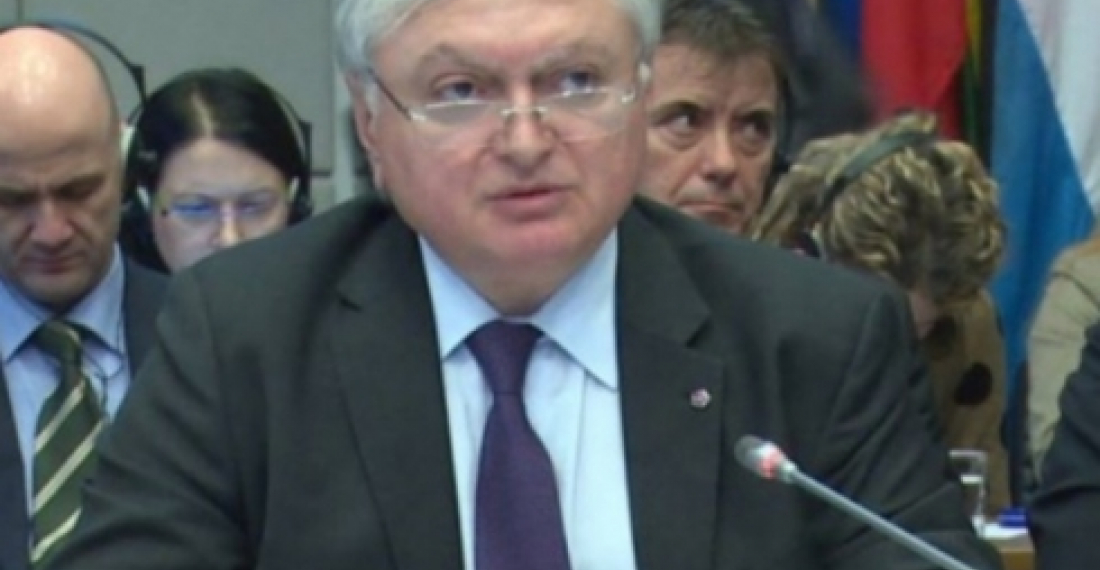
Armenian Foreign Minister Edward Nalbandian touched on the current state of the Nagorno-Karabakh conflict and conflict settlement process and other international issues when addressing the OSCE Permanent Council in Vienna on 11 March. We are reproducing here his speech in full.
Mr. Chairman,
Excellences,
Dear friends,
It is a pleasure to address the Permanent Council again. Last time I was here in 2013 in my capacity as the Chairman of the Committee of the Ministers of the Council of Europe. I will start from the most important issue on our national agenda today - the Centennial commemoration of the Armenian Genocide.
Back in May 1915 the governments of France, Great Britain and Russia characterized the Armenian massacres as "crimes against humanity and civilization." This was one of the first occasions of the use of the term "crimes against humanity" on an international level, leading to its elaboration as an inherent concept of the international legal system.
For the contemporaries of the Armenian Genocide it might really sound as a miracle that the Armenian nation could survive and re-establish its statehood. It is therefore truly symbolic on this centenary to address you as the Minister of Foreign Affairs of one of the 57 participating states of this organization.
As a nation, which passed through the horrors of genocide, Armenia is a firm advocate of the international efforts of prevention of crimes against humanity. One of the most effective measures in this regard is the full and frank acknowledgment of past genocides. That is why states must not subordinate this noble cause to any geopolitical calculation. The OSCE is also well placed to address the issue, since the adherence to its principles and commitments can vastly contribute to the Genocide prevention efforts.
Remembrance dates should be approached by genuine will of peace and reconciliation. It is with this aim that the Armenian President invited his Turkish counterpart to participate in the commemoration of the genocide centenary on April 24th in Yerevan. I personally handed over the invitation to President Erdogan in Ankara. It is regrettable that our invitation was left unanswered, constituting yet another missed opportunity.
Mr. Chairman,
In September 2014 the sanctuary for the remains of many victims of the Armenian Genocide, the Saint Martyrs Armenian Church, in Syrian town of Deir el-Zor was destroyed by terrorists in a sad, yet symbolic link between past and present crimes against humanity. Destruction of cultural masterpieces is an attempt to erase the memory of other people, destroy millennia-old cultures and civilizations.
Recently we all saw the chilling video footage of how the ISIS militants were smashing the 2.700 years old statues in the Mosul museum. This crime against civilization is an appalling reminder of earlier similar barbaric acts of destruction of Bamian Buddha's statues, Mausoleums of Timbuktu and thousands of Medieval Armenian cross-stones in Nakhijevan.
During the recent years the OSCE has rendered its input to the issues related to the protection of the religious minorities. Armenia raised the issues of protection of religious groups in the OSCE area and its neighborhood at the level of the Ministerial and Permanent Councils, including by reminding participating states of their commitments to prevent use of their territories by terrorist groups.
Mr. Chairman,
Armenia values the OSCE both as a norm setting and an implementing organization. We continue to closely cooperate with the OSCE institutions, including with the ODIHR and the Representative for Freedom of the Media. Their input in raising the democratic profile of Armenia is well-perceived in our country equally by the Government and civil society. Human dimension is mainstreamed in the activities of Yerevan Office which is currently the only full-fledged OSCE office in the South Caucasus. There have been positive developments regarding Armenia's compliance with human rights instruments, democratic reforms, good governance, freedom of expression and assembly, free media and internet.
Mr. Chairman,
With regard to the evolving integration processes in the OSCE area, let me share our conviction that by employing more creativity and building our approaches on opportunities rather than incompatibilities, we can make best use of different integration formats and generate synergies while avoiding creation of new dividing lines.
As it is known Armenia recently joined the Eurasian Economic Union, which reflects our strategic interests, creates new opportunities for the economic development of the state.
Currently we are working with our EU colleagues to identify the scope of our future legal framework that will reflect the essence of our cooperation, building upon the progress that we have achieved. Armenia is ready in all formats, in all possible areas and directions to continue its comprehensive cooperation, which do not contradict our commitments in other integration processes.
Mr. Chairman,
Needless to say that conflict and crisis situations continue to occupy a central place on the OSCE agenda. The Ukrainian crisis, in particular has dominated the discourse. Armenia has welcomed the Minsk Summit results - the adoption of joint declaration by the Presidents of Ukraine, Russia, France and the Chancellor of Germany and the signing of document by Contact Group on the means of implementation of Minsk agreements.
In 2014, the year of 20th anniversary of the signing of the cease-fire agreement between Nagorno-Karabakh, Azerbaijan and Armenia, Baku significantly escalated the situation by drastically increasing the ceasefire violations and targeting civilian areas, including with the use of heavy weaponry. It has claimed unprecedented high number of casualties among all parties to the conflict. Azerbaijan having an almost total control of mass media conceals the real number of its losses caused by its provocations.
In this situation of ongoing escalation as a result of Azerbaijan's destructive stance the Co-Chairs met with the Foreign Minister of Azerbaijan and (I quote from the press-release of the Co-chairmen) "expressed serious concern about reported incursions across the Line of Contact and the Armenia-Azerbaijan border". They directly urged (and I quote) "Azerbaijan to observe its commitments to a peaceful resolution of the conflict" (end of quote). We are glad that the Co-chairs have eventually responded to our calls to clearly identify the side responsible for the violence. However, nothing restrains Azerbaijan. Not even the calls of Co-Chair Countries to refrain from provocative actions especially on the eve of and during religious holidays. Azerbaijan intensified its attacks on the New Year and Christmas holidays causing several casualties.
During their last visit to the region in February the Co-Chairs stated: "the Presidents agreed to consider proposals from the Co-Chairs that could strengthen the ceasefire". However, immediately after the regional visit of the Co-Chairs Azerbaijan rejected the proposals and further escalated the situation displaying its flagrant disrespect to the proposals of the Co-Chairs.
The implementation of the agreement on the mechanism to investigate the incidents on the Line of Contact, together with other proposals on confidence and security building measures made by the Co-Chairs could be an important tool for prevention of such incidents and creation of the environment conducive for the peace talks. However, Azerbaijan continuously rejects numerous proposals of Co-Chairs on consolidation of the cease-fire, withdrawal of snipers and on other confidence building measures.
Azerbaijan has failed the cooperation with the OSCE in all dimensions and instead of using it as a floor for the genuine discussions dares to exploit the Organization for the purposes of pushing its narrow political agenda. Some of you have witnessed how Azerbaijan threatened to veto the entire budget of the OSCE if any financing is allocated to the creation of the investigative mechanism.
And this is not the only case when Azerbaijan attempted to paralyze the work of the Organization. The same happens during the preparatory phase of almost every Ministerial Council, when Azerbaijan takes hostage our joint decisions in an attempt to impose its narrow objectives. The same happened when Azerbaijan while downgrading the status of the OSCE office in Baku at the same time tries to hinder the operation of field missions in the neighboring participating states. Last but not least Azerbaijan entertains itself by introducing a fabricated titles on each PC agenda.
Azerbaijani provocations on the line of contact with Nagorno-Karabakh and border with Armenia have also been matched with Azerbaijani consistent bellicose, warmongering rhetoric and anti-Armenian hate speech. On numerous occasions Baku threatened to solve the conflict by military means and claim that Armenia and its millennia old capital are Azerbaijani lands. Those journalists, activists and the intelligentsia who have been advocating for peace and reconciliation are all persecuted as "Armenian spies". Azerbaijani authorities punish those who dare to think about reconciliation and rewarding those who commit crimes against Armenians.
Baku continues to oppose the Minsk Group Co-Chairs and is doing its utmost to undermine the peace talks. It rejects the proposals that are the product of the tireless efforts of the last six years - about twenty summits, several dozen ministerial-level meetings, innumerable visits by the three Co-Chairs to the region. Armenia, unlike Azerbaijan, has stated many times that it is ready to continue negotiations, based on the proposals of the Co-Chair countries.
Instead of engaging in the negotiations Baku tries to present its own ideas on creation of the imitation of negotiations, as proposals of the Co-Chairs, misinterprets the essence of the conflict and negotiation process and undertakes a campaign of denigration against the Minsk Group Co-Chairs. It also continuously attacks the Personal Representative of the OSCE Chairman-in-Office. Facing this reality, the Minsk Group Co-chairs in January 27th were obliged to remind the Minister of Foreign Affairs of Azerbaijan about their mandates and they (I quote) "expressed concern about voices critical of the ongoing negotiation process, the role of the Minsk Group Co-Chairs, and the duties of OSCE monitors" (end of quote).
On May 3, 2015 the people of Nagorno-Karabakh for the sixth time will exercise their democratic right to elect members to the National Assembly. The democratic processes in Nagorno-Karabakh are not meant to influence the peace process or anyhow add to its international recognition, as was referred by some participating states also here at one of the last PC meetings. Building of democracy based on fundamental human rights and freedoms anywhere in the world should only be welcomed by other democratic members of the international community. Let us remind that Article 2 of Universal Declaration of Human Rights states (I quote) "Everyone is entitled to all the rights and freedoms set forth in this Declaration, without distinction ... No distinction shall be made on the basis of the political, jurisdictional or international status of the country or territory to which a person belongs" (end of quote). It is indicative, in this regard, that according to the Freedom House report on the Freedom in the World in 2015 Nagorno-Karabakh is way ahead of Azerbaijan in terms of fundamental freedoms.
Therefore, It does not come as a surprise when Baku criticizes elections in Nagorno-Karabakh given well-known Human Rights situation in Azerbaijan. However, sometimes few participating States while declaring about their support the Minsk Group Co-Chairs at the same time are resorting to the statements that contradict the spirit and terminology of the peace process. The Co-Chairs have been clear to note that through the electoral process "Nagorno-Karabakh tries to organize democratically the public life of its population". We call on all participating States to follow the Co-Chairs' wording, not only in the case of elections in Nagorno-Karabakh, but on other matters related to that issue as well, since this format is the only internationally mandated body for the conflict resolution and any deviation from their language may mean taking the sides in this dispute.
Mr. Chairman,
In the light of deteriorating security environment around the Nagorno-Karabakh conflict we believe that the consolidated and concerted actions of the international community through unconditional support of the activities of the Minsk Group Co-Chairs is the only way of advancing towards a fair, lasting and durable settlement.
In the year that marks the 40th anniversary of signing of the Helsinki Final Act the best way to honor its commitments and ensure its continued relevance would be the joint efforts of achieving meaningful progress on issues that continue to challenge our region, not leaving anything aside as less important and not creating artificial hierarchy between the issues which concern all of us.
Thank you, Mr. Chairman.
source: commonspace.eu with Armenian Public Radio.
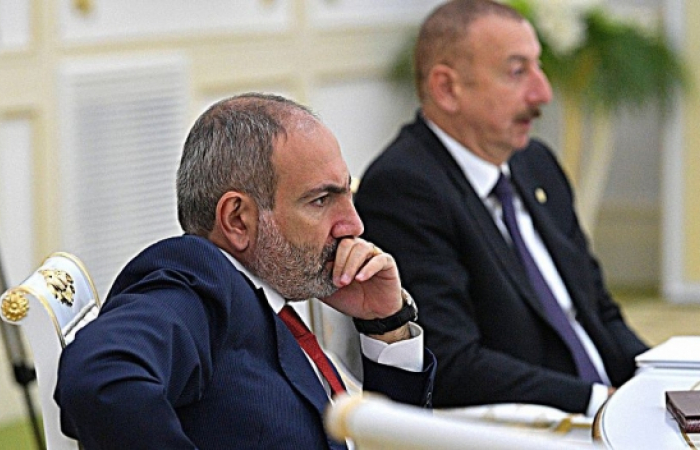
photo: Edward Nalbandian (archive picture).