


NATO parlamentarians discuss South Caucasus at Kiev meeting

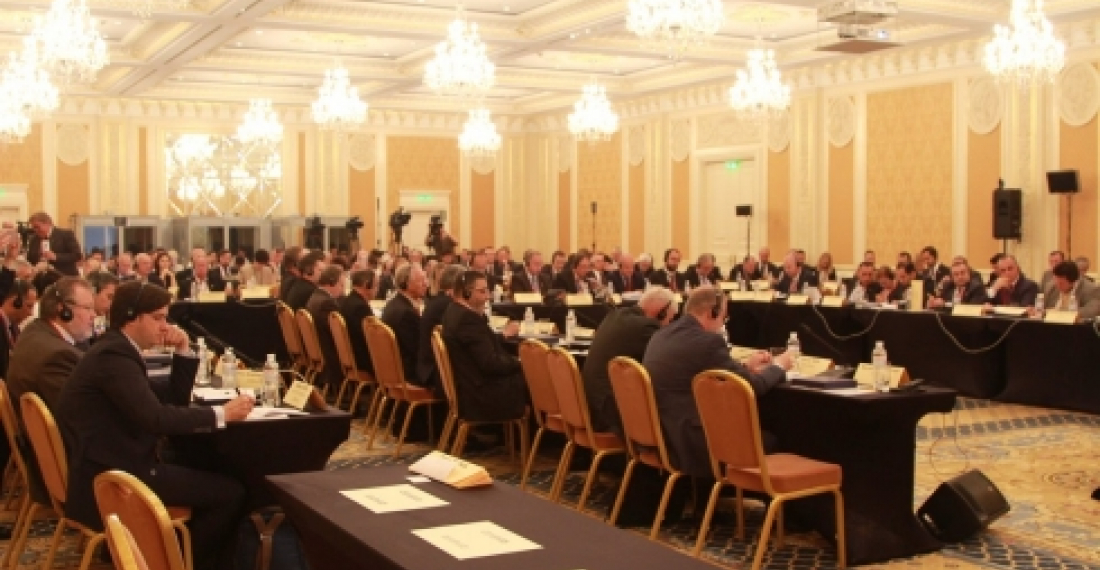
NATO members of Parliament discussed the situation in the South Caucasus during their meeting in Kiev Thursday (16 June). The meeting hosted by the Ukrainian Parliament is being attended by over one hundred and sixty participants including eighty members of parliament from 25 NATO member states and partner countries.

The session opened with a presentation by Dr Dennis Sammut, Director of LINKS (Dialogue, Analysis and Research) who spoke about the Russian involvement in the region, including in the process of resolution of the unresolved conflicts in Abkhazia, South Ossetia and Nagorno-Karabakh.

Dr Sammut said:

"The South Caucasus is a region which Russia considers to be in its sphere of influence. Often events in the region are looked at in episodical fashion, as if they are unrelated to each. Yet if we take a step back and reflect on what has happened in the last twenty five years we can see that Russia, even in the chaotic days of Boris Yeltsin persistently pursued a policy that sought to reassert its hegemony on the region, and that it has manipulated divisions and discord in the region to achieve its objectives. Yes, it is true that local actors often played in the hands of Russian plans, and events often developed a dynamic and momentum of their own, but if we want to understand why we have had twenty five years of not much peace, and not too much war than we have to look at Russian intentions and actions to understand."

 Referring to the situation in Abkhazia and South Ossetia Dennis Sammut said that 

"Most of the time Russia has preferred to present itself as a peacekeeper, working through proxies to support one side against another. It was only in 2008 that it engaged directly in fighting, in the short war with Georgia in August 2008. Subsequent to that Russia decided that it would do away with the pretence that it was in Abkhazia and South Ossetia as an impartial peacekeeper. Instead it recognized the two entities as independent states, received their Ambassadors in grand ceremonies in the Kremlin, and de facto adopted them as its protectorates. Russia subsequently signed long term defence arrangements with both entities, and considerably expanded its military arrangements in the two territories. Ever since Russia has poured a generous amount of money in the two protectorates, and in tandem a generous amount of soldiers and armaments. The two territories have become Russian forward bases: the ones in Abkhazia projecting Russian power forward in the Black Sea, the ones in South Ossetia projecting Russian power forward through the heart of the South Caucasus.

It is fair to say that in the initial period Russia's presence was welcomed by both the Abkhaz and the Ossetian ethnic population, and Russian diplomatic recognition was seen as the ultimate proof of Russian support. There were high hopes of how the two territories would benefit from Russian financial aid. The Russian themselves thought that their benevolence will secure them the support of the hearts and minds of the Abkhaz and the Ossetian people. After the initial euphoria however reality quickly turned sour. Clearly the honeymoon period is now over. There are serious tensions in Russia's relations with the two territories, and huge disappointment on all sides."  

Turning to the Karabakh conflict Dr Sammut said that

"This situation is not satisfactory for neither Armenia nor for Azerbaijan but a solution has so far alluded the sides. Ironically everybody knows what the solution is – it is based on the so-called Madrid principles, a sort of road map for peace that both sides say they agree with in principle. The mechanism for resolving the conflict is also known and has widespread international support – the OSCE Minsk Process co-Chaired by Russia, France and the United States. So why no progress?

The Nagorno-Karabakh conflict is a complex combination of three different dynamics:

  • The internal politics in Armenia and Azerbaijan
  • The relationship between Armenians and Azerbaijanis and between the Armenian world and the Turkic world
  • The global political and strategic balance, and more specifically Russia's role in it, and how that plays out in the South Caucasus

A successful and durable resolution of the conflict is only possible if the three dynamics can somehow be calibrated in a way that they can be mutually re-enforcing for a solution.

The conflict enables Russia to exert leverage on both Armenia and Azerbaijan in ways that would be impossible if it was resolved. Russia therefore, whilst being one of the three mediators, has no interest in resolving the conflict. In fact over the last ten years in particular it has been the main cause for escalation, supplying huge quantities of arms to both sides. The Russians even boast that by doing so they are ensuring regional strategic balance."

Dr Sammut said

"The four-day war has exposed the limitations of Russian strategy, nowhere more so than in Armenia. Over the last years the Armenian government of Serzh Sargsyan had a choice, and it chose to throw its lot with Russia. It did so not frivolously but because it had assessed that this was the best way to secure Armenia against the perceived threat from the Turkic world around it. In April this decision was put under great scrutiny. Like the Abkhaz, the Armenians learnt very quickly that Russian military basis on their territory were not there to protect them: they were there to protect Russia. Many in Armenia and elsewhere believe that Russia orchestrated the start and choreographed the finish of that episode as a means for maintaining the initiative and as part of a process of recalibrating its relationship with Armenia and Azerbaijan. For some months Russia has been pushing the so-called Lavrov ideas, a sort of Madrid Principles lite - an important pre-requiste of which is the withdrawal of Armenian troops from some of the Azerbaijani land which they currently hold. But is there a catch for Azerbaijan? Russian media over the last months and weeks have been suggesting that as a quid pro quo for the return of some of its territories Azerbaijan will join the Eurasian Economic Union, or in another version, that Russian peacekeepers will form the largest contingent of a Russian peacekeeping force that will deployed on the Azerbaijani side of the line of contact. Azerbaijan denies that this is part of the arrangement but the huge outcry in Azerbaijan against both ideas has put the government on notice that this is a red line they cannot cross. The Russians may therefore have ended up after 2 April alienating the Armenians whilst not achieving their immediate objectives in Azerbaijan either."

Following the presentation by Dennis Sammut the representatives of the Parliaments of Armenia, Azerbaijan and Georgia made short presentations articulating the position of their respective countries.

The three day meeting which opened on Tuesday comes to a close this afternoon.

source: commonspace.eu

photo: The meeting of NATO parliamentarians in Kiev this week brought together 160 participants including eighty members of parliament from 25 NATO member states and partner countries (picture courtesy of NATO PA)

 

Latest

Editor's choice
Monday Commentary
Monday Commentary: PEACE IN OUR TIME?

Monday Commentary: PEACE IN OUR TIME?

Making peace between Armenia and Azerbaijan was never going to be simple, nor easy, nor quick. It is taking time, writes Dennis Sammut in this Monday Commentary. “There is a sense of realism coming from the leaders of the two countries – President Ilham Aliyev of Azerbaijan and prime minister Nikol Pashinyan of Armenia, that frankly, is necessary and welcome”, he writes. At a time when conflicts are raging all over the world – from Ukraine to the Gulf, from Africa to South Asia, the prospect that Armenia and Azerbaijan had finally, after decades of conflict that left thousands of dead and many more displaced, decided on embarking on a journey of peace was welcomed. Peace between Armenia and Azerbaijan can be top-down up to a point. Both leaders have spent political capital preparing for a peace deal. But both are aware that their people are not ready for peace yet. In fact, in Armenia, most of the elite are negative toward a peace deal with Azerbaijan. Pashinyan needs time to persuade his countryfolk. That is why 2031 is realistic. Ilham Aliyev runs a tighter shop, but he is also not immune to public opinion. Every time someone hits a landmine in Karabakh, which unfortunately happens often, peace comes into question. Which is why Aliyev chooses to sound hardline, more often than not. In pursuing the peace agenda, both Aliyev and Pashinyan need to proceed cautiously. But they are right in making peace the central issue in their agenda. It is the main issue, and the one that will define them in history. So forward, cautiously but resolutely! In pursuing the peace agenda, Aliyev and Pashinyan need to be supported clearly and unambiguously. There are too many people in Baku and Yerevan who are sitting on the sides, waiting. The international community is not doing enough. It is time to be counted. Otherwise, the spoilers will win, and the region will go back to its bad habits. (Click the image to read the full commentary).
Editor's choice
News
Armenian prime minister opens first UK-Armenia Business Forum

Armenian prime minister opens first UK-Armenia Business Forum

Armenian prime minister, Nikol Pashinyan, opened the "Armenia–United Kingdom Business Forum 2026," which is being held in Yerevan for the first time. The Prime Minister Pashinyan delivered a speech and welcomed the attendees, emphasizing that holding the forum is a logical step following the signing of the memorandum establishing a strategic partnership between Armenia and the United Kingdom this May: "After establishing such a partnership, the primary question that arises for governments is: how do we turn that political will, expressed through adopted documents, into reality? And the most effective way to solve this problem is to make the political substance discussed between governments a part of everyday life. Conferences like this serve precisely that purpose: to fill the space opened up by governments with real life''. Turning to the economy and business, Nikol Pashinyan noted that experience shows that individuals unconstrained by the specific scope of governmental or other official duties are better at identifying opportunities and prospects. In this context, the country's leader expressed hope that the ideas raised during the conference discussions would advance to the next stage of development and materialize into concrete agreements. ''Overall, it is evident that the Republic of Armenia and our region are undergoing a transformation linked to the peace established between Armenia and Azerbaijan and the developments stemming from it. We are currently working on a daily basis to launch the implementation of the TRIPP project on the ground—an initiative that will undoubtedly serve as a cornerstone for transforming the economic landscape not only of the Republic of Armenia but of the entire region. It is already the case, as we are currently witnessing a certain level of investment-related activity surrounding Armenia; it is clear that this project will, in turn, generate new projects, and the investment appeal of Armenia and our region will strengthen," the Prime Minister said, adding that in the near future, alongside developments in the TRIPP project, the opening of the Armenia-Türkiye border is expected, as well as the opening of railway connections between Armenia and Azerbaijan and between Armenia and Türkiye. (Click image to read more),

Popular

Editor's choice
Monday Commentary
Monday Commentary: European-Azerbaijan relations need an intensive and multifaceted dialogue that is frank and honest

Monday Commentary: European-Azerbaijan relations need an intensive and multifaceted dialogue that is frank and honest

Last week I visited Baku, Azerbaijan. My visit was relatively short, but very intensive, and had many meetings with stakeholders and colleagues. When I arrived in Baku first time in 1996,  Azerbaijan was a different country: weak, poor, and shaken by defeat in war. For thirty year the Karabakh issue dominated the agenda: the political agenda but also the popular mindset. Now, thirty years later, Azerbaijan has returned to Karabakh, and peace with Armenia is on the horizon. It is a new era for Armenia-Azerbaijan relations, for the South Caucasus, but also for Europe.  But we cannot be complacent: the Peace agreement has been initialed but not signed; borders remain closed; TRIPP is ambitious but remains an idea; and there are spoilers who want to turn the clock back. We must not allow them, and in this Europe and Azerbaijan must work together. Europe’ vanguard organization is the European Union – it is a free union of 27 member states; it is a strong global economic force, and increasingly a diplomatic and military force too. But it remains “work in progress” and can often appear dysfunctional. It often lacks collective and institutional memory. In its dealings with Azerbaijan the EU has made many mistakes – not least opening the delegation here late – in 2008. It sometimes appears condescending. Some utterances from the European Parliament and from some quarters in some member states are not understandable even for me. They irritate the Azerbaijanis, but serve no other purpose But Azerbaijan has also not handled relations with the EU well. It has failed to respond when the hand of friendship reached out; and it confused irritating actions, sometimes by well-meaning people; sometimes by outright spoilers, with strategic action. In short, EU-Azerbaijan relations have suffered from a lack of proper dialogue. This dialogue must be frank, honest and multi-faceted involving different segments of society on both sides.   Is Azerbaijan Europe? When Azerbaijan applied to join the Council of Europe in the 1990s, there were some who opposed, saying this was not Europe. I was one of the people who argued that Armenia and Azerbaijan may be on the periphery of the continent geographically, but were European in essence. Certainly their elites. During the discussion on 4 September in Baku, my friend Farhad Mammedov, mentioned that Azerbaijan is not interested in joining the EU, and was now close to the Central Asian countries in the 5 plus 1 format. Neither things mean that Azerbaijan is not Europe. There are several European countries that are not in the EU, and do not want to be, for example Norway and Switzerland. Iceland has recently voted to stay out of the EU. The UK was a member and left. Europe is bigger than the EU, and the holding of the European Political Community summit in Baku in 2027 proves that. Despite all the rhetoric, I never heard the president of Azerbaijan  saying that Azerbaijan is not Europe, nor have I heard any European president say it either. Not wanting to join the EU and forging close relations with neighbouring regions does not make Azerbaijan any less European. It is only logical that when Europeans talk to Azerbaijan they talk like family. The conversation is often frank. It must also be honest, and Europeans need always to remember this too. A frank, honest and multi-faceted dialogue A frank, honest and multifaceted dialogue will contribute to relations between Azerbaijan and the rest of Europe: it will avoid misperception, which unfortunately is very common on both sides; it will provide a forum where problems can be discussed and resolved, and it will increase mutual trust, so that together common problems can be addressed. (click image to read the full Monday Commentary)
Editor's choice
Monday Commentary
Monday Commentary: “The barren rocks of Aden” and “These lands of Yemen are so ruthless”

Monday Commentary: “The barren rocks of Aden” and “These lands of Yemen are so ruthless”

There are two early 20th-century tunes that mark foreign attempts to occupy and “pacify” Yemen. The Scottish tune “The barren rocks of Aden” marks the mobilisation of Highland soldiers, enlisted to be deployed to the Yemeni port of Aden, that in 1837 became the last colony to be incorporated into the British Empire. The tune talks of the harshness of the terrain, but is celebratory, It was even played as a farewell tune to Sir William Luce at the parade in Sharjah celebrating his end as “British Viceroy” in the Middle East in 1966. The second tune is an Anatolian lament. As Ilker Sezer reminded us this weekend, in his weekly feature on “Turkiye Today”, it “mourns the tragic fate of Ottoman soldiers dispatched to the harsh, remote deserts of Yemen during the fall of the empire, young men who marched away from their villages and never returned home. Most of their names, and numbers, were never recorded. Yet, their fate left a mark on the Turkish psyche.” Subsequent invaders have discovered that Yemen is a grave that cannot be overcome by the strength of modern technology, and that whilst Yemeni society is splintered and divided, building a reliable alliance with Yemeni factions is difficult. These are the harsh lessons facing Saudi Arabia, as the Kingdom faces its biggest challenge in its modern history. The leadership of the Kingdom now has to respond decisively. At stake is their very credibility. This is likely to be a long and messy conflict. Saudi military objectives need to be focused: to box in the Houthis rather than destroy them. This is likely to include: (a) regaining territory lost on the Red Sea coast; (b) control over Bab el Mandeb Strait; (c) some kind of cordon sanitaire on the Saudi-Yemeni border; and if things go well (d) the capture of Sanaa. All this would not eliminate the Houthi problem, but it will contain it. In the end the Saudis will have to continue managing Yemen with a mixture of carrot and stick. For the moment, the stick is likely, but the carrot cannot be forgotten either. (click the image to read the Monday Commentary in full)

