


The civil war in Yemen has been going on for ten years, and the world has pretended not to notice. It is only when the conflict spills over to neighbouring countries and regions that we see a flurry of activity, usually of the wrong kind. This was the case when targets in the UAE and Saudi Arabia came under attack, or more recently when shipping in the Red Sea was targeted by Yemen’s current ruling group, the Houthis.
The Houthis
The Houthi movement emerged from the Northern Yemeni province of Saada. They are the political and military expression of the Zaidi community, a sect within Shia Islam which claims about 35% of Yemen’s population estimated around 35 million. The Houthi movement, also known as Ansar Allah (Partisans of God), emerged in the 1990s. It is predominantly made up of Zaidi Shias, and their leadership comes mainly from the Houthi tribe.
The Zaidis ruled Yemen for 1,000 years up until 1962 when a revolution toppled the Imam and his government. The Houthi movement has often advocated for Zaidi revival but they are aware that the Imam, was and remains hugely unpopular.
Being much more savvy, the Houthis participated in the popular uprising of 2011 by coordinating with other elements of the Yemeni opposition. After the regime of Ali Abdalla Saleh was toppled they participated in the National Dialogue Conference, but rejected its conclusions. As 2014 came to a close, the Houthis repaired their relationship with Saleh who remained influential, and lurked in the background. Together they tipped the balance of power, and the Houthis took control of the Yemeni capital, Sanna. Subsequently, Yemen has had two governments, and a civil war.
Anti-Israel and anti-US stance and rhetoric help the Houthis to achieve legitimacy in the wider Yemeni community and public opinion. However it comes at a cost, The Houthi Movement has been redesignated as a terrorist group by the US and most western governments. The US has also started air strikes against Houthi targets. The Trump White House has apparently given US Central Command a free hand to target Yemen at will. They are conducting operations, using the base on Diego Garcia as a launch pad.
However, these air strikes will not reduce the Houthi control over Yemen. The first time an air force was used against an insurgency was by the British Royal Air Force in Yemen shortly after WW1
They continued to use this tactic until they unceremoniously left (Southern) Yemen in 1967. In all their time the use of air bombardments did not help their position. On the contrary it hardened the attitude of the common people against them. There is nothing to show it will be very different with the Americans in 2025
Ali Abdullah Saleh and the significance of Sanaa
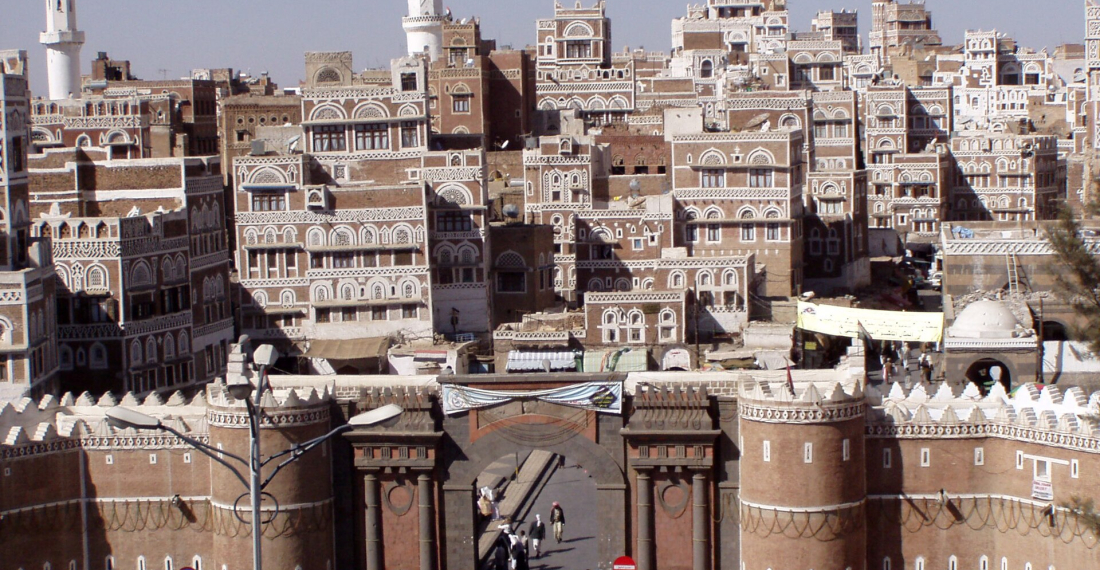
I visited Yemen many times from 1980-2015. Sanaa was a bustling Arab city. Until he was overthrown in 2011/12, the shadow of the president, Ali Abdullah Saleh, lay over the city. His web of corruption, intrigue and political guile left most Yemenis breathless. He managed the country by playing one group against the other. He could be all things to everyone. He even persuaded the Americans he was a democrat. Once I was on a plane in the middle of the night, about to leave Tbilisi, when I turned my head and saw sitting next to me Prime Minister Zurab Zhvania, who I knew very well. “Where are you going?” I asked. “Yemen”, he replied. Apparently, Saleh had persuaded the US group NDI that he was a democrat, and the Americans decided to take Zhvania to Sanaa to share his experience, the Georgian Prime Minister being, at the time, the best example the Americans had of a democratic success story.
Ali Abdullah Saleh may today be dead, but his many relatives are very much alive, and they have networks and financial resources that few others have. Some see Saleh’s relations as a solution to Yemen’s many problems. It's ironic that one sees a sense of nostalgia for Saleh and his time.
Humanitarian Disaster
Yemen today is a humanitarian disaster. The toll of the war is very high. 160,642 are reported killed in the fighting, including many civilians. Nearly 20 million people, more than half the population, need aid to survive. Millions live in poverty, and millions have been displaced. The numbers and the sheer size of the humanitarian disaster is simply staggering. How to help the Yemeni people, without helping the Houthi movement, especially now it has been re-designated as a terrorist group, is the biggest challenge of the international community. The Americans have washed their hands and are moving out. USAID was one of the leading donors, and millions of Yemenis depended on it. Its work and money have abruptly stopped and the Americans are now content with bombing Yemen from the air. Will the European Union and European countries step in to fill the gap? The problem is simply too large.
Civil society is too weak
Yemeni civil society is too weak to play a decisive role. In the short period 2011-14, they blossomed, and were seen as the future. But a decade of Houthi rule in Sanaa has weakened them, some say decisively. But if Yemen is ever to rise from the ashes, civil society will need to be fully involved.
The neighbours
The Houthis have turned to Iran for help, and the Iranians were quick to oblige, providing military and intelligence support. In the west, the Houthis are portrayed as a proxy of Iran but this is an oversimplification. The strength of the Houthis is that they are fully embedded within the Yemeni nation. This makes Yemen difficult to deal with.
Two neighbours tried, and they have now become part of the story: Saudi Arabia and the United Arab Emirates (UAE). They tried to defeat the Houthis militarily, but failed. They now are pursuing their agendas separately.
The Saudis have a long history with Yemen, and are trying to do with money what they failed to do with arms. They support the internationally recognised government but indications are they are also talking to the Houthis. The Saudis have the potential to be game changers but they need to play the long game and be ready for compromise and for messy solutions. It seems Mohammed bin Salman, who a decade ago rushed Saudi Arabia into a full war with the Houthis, has learnt to be more flexible and patient.
The second neighbour is the UAE. It is smaller than Saudi Arabia, but its financial capacity is high. The UAE has concentrated on the South, which until 1990 when Yemen united, was a separate country, and before that a British territory consisting of the Colony of Aden and two protectorates. Here the Houthis have little influence, and the Southern Movement has widespread support, and wants ideally to separate again. The UAE has concentrated its efforts in recent years on this part of Yemen, bypassing the issue of separation, but supporting the South otherwise.
Does Yemen have a future?
It is quite understandable that many are pessimistic about Yemen and its future. The redeeming factor is the Yemeni people. Their resilience is inspiring. There are amongst them extremely clever people. The problems are huge, and the international community must be ready to intervene strategically to support. But in the end the Yemeni problems will have to be solved by the Yemeni people, and this may take time.



