

Monday Commentary: Where does 100 days of war in the Middle East leave everyone?


The war against Iran, unleashed by the United States and Israel started 100 days ago, on 28 February 2026. Two days later, in my Monday Commentary on commonspace.eu, I said that Donald Trump had opened Pandora’s Box, and that the conflict unleashed will have deep and lasting consequences for the region, and for the world. Unfortunately, it seems I was right. We are just at the beginning of what are likely to be, a chain of events, that remain for the most part unpredictable, even if the dangers, turmoil and risks, can already be seen.

The problem is far from being resolved. A sort of a ceasefire has decreased the violence in the Gulf. Trump, under pressure from many quarters, to bring the crisis to a halt, keeps promising a deal “soon”, but in this, as with everything else in this saga, Trump is far away from reality. The revolutionary regime in Iran did not melt away; the killing of the Supreme Leader did not end the regime, nor did it mellow it down, the Iranian people did not rise to overthrow the clerics and their system, and the world did not rally around the US to support its adventure. Instead, Trump found himself tied to Israel’s Benyamin Netanyahu, and his convoluted view of the Middle East. Traffic through the vital global trade artery – the Strait of Hormuz, has been disrupted, as have global energy supplies, and other vital goods, such as fertilizer.

Even if a semblance of peace is restored, the impact will be widespread and everlasting.

This is seen, and will be seen even more crudely in the future, in the six Gulf monarchies that constitute the Gulf Co-operation Council (GCC).

The six countries have since the late 1960s relied on the US for their defence and security. They had blind faith in the US, and this seemed to increase when Donald Trump returned to the White House for a second term. They did not want the war. It came as an unpleasant surprise. But once it started, they expected the Americans to win it quickly and decisively. Instead, they find themselves faced with an injured but emboldened Iran, and a new Gulf reality that is unpleasant and uncomfortable.

The GCC countries have to go back to the drawing board. At least three of them, Saudi Arabia, Qatar, and UAE, have the financial clout necessary, and leaders that are sharp enough to deliver. But there are some realities that will be inevitable. One can mention five:

  1. Saudi Arabia will become more dominant. The Kingdom has always been the primus inter pares in the region. This will only become more so in the future. For the moment UAE does not seem to accept this, but in time, forced by circumstances, it will also fall in line;
  2. The GCC will search for a new security model, in which the US will be a part, but only a part; Since it replaced Britain as the main security provider in the Gulf in the late 1960s, the United States has had monopoly of military power. Everything indicates that the GCC countries will now look for something else;
  3. The ‘’Dubai Magic” is over. Neither the tourists nor the bankers, will come back soon. The time of unlimited spending sprees is over; the future has to be built on new realities.
  4. The six GCC states are hereditary absolute monarchies ruled by six families. The new reality will increase the stress on the system of internal governance. Whilst one should not overstate this, one cannot ignore it either;
  5. Managing Iran will remain one of the challenges ahead. Much work needs to be done, and the GCC countries will have to be ambitious, creative, bold and generous, in the process. Their long-term survival will depend on how well they do this.

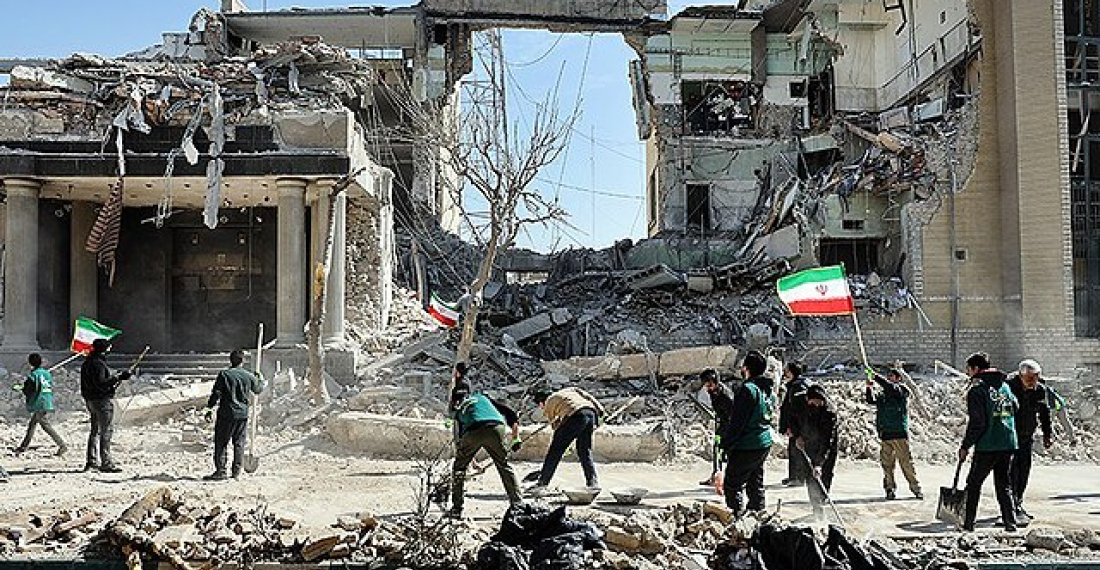
Iran, a hundred days after the killing of the Supreme Leader, is injured but emboldened. The heavy bombardments by the most powerful planes and missiles of the US and Israel, killed thousands of people, including one tier of leaders. But the worst damage is the material damage to infrastructure and facilities that will take years to restore. So far, the Islamic Republic, and its institutions have remained intact. But that does not mean they are not under pressure. Beyond the bravado speech coming out of Tehran, there is another reality. The war might not have triggered the revolt that Netanyahu and Trump expected, but it has triggered a process of change, the full implications of which will only be seen once the dust has settled.

Donald Trump emerges from the last hundred days weakened and vulnerable. The outcome of the war is not what he expected. It was his war, even if some say that it was Netanyahu’s war. He thought he could win it quickly and decisively. He didn’t. Americans, to the right and to the left, are unhappy with the war and its consequences. They will have their say in the mid-term elections later this year. It is too early for the opponents of Trump to claim victory. But the writing is on the wall. The war will define Trump’s second term. For the moment it does not look good for the president.

It does not look good for the United Sates either. Despite the impressive display of US shooting power, the war exposed the limits of US power, and the increasing US isolation in the world. The US can flatten a country, but it cannot flatten a people. The US deployed everything it has against Iran, except nuclear weapons. It dented the Iranian regime and its capabilities. Maybe even more. But it did not obliterate it. That clearly came as a surprise to Donald Trump; to US allies in the Gulf it came as a shock; to US adversaries in the world, who were watching carefully, it was a very instructive moment, and they all drew their own conclusions.

The last hundred days have had an impact on others too: Israel; Lebanon, and the Palestinians, are caught in it.

Europe is trying desperately not to be embroiled in Trump’s war. But Europe must be prepared for the day after. There is little sign of that yet.

source: Dr Dennis Sammut is the Director of LINKS Europe, and Managing Editor of commonspace.eu
Latest

Editor's choice
News
Kazakhstan set for major construction program after Tokayev’s speech

Kazakhstan set for major construction program after Tokayev’s speech

Kazakh President Kassym-Jomart Tokayev called for the construction and renovation of public infrastructure across all regions of Kazakhstan, and proposed declaring 2027 “the Year of Large-scale Construction”. Delivering his address to the people of Kazakhstan in his “state of the union” address, Tokayev stressed the need to launch construction and renovation projects in regional centers, districts and settlements throughout the country. Our collective nationwide response to the approaching era of artificial intelligence should be to build — and, once again, to build!, Tokayev emphasized. According to the President, key priorities include the construction of roads, airports, railway stations and healthcare facilities. Special attention will also be given to rehabilitation centres for children with special needs. In addition, every region should have creative development centres, sports complexes, libraries and scientific centres. Tokayev also highlighted housing construction as an important priority. Kazakhstan’s large-scale “People’s Construction” program, announced by the President, will pave the way for major infrastructure development and reforms across all sectors of the economy, Kazakh Prime Minister Olzhas Bektenov said at a government meeting. Bektenov stressed the need to develop a clear action plan to implement President Kassym-Jomart Tokayev’s state-of-the-nation address, delivered on October 28. The Prime Minister said the address sets out the central goal of building a fair, strong, clean and progressive Kazakhstan. Achieving this objective will require making the fullest possible use of the country’s existing potential and the opportunities emerging from modern innovation. Bektenov highlighted the significance of the “People’s Construction” initiative, describing it as the starting point for major infrastructure transformations and comprehensive reforms throughout the economy. “This large-scale project will provide significant momentum for employment growth and improving citizens’ well-being. This address is the most substantive policy document for the near future. We must have a clear action plan for its implementation”, he said. Kazakhstan also plans to build nearly 70 new healthcare facilities across the country. (click image to read more)

Popular

Editor's choice
Monday Commentary
Monday Commentary: European-Azerbaijan relations need an intensive and multifaceted dialogue that is frank and honest

Monday Commentary: European-Azerbaijan relations need an intensive and multifaceted dialogue that is frank and honest

Last week I visited Baku, Azerbaijan. My visit was relatively short, but very intensive, and had many meetings with stakeholders and colleagues. When I arrived in Baku first time in 1996,  Azerbaijan was a different country: weak, poor, and shaken by defeat in war. For thirty year the Karabakh issue dominated the agenda: the political agenda but also the popular mindset. Now, thirty years later, Azerbaijan has returned to Karabakh, and peace with Armenia is on the horizon. It is a new era for Armenia-Azerbaijan relations, for the South Caucasus, but also for Europe.  But we cannot be complacent: the Peace agreement has been initialed but not signed; borders remain closed; TRIPP is ambitious but remains an idea; and there are spoilers who want to turn the clock back. We must not allow them, and in this Europe and Azerbaijan must work together. Europe’ vanguard organization is the European Union – it is a free union of 27 member states; it is a strong global economic force, and increasingly a diplomatic and military force too. But it remains “work in progress” and can often appear dysfunctional. It often lacks collective and institutional memory. In its dealings with Azerbaijan the EU has made many mistakes – not least opening the delegation here late – in 2008. It sometimes appears condescending. Some utterances from the European Parliament and from some quarters in some member states are not understandable even for me. They irritate the Azerbaijanis, but serve no other purpose But Azerbaijan has also not handled relations with the EU well. It has failed to respond when the hand of friendship reached out; and it confused irritating actions, sometimes by well-meaning people; sometimes by outright spoilers, with strategic action. In short, EU-Azerbaijan relations have suffered from a lack of proper dialogue. This dialogue must be frank, honest and multi-faceted involving different segments of society on both sides.   Is Azerbaijan Europe? When Azerbaijan applied to join the Council of Europe in the 1990s, there were some who opposed, saying this was not Europe. I was one of the people who argued that Armenia and Azerbaijan may be on the periphery of the continent geographically, but were European in essence. Certainly their elites. During the discussion on 4 September in Baku, my friend Farhad Mammedov, mentioned that Azerbaijan is not interested in joining the EU, and was now close to the Central Asian countries in the 5 plus 1 format. Neither things mean that Azerbaijan is not Europe. There are several European countries that are not in the EU, and do not want to be, for example Norway and Switzerland. Iceland has recently voted to stay out of the EU. The UK was a member and left. Europe is bigger than the EU, and the holding of the European Political Community summit in Baku in 2027 proves that. Despite all the rhetoric, I never heard the president of Azerbaijan  saying that Azerbaijan is not Europe, nor have I heard any European president say it either. Not wanting to join the EU and forging close relations with neighbouring regions does not make Azerbaijan any less European. It is only logical that when Europeans talk to Azerbaijan they talk like family. The conversation is often frank. It must also be honest, and Europeans need always to remember this too. A frank, honest and multi-faceted dialogue A frank, honest and multifaceted dialogue will contribute to relations between Azerbaijan and the rest of Europe: it will avoid misperception, which unfortunately is very common on both sides; it will provide a forum where problems can be discussed and resolved, and it will increase mutual trust, so that together common problems can be addressed. (click image to read the full Monday Commentary)
Editor's choice
Monday Commentary
Monday Commentary: “The barren rocks of Aden” and “These lands of Yemen are so ruthless”

Monday Commentary: “The barren rocks of Aden” and “These lands of Yemen are so ruthless”

There are two early 20th-century tunes that mark foreign attempts to occupy and “pacify” Yemen. The Scottish tune “The barren rocks of Aden” marks the mobilisation of Highland soldiers, enlisted to be deployed to the Yemeni port of Aden, that in 1837 became the last colony to be incorporated into the British Empire. The tune talks of the harshness of the terrain, but is celebratory, It was even played as a farewell tune to Sir William Luce at the parade in Sharjah celebrating his end as “British Viceroy” in the Middle East in 1966. The second tune is an Anatolian lament. As Ilker Sezer reminded us this weekend, in his weekly feature on “Turkiye Today”, it “mourns the tragic fate of Ottoman soldiers dispatched to the harsh, remote deserts of Yemen during the fall of the empire, young men who marched away from their villages and never returned home. Most of their names, and numbers, were never recorded. Yet, their fate left a mark on the Turkish psyche.” Subsequent invaders have discovered that Yemen is a grave that cannot be overcome by the strength of modern technology, and that whilst Yemeni society is splintered and divided, building a reliable alliance with Yemeni factions is difficult. These are the harsh lessons facing Saudi Arabia, as the Kingdom faces its biggest challenge in its modern history. The leadership of the Kingdom now has to respond decisively. At stake is their very credibility. This is likely to be a long and messy conflict. Saudi military objectives need to be focused: to box in the Houthis rather than destroy them. This is likely to include: (a) regaining territory lost on the Red Sea coast; (b) control over Bab el Mandeb Strait; (c) some kind of cordon sanitaire on the Saudi-Yemeni border; and if things go well (d) the capture of Sanaa. All this would not eliminate the Houthi problem, but it will contain it. In the end the Saudis will have to continue managing Yemen with a mixture of carrot and stick. For the moment, the stick is likely, but the carrot cannot be forgotten either. (click the image to read the Monday Commentary in full)