


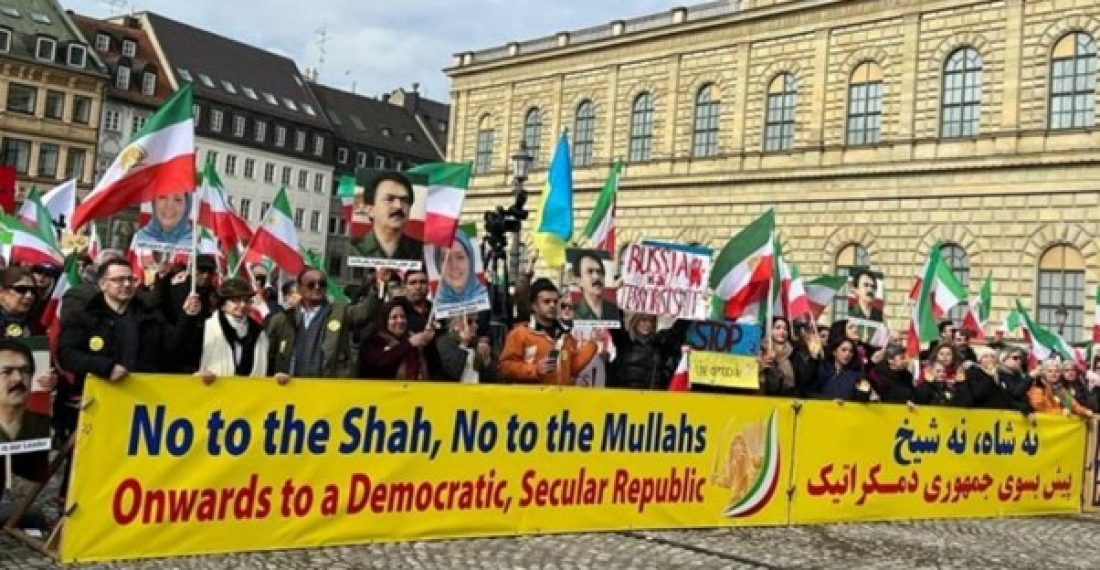
One slogan at a pro-democracy Iran rally held in Berlin, one of many that took place in Europe this weekend, caught my attention. It said “No Shah, no Mullahs”. It caught the dilemma of many Iranians, inside and outside the country, that are being forced into a false choice between the present clerical regime, and the “Shah”, the son of Mohammed Reza Pahlavi, who ruled Iran from 1941 until the 1979 revolution. For most of the time, and certainly since 1953, the Shah was absolute ruler.
Mohammed Reza Pahlavi was no democrat. He ruled as an absolute dictator, with the help of a secret police that tortured and abused people. Most Iranians lived in abject poverty, whilst the Shah, his family, and associates lived in great luxury in Tehran, which had also become a sort of western playground in the Middle East.
It is at best disingenuous, at worst an act of great folly and cynicism, that in the United States, the son and heir of Mohammed Reza Pahlavi, is being promoted as the alternative to the clerical regime that currently rules Iran.
It is true, that among the remnants of the extensive Shah’s apparatus, especially the older generation, there are those who are nostalgic for the Shah and his times. But they are a small minority. The Shah (the son) can never be the rallying point around which a critical mass of the Iranian people will gather.
There is a dilemma which has been a factor in Iranian politics and society since 1979. The revolution was not purely an Islamic clerical affair. Thousands of leftists, and supporters of secular parties, who had long opposed the Shah, were on the forefront of the 1979 Iranian revolution, some playing a critical role in the final weeks before the end of the Shah era.
But it is equally true, that the religious establishment, the Ayatolahs, were the strongest, best organized, group. And they had a national spread, which the others had not. When Ayatolah Khomeini returned from exile in Paris in 1978, they also had a leader. Once the Shah was gone, the anti-Shah solidarity collapsed, and the Shia clergy emerged as the dominant force. They have ruled Iran since, creating an Islamic republic in which the Mullahs dominate – in state institutions, in business, and in every aspect of life.
Today Iran is also ready for change, but this change cannot be going back half a century in time. No Shah, no Mullahs, as the slogan in Berlin said.
Its time for Iran to turn the page, but this has to be done by the Iranian people in their own way. You cannot bomb a new regime to replace the present one. The Iranian system is resilient, and will not allow change imposed from outside.
What will emerge will not be what Israel and the US wants, but it can be what the region needs: a peaceful, stable and prosperous Iran at peace with itself and its neighbours.
Change is likely to come incrementally, and from inside the system. Many inside the system understand that change is needed.
Trump is keeping his options open. But his military have advised him that Iran is no Venezuela. Countries close to Iran, including Saudi Arabia, Pakistan, Turkey, Azerbaijan and others have cautioned against a US attack on Iran. For the sake of the region, and of the Iranian people, one hopes that Trump will listen.
source: Dr Dennis Sammut is the Director of LINKS Europe, and Managing Editor of commonspace.eu



