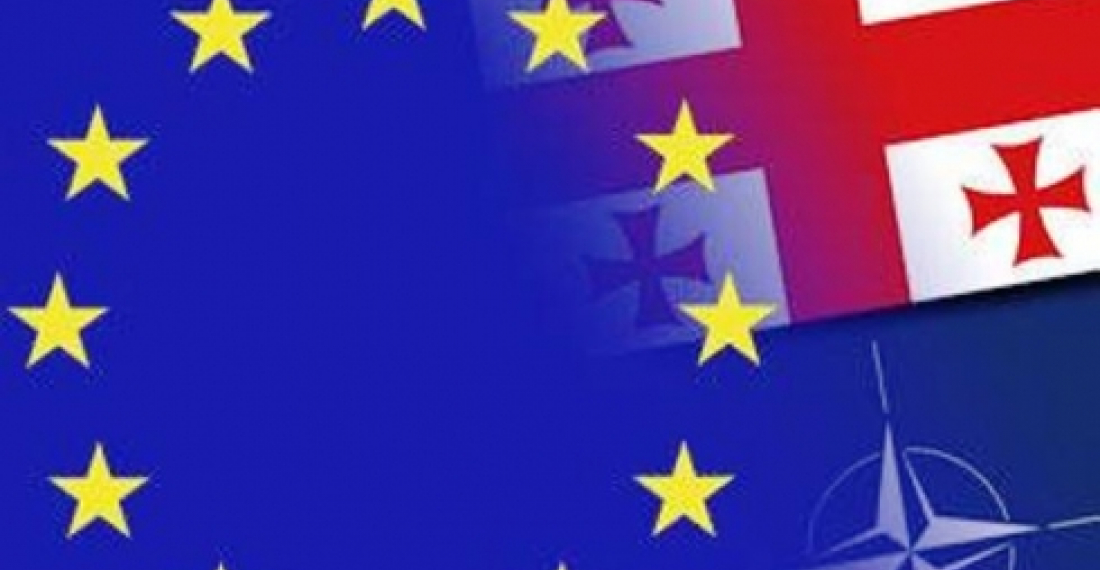
In this op-ed for commonspace.eu Dennis Sammut argues that it is time that taboos are broken, and Georgia should now be given an EU and NATO membership perspective regardless of what Russia says.
Georgian Prime Minister Irakli Garibashvili, who is currently on an official visit to the United States, has raised the stakes in terms of his country's expectations from Europe and the United States over the coming months. Fresh from a meeting with President Obama at the White House, Garibashvili told the US think tank "Atlantic Council" that NATO should give Georgia a Membership Action Plan (MAP) at its summit in September in Britain, and also called on the EU to make "a clear promise of membership to the successful countries" of the Eastern Partnership. Both demands would have sounded to many at best premature, one year ago. There were too many uncertainties surrounding Georgia, and the international situation seemed to suggest that a slower, more subtle approach to events in Eurasia was desirable.
Yet several things have happened over the last year or two that have made even cynics like myself think again. First there were developments in Georgia itself. Few could have believed that the transition of power from the increasingly despotic administration of Saakashvili to the Georgian Dream coalition could have proceeded so smoothly. Even fewer believed that once he had power, the mastermind and architect of the transition, Bidhzina Ivanishvili, would then retire from front line politics and leave a younger generation to carry on the task of government. Yet these things happened, and credit must be given to all concerned, including Saakashvili and the United National Movement.
Over the last two years the Georgian political elite have shown an increasing maturity, whilst Georgian civil society has shown an ability to keep politicians in check, and to hold them to account even in the most difficult of circumstances. Those of us who have followed Georgian politics over two decades, and who often despaired at the failures of its politicians, have been pleasantly shocked by the events of the last two years. There are now several EU countries that have a thing or two to learn from Georgia. Many problems remain in the field of governance and in the consolidation of the democratic process, but now Georgia's biggest challenges are in the economic sector, and it is right that this is where the new government is putting the emphasis.
In the international sphere, and particularly with regards to events in the Eurasian region, much has changed too. Over the last year Russia, in its quest for great power glory, not for the first time, has overplayed its hand. Russia's attempts in 2013 to undermine the European Union's modest Eastern Partnership strategy, and to frustrate the desire of a number of former Soviet republics to establish association arrangements with the EU, have now clearly misfired. The people of Ukraine have seen to that, paying with their blood. By the end of the day Russia is likely only to have Armenia to show as a trophy for its expensive and misguided policy. In Ukraine the situation will remain unstable for some time, and western countries should not try to pre-empt the process. Ukrainians must get their act together and move their political process forward to a new level, as the Georgians have done successfully.
With Georgia however it is another matter. If there was ever a time when Georgia should be put on a clear time table for full NATO and EU membership that time is now. I have never believed that NATO membership is a panacea for every situation, and some countries may be wiser staying out. The Georgian people have however made up their mind, and there is broad consensus amongst Georgians that this is what they want. There is now no justification for continuing to procrastinate over Georgia's membership. It will irritate Russia, but that may be one of the reasons why it needs to be done. The lingering sense that Russia somehow has a veto on what happens in the former soviet republics has lingered long enough, and is now itself a cause for instability and insecurity, let alone being an infringement of the rights of these countries to determine their future. NATO membership for Georgia is a taboo that needs to be broken, for the sake of Russia as much as for the sake of Georgia.
On the other hand membership of the EU is somehow perceived as a more technical issue, requiring time. Indeed Georgia will need to be eased into membership, as well as being required to implement substantial reforms. Yet putting Georgia on a time table for membership will consolidate the fragile gains of the last two years in the political field, and will considerably help Georgia to forge its economic future. No doubt the Brussels bureaucracy, and those of the member states who are so minded, may well come up with hundreds of difficulties, and most of them will be real enough. Yet there is never going to be a better time for accepting Georgia's European aspirations and the EU needs to rise to the occasion and put membership on the table.
As could be seen from the visit of the Georgian Prime Minister to Washington in the last days there is a lot of goodwill towards Georgia in the US, and the same can be said for the European Union. Yet goodwill is meaningless unless backed by action, and it is now time for the US and the EU to take the plunge and throw their full weight behind Georgia.
Dennis Sammut is a foreign policy analyst and a regular contributor to commonspace.eu. He is currently based at Oxford University, and may be contacted at dennis.sammut@spc.ox.ac.uk