


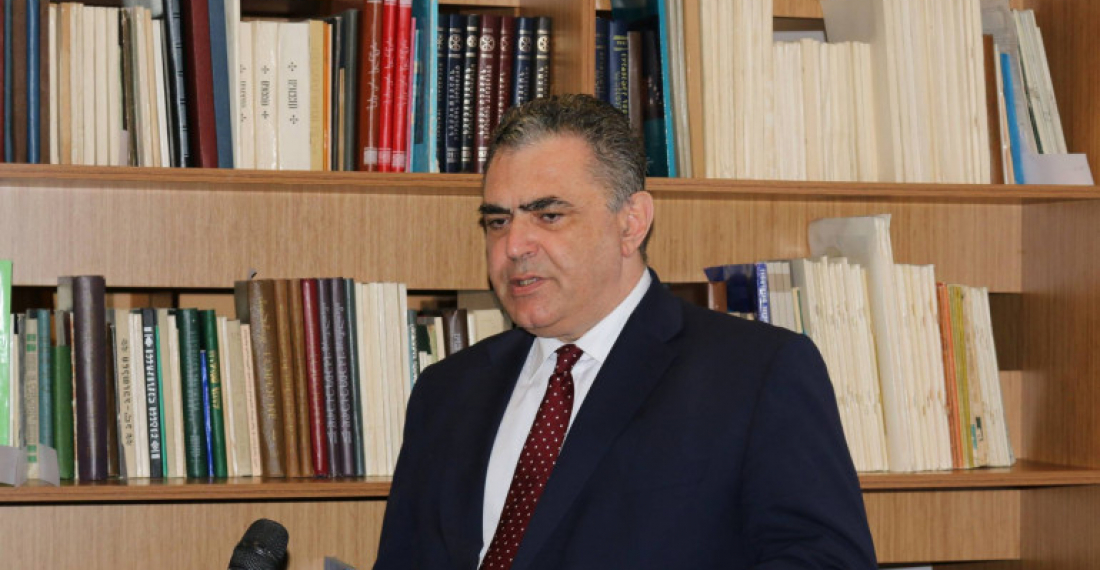
"Time for a big gesture." In an interview with Arminfo News Agency, Dennis Sammut looks at next steps needed on Karabakh peace process.

ARMINFO's News Agency David Stepanyan interview Dennis Sammut, Executive Director of LINKS on recent issues surrounding the release of Ramil Safarov and the future of the karabakh peace process.

The extradition of Ramil Safarov has already resulted in the cancellation of a range of initiatives aimed at developing Armenian-Azerbaijani dialogue. Is it possible to continue efforts to establish a dialogue between the Armenian and Azerbaijani public as a precondition to resolving the Karabakh conflict, as the OSCE MG co-chairs have repeatedly mentioned it?

Dialogue and public diplomacy were the first victims of the events of the last two weeks. The same thing happened in 2004 when the murder took place in Budapest. It took a lot of work and effort to restore at least a minimum level of dialogue, but it was achieved. The same must happen now. Those calling for cutting of people to people contacts are simply playing into the hands of extremists.

Evidently, extradition and glorification of the murderer Safarov will affect not only the region and the Armenian-Azerbaijani relations, but also the policy of Yerevan and Baku with regard to international partners. What do you predict will be the consequences of the current situation?

There is undoubtedly concern in the international community about how the events surrounding the release of Safarov unfolded. I think what irritated European countries in particular was the lack of sensitivity. The perception that Azerbaijan did not act properly will linger for some time. In the end it will depend on future actions too. But there is no doubt that Azerbaijani diplomacy will have some hard work to do to restore the confidence of international partners.


Safarov's pardon has made Aliyev more popular inside Azerbaijan , even if such actions contradict international diplomacy and International Law. Can one conclude that the retention of power has become the priority for Aliyev, superseding even the international interests of Azerbaijan ?

Every government has to balance between domestic and foreign policy. The government of Azerbaijan is not an exception. Nor is the government of Armenia. However these issues, and the whole debate over Nagorno-Karabakh should not be instrumentalised for short term political gain. There will be Presidential elections in both Armenia and Azerbaijan next year. We should expect a lot of rhetoric, but we need to see statesmanship not cheap politics.

The years of negotiations within the Minsk Group have already shown that it is impossible to speak of Nagorno Karabakh's future without taking into consideration the realities of the last twenty years. That is, "return" of disputed territories to the former mini-metropolises is out of question regardless of the claims of territorial integrity of entities established in the Soviet Union. Do you think that the restoration of Azerbaijan's territorial integrity in this context has any perspective?

We tend to see these things in black and white terms. A solution over Nagorno Karabakh is never going to be either black or white, but some shade of grey. The future status of Nagorno-Karabakh is perhaps the most difficult aspect of the conflict and will be determined last. This status needs to be underpinned by two considerations: the security of all states and the safety of all citizens, particularly of minorities living amongst majorities. The return to Azerbaijan of territory around Nagorno-Karabakh currently under Armenian occupation is generally accepted to be a precondition.

What should the international community be doing at this stage?

The Safarov incident has shown once more that the Karabakh conflict is a difficult and serious problem with the potential to spiral quickly into a big problem. Big problems require big solutions. There is a very worrying trend in diplomatic circles to try to address the problem with small measures. This is not going to work. Confidence building measures, public diplomacy and people to people contacts are important, even vital for any peace process to succeed. However they can be most useful if they are developed in tandem with a proper peace process.

We need a big gesture from the international community on Karabakh - something that the sides can see is serious, and can engage with seriously, because if they don't they have something to loose.

source: This interview is reproduced in full from Arminfo News Agency
Related articles

Editor's choice
News
Borrell tells the European Parliament that the situation in Afghanistan was critical, but the EU will remain engaged

Borrell tells the European Parliament that the situation in Afghanistan was critical, but the EU will remain engaged

Borrell underlined that the European Union will make every effort to support the peace process and to remain a committed partner to the Afghan people. "Of course, we will have to take into account the evolving situation, but disengagement is not an option.  We are clear on that: there is no alternative to a negotiated political settlement, through inclusive peace talks.
Editor's choice
News
NATO Chief says war is on Europe's doorstep, and warns against complacency

NATO Chief says war is on Europe's doorstep, and warns against complacency

Russia could attack a NATO country within the next five years, the Secretary General of NATO, Mark Rutte, said in a stark new warning. "NATO's own defences can hold for now," Rutte warned in Berlin, but conflict was "next door" to Europe, and he feared "too many are quietly complacent, and too many don't feel the urgency, too many believe that time is on our side. "Russia is already escalating its covert campaign against our societies," Rutte said in a speech in Germany. "We must be prepared for the scale of war our grandparents or great-grandparents endured." Earlier this month, Russia's President Vladimir Putin said his country was not planning to go to war with Europe, but it was ready "right now" if Europe wanted to - or started a war. But similar reassurances were given by Moscow in 2022, just before 200,000 Russian troops crossed the border and invaded Ukraine. Putin has accused European countries of hindering US efforts to bring peace in Ukraine - a reference to the role Ukraine's European allies have recently played in trying to change a US peace plan to end the war, whose initial draft was seen as favouring Russia. But Putin was not sincere, Nato's secretary-general said in the German capital, Berlin. Supporting Ukraine, he added, was a guarantee for European security. "Just imagine if Putin got his way; Ukraine under the boot of Russian occupation, his forces pressing against a longer border with Nato, and the significantly increased risk of an armed attack against us." Russia's economy has been on a war footing for more than three years now - its factories churn out ever more supplies of drones, missiles and artillery shells. According to a recent report by the Kiel Institute for the World Economy, Russia has been producing each month around 150 tanks, 550 infantry fighting vehicles, 120 Lancet drones and more than 50 artillery pieces. The UK, and most of its Western allies, are simply not anywhere near this point. Analysts say it would take years for Western Europe's factories to come close to matching Russia's mass-production of weapons. "Allied defence spending and production must rise rapidly, our armed forces must have what they need to keep us safe," the Nato chief said.

Popular

Editor's choice
News
NATO Chief says war is on Europe's doorstep, and warns against complacency

NATO Chief says war is on Europe's doorstep, and warns against complacency

Russia could attack a NATO country within the next five years, the Secretary General of NATO, Mark Rutte, said in a stark new warning. "NATO's own defences can hold for now," Rutte warned in Berlin, but conflict was "next door" to Europe, and he feared "too many are quietly complacent, and too many don't feel the urgency, too many believe that time is on our side. "Russia is already escalating its covert campaign against our societies," Rutte said in a speech in Germany. "We must be prepared for the scale of war our grandparents or great-grandparents endured." Earlier this month, Russia's President Vladimir Putin said his country was not planning to go to war with Europe, but it was ready "right now" if Europe wanted to - or started a war. But similar reassurances were given by Moscow in 2022, just before 200,000 Russian troops crossed the border and invaded Ukraine. Putin has accused European countries of hindering US efforts to bring peace in Ukraine - a reference to the role Ukraine's European allies have recently played in trying to change a US peace plan to end the war, whose initial draft was seen as favouring Russia. But Putin was not sincere, Nato's secretary-general said in the German capital, Berlin. Supporting Ukraine, he added, was a guarantee for European security. "Just imagine if Putin got his way; Ukraine under the boot of Russian occupation, his forces pressing against a longer border with Nato, and the significantly increased risk of an armed attack against us." Russia's economy has been on a war footing for more than three years now - its factories churn out ever more supplies of drones, missiles and artillery shells. According to a recent report by the Kiel Institute for the World Economy, Russia has been producing each month around 150 tanks, 550 infantry fighting vehicles, 120 Lancet drones and more than 50 artillery pieces. The UK, and most of its Western allies, are simply not anywhere near this point. Analysts say it would take years for Western Europe's factories to come close to matching Russia's mass-production of weapons. "Allied defence spending and production must rise rapidly, our armed forces must have what they need to keep us safe," the Nato chief said.


