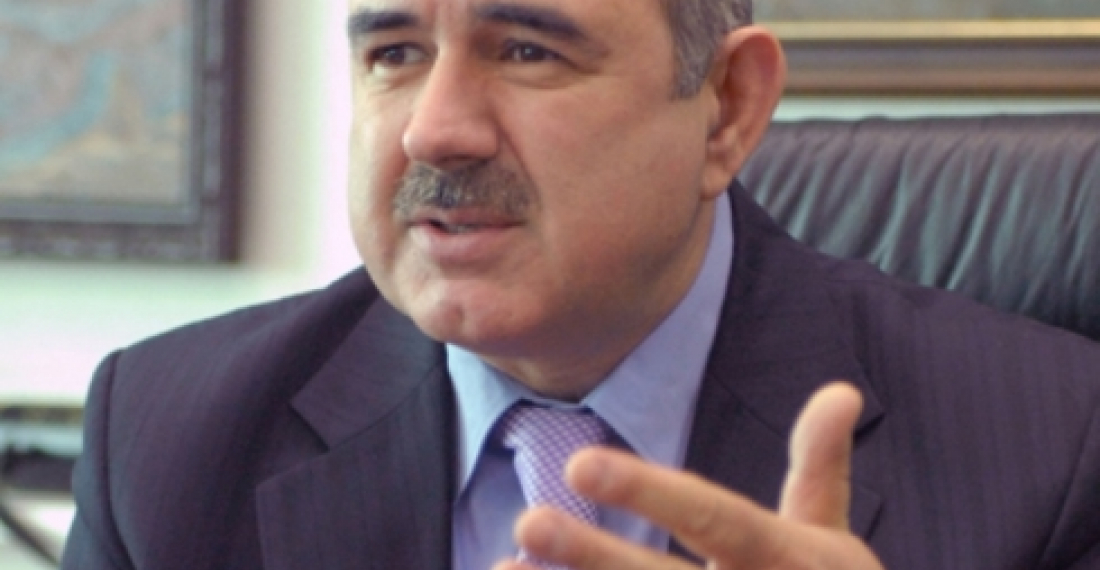
When Russia recognised South Ossetia as an independent country in 2008, Dimitri Medoev became the first Ambassador accredited to the Kremlin. In this exclusive interview with commonspace.eu Medoev blames Georgia for starting the war, and the international community for complacency bordering on complicity. He dismisses the role of civil society in the long term resolution of the conflict and says Russia was the salvation of the Ossetian people. He sees value in the Geneva process and says that South Ossetia is open for contacts with all European institutions.(This interview is part of our coverage to mark the 5th anniversary of the 2008 Georgia-Russia War).
Five years have passed since the August conflict in South Ossetia and the Georgia-Russia War. Do you think what happened then could have been avoided?
Indeed, five years have already passed, and the assessment has not changed, including with regard to who attacked who. The whole world has already recognized that Russia did not attack Georgia, on the contrary, Georgia attacked South Ossetia, and it was not a Georgian-Russian war but Georgian aggression against South Ossetia. It's time to recognise the reality.
As a living witness to all the events that took place five years ago. With all responsability I want to confirm that the first strike of the Georgian army targeted the peaceful citizens of South Ossetia and the Russian peacekeepers, who that night suffered serious losses. Here I want to emphasize that Georgian troops on the night of August 8, 2008 attacked the barracks of the Russian peacekeepers who were deployed in South Ossetia under international agreements.
The Georgian government violated all international agreements. They destroyed what had been a very effective four-sided negotiation format and with their criminal actions annulled the entire peacekeeping operation which had been on-going since 1992.
The results are well-known - many victims, destructions, broken lives, and the irrevocable loss for Georgia of South Ossetia and Abkhazia.
Also today, I want to say for the first time exclusively in this interview that defenders of Tskhinval for three days stood shoulder to shoulder against the "commandos" of Saakashvili, who were armed to the teeth, before the arrival of Russian army units, and they did not lose any of their positions.
You ask whether it was possible to avoid it? I say, yes you could, including with the help of the international community. But the world not only was silent in those days, but also was actively arming Georgia. The Americans even called Georgia a "beacon of democracy", and it's leader was turned into a "holy cow" in the eyes of the world that could not be touched - only to feed, "train and equip". You must remember the program NATO for Georgia?
The result was what we got - Georgia trampled all international norms, and in the opening day of the Beijing Olympics it attacked South Ossetia and unleashed this bloody war.
There were many deaths and a lot of destruction in South Ossetia as a result of that war. Have the people of South Ossetia recovered from the conflict?
The victims were many, and the destruction was enormous. We still have not put everything in order. August 2008 was the culmination of, let's say, the last stage of destruction of South Ossetia. Here also I want to remind you that the destruction of South Ossetia began from the time of the Georgian Soviet Socialist Republic government - in particular in times of the end of Communist era and early nationalist Gamsakhurdia - 1989 - 1992 years. Until 2008, all the while, every Georgian government was fighting against South Ossetia, destroying its economy and infrastructure.
Today the situation has changed radically. It has already been five years since Russia has recognized the independence of South Ossetia; no one shoots at us anymore and no one threatens my country. We feel protected for the first time in 20 years and for the first time in many years, we have the opportunity to live without fear for the safety of our children. In this time we not only restored the destroyed buildings and built a lot of new important facilities, we also try to revive and return to a dignified life. And most importantly, we want to live in safety and no longer to think about war.
Some accuse the South Ossetian authorities of ethnic cleansing after the conflict. The Georgian villages on the road from Tskhinvali to the Roki Tunnel have disappeared, and the Georgian population of Akhalgori has mostly left under duress. Are these criticisms justified?
Don't you think it is strange that no one in Europe ever accuses Georgia of ethnic cleansing against the Ossetians, Russian, Abkhaz, Greeks? I recall - 114,000 Ossetians were expelled from Georgia nationwide from 1989 to 1992 - that is the official data recorded in the migration committee of North Ossetia. During the same period, 117 Ossetian villages were burned in South Ossetia, and more than a thousand peaceful inhabitants were killed.
All this is properly documented, but, oddly enough, the international community does not care about it, and that in itself is a sad fact. Double-standards? Or how Gerald Seymour said - "One man's terrorist is another man's freedom fighter". This is not serious at all.
As for the Georgian population of the villages mentioned by you, the situation is very simple. Residents of these areas had become hostages to Saakashvili's plans to seize South Ossetia. They were unwitting participants in this process.
The fact is that two weeks before the attack on South Ossetia, the Georgian authorities conducted a massive operation of moving all the people of the area to the internal part of Georgia, as they were told by officials in Tbilisi temporarily. According to their design, these same people would go back within a week after the Georgian "blitzkrieg". So that's how they became involved in the shady enterprise and become part of the military operation of the Georgian army. The question is under what law or international convention these people may qualify as refugees? Especially as the population in these Georgian villages by "default" agreed with Saakashvili's war plan, to create a so called "open field" against their Ossetian neighbours.
We understand the situation in which they have found themselves thanks to their government, and we strongly protest against the fact that these questions are addressed to us or, worse, to the Russians. Such matters have a legitimate addressee - the government of Georgia and Saakashvili personally. I am convinced that the majority of the people who were moved, will agree with my statement. Today, they know exactly why they are there and why they have failed to return.
But there are a number of other interesting questions that arise. For example, how such an operation went unnoticed by representatives of numerous of international organizations, human rights centers and embassies of foreign countries accredited in Tbilisi? What was the OSCE Mission doing at this time- the OSCE being a former member of the monitoring process in the former Georgian-Ossetian conflict zone? What happened to the former employees of the OSCE Office in Tskhinval a few hours before the attack of the Georgian army? Today we know they ended up. It turns out that they, as well as residents of the Georgian villages which you mentioned, knew in advance. No one ever hinted about that to the peaceful inhabitants of Tskhinval, who unsuspectingly went quietly to bed that fateful night.
And these are only some of the questions the Georgian side and some international organizations have to face.
South Ossetia participates in the Geneva Process, even if informally. What is your evaluation of this process?
First of all, all parties are involved in this process informally. But it does not matter. As you know, this process, which is actually called the discussions on security in Transcaucasia, started after the famous shuttle flights of President Sarkozy of France in August 2008, and his meetings with Russian leaders, and they are held under the agreed plan informally known as the "Medvedev - Sarkozy plan". This is not a negotiation between Russia and Georgia. This is a multi-stakeholder consultation on regional issues.
The Parties meet regularly in Geneva, there is a discussion of issues that are of interest to all participants. We do not always reach agreement on certain issues, there are even fundamental disputes and fundamental differences, and all of this is understandable. In any case, this is the only platform now where interested parties in the peace process can meet and declare the interests of their countries. Each of the participants represents their government, there are not two, or a group of parties, each delegation is responsible for itself. Geneva authorities have kindly provide their facilities to conduct such a dialogue and create all the necessary conditions for this. I think it is useful.
Are the South Ossetian authorities interested in a more active role by the European Union to resolve the conflict?
We respect the role of the European Union in international affairs, but in this case I do not quite understand the resolution of what conflict you speak about. What was called "the Georgian-Ossetian conflict", ended on the night of 7 to 8 August 2008, when Saakashvili attacked the city of Tskhinval, and the position of the Russian peacekeeping battalion.
I have already mentioned that the format of the settlement of the former Georgian-Ossetian conflict was based on international multilateral agreements, particularly on the Georgian-Russian agreement on the further development of the process of peaceful settlement of the Georgian-Ossetian conflict and the Joint Control Commission agreement, signed in October 31, 1994 in Moscow .
According to the Agreement, tripartite peacekeeping force which consisted of Georgian, Ossetian and Russian battalions were acting in a special area of responsibility.
As soon as Georgian troops attacked their Russian and Ossetian colleagues in the peacekeeping operation - these aforementioned agreements ended, that is, the peacekeeping operation had ceased to exist de facto, and also de jure after Russia recognized the independence of South Ossetia.
After that questions related to defence and security, economic development, social and humanitarian and other issues of South Ossetia are developing on the basis of bilateral Russian-South Ossetian intergovernmental agreements. This mechanism is working quite effectively now.
As for the participation of the European Union, for the moment the government of South Ossetia has not received any proposals from this highly regarded organization. I can confidently say that if we receive one, it will be studied with great attention. Our country is open for contacts with all European institutions, but, unfortunately, this is a one-sided desire.
After the war Russia recognised South Ossetia as an independent state. Many thought at the time that others would follow but so far only five countries have established diplomatic relations? Is this a sign that South Ossetian independence is simply a myth?
Let's begin with the fact that the recent events in Libya and Egypt, in the Middle East and Syria have put all countries in the region on the brink of a large-scale worldwide disaster and this is not a myth, but a harsh reality. But the legal consequences of this chaos could become no less challenging to the existing world order today. And I would not be surprised if in such developments some of the world powers will begin to convince everyone that the Charter of the United Nations is a myth. They have been doing it in practice, and, unfortunately, they have already succeeded in a small way.
We respect the Charter of this authoritative organization, we share its values, because the UN does not differentiate between large and small nations, and this is extremely important. We also respect those States who have exercised their sovereign right and recognized our independence, while also, I note, being under tremendous pressure from countries we all know about.
Now the main thing. I think you will agree with me, is that the nature and the location of those recognising South Ossetia is quite wide: on the one hand a member country of the UN Security Council, and on the other a small island nation in the Pacific Ocean - also a full member of the UN. Of course, the recognition by Russia is particularly significant, and it is not by chance. Russia has been historically and spiritually close to our country, and our main strategic partner and ally for many centuries. We celebrated the 260th anniversary of the first Ossetian embassy in St. Petersburg last year. Where there many ambassadors at the Russian Imperial Court in those days?
Now, our relations are developing dynamically. Judge for yourself. Today, the level of bilateral relations between Russia and South Ossetia is very high - there are already in force more than 65 agreements between the two governments and this creates extensive co-operation in many spheres.
Working as my country's ambassador in Moscow, I want to note that not all the countries that have diplomatic relations with Russia have been able to develop such a solid package of agreed documents. This process continues, and it's irreversibility was documented in the new foreign policy doctrine of Russia, which is determined by the decree of President Putin on 7 May 2012.
At this time we mark the 5th anniversary of the events of August 2008. Of course they are of great importance not only for South Ossetia, but also for Russia. The recognition of our republic became the most important event in the modern history of the entire Ossetia. The people of South Ossetia will never forget that their salvation came from Russia.
Also this year we celebrate another anniversary - five years of the establishment of diplomatic relations between the Republic of South Ossetia and the Russian Federation, as well as five years of the establishment of the first Embassy of our state in Moscow.
If, in your opinion, it's all a myth, then what is the "Georgian Dream"?
In the 1990s and later you were yourself involved in many Track 2 initiatives aimed at building trust between Ossetians and Georgians and those initiatives yielded some results at the time. Is it time now for new civil society initiatives to reduce tension and try to bring the region to normality?
Indeed, we went through the path of public diplomacy but that was in the past. It enabled us to get a clear understanding of the non-governmental sector. It was a very useful experience that enabled us to conclude that it's all very vague, fragile and unreliable. We are building a democratic state, and in this case we need a more serious and responsible approach.
It is well known that Saakashvli and his team came to politics from the NGO sector, after participating in all kinds of trainings, round tables, summer and winter schools ... The result is negative. Therefore, I believe that this is not our way. We are fully capable to develop our civil society and support free media according to our laws and to the benefit of all society. South Ossetian civil society, if freely able to choose, can choose its own direction, as well as set goals and objectives of its development. Guidance from the side and according to dictates is not acceptable.
Furthermore, I think that the reasoning of the so-called "confidence-building measures between Ossetians and Georgians" - is a light-headed approach, and more than frivolous. It sounds like the Soviet slogans about friendship of peoples - it is yesterday. Experience shows that it is just nice talk, attractive on the surface, but in my view useful only for NGOs aiming to obtain grants.
I'm sure that everyone is tired from these initiatives, and especially the Georgians and the Ossetians. It is better to come to South Ossetia and see how the people really live there. Believe me, they live normally - not very rich - but that is changeable, but very friendly, and most importantly, in peace and harmony.
In fact, people in Georgia were always well aware that there is South Ossetia close by, distinctive, separate, and that it is another country, it is the land of the Ossetians who always wanted to live their own life and destiny. Today, the reality is that the Republic of South Ossetia is an independent state, and I assure you, it is there to stay.
The problem, in my opinion, is that not a single Soviet or post-Soviet government of Georgia ever wanted to recognise this reality. And every Georgian government had problems with the Ossetians and other neighbours during the last century. It is time for Georgia to finish with this practice in the 21st century. Sooner or later, they will still need to recognize the right of the Ossetian people to their own state and begin to build civilized and equitable inter-state relations relationships with the Republic of South Ossetia. This process is irreversible.
Therefore, the main issue for Georgia, in my opinion is how soon the new government of Tbilisi will be able to reach a level of maturity and political confidence to begin openly discussing such complex issues. Today, unfortunately, this is impossible.
In conclusion, I emphasize - we are on our way and we do not have time get distracted by these type of discussions, especially because it could be interpreted as an unwarranted interference in the internal affairs of a neighbouring state.
(c) Commonspace.eu. This article first appeared in the Summer 2013 issue of CommonspaceEXTRA
photo: Dimitri Medoev
Related articles on commonspace.eu:
Never again! 10 Questions about the August 2008 Georgia Russia War (publihsed on 6 August 2013)
Russia builds an artificial fence in the heart of the Caucasus (published on 5 August 2013)