


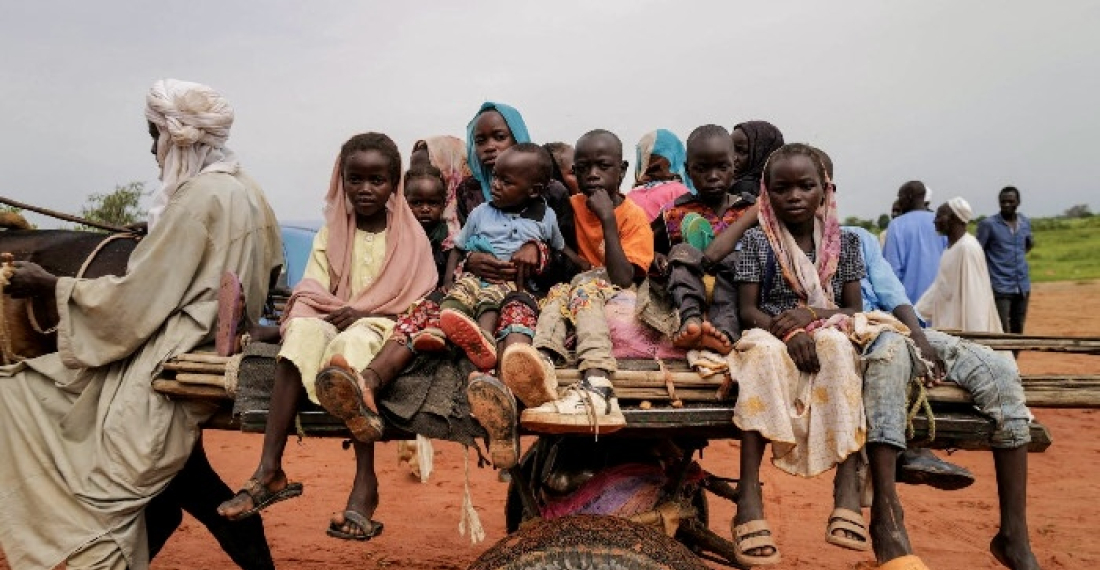
Sometimes a war becomes real not because of headlines, but because of a single image, a single voice, that breaks through the noise of a world that has stopped paying attention. For me, it was a video of a man speaking to a group of displaced Sudanese children. Their clothes were dusty, and their eyes bore the heavy confusion of children who have seen too much. He was trying to tell them about Palestine. “Pray for them,” he said. And the children nodded, soft and obedient, their own suffering left untouched in that moment, as though their lives demanded less urgency, less outrage, less prayer.
I don’t blame him. He meant well. He believed he was teaching empathy. But what I saw in that video was something deeper, something painful: a hierarchy of solidarity so deeply rooted that even the victims of one genocide were being asked to redirect their compassion toward another, more visible one. Those children, scared, starving, displaced, were being asked to care about a world that still does not know how to see them.
Sudan’s latest war began in April 2023, though the seeds of its violence were planted long before. The Sudanese Armed Forces and the Rapid Support Forces did not collide out of nowhere; they emerged from decades of political rot, unaddressed grievances, ethnic persecution, and military rule that carved deep fractures into the country’s social fabric. When fighting exploded across Khartoum and later consumed Darfur, Kordofan, and the east, it unleashed one of the worst humanitarian catastrophes of the 21st century.
Whole cities emptied. Markets burned. Families fled on foot. And a famine began tightening its grip, slow and suffocating. And yet, the world remained mostly silent.
To understand this silence, one must face an uncomfortable truth: not all suffering is granted equal legitimacy in the global imagination. Palestinians have long fought occupation with the support of vast diaspora networks and decades of global mobilisation. Their struggle resonates across continents. More and more people understand the violence inflicted on them, understand the structures behind it, and understand why solidarity is necessary.
But Sudanese suffering is treated differently. Sudanese death is too often framed as an unfortunate feature of the region, a tragedy that feels expected rather than outrageous. Even when evidence of atrocity is abundant, it fails to command the same emotional weight.
I think of a grandmother from Darfur who walked for two days through active fighting just to save four surviving children after her daughter and granddaughter were killed. I think of a mother who ran from West Darfur to Chad, carrying children past bodies abandoned on the road, saying she survived only because she moved faster than the killings. I think of families living on floors in displacement camps, drinking from shared taps, waiting for food that rarely comes. These are the stories that should have flooded our screens. Instead, they hover at the margins, present but not amplified.
When a fragile prospect for peace appeared in the form of RSF’s announcement that they would enter a three-month humanitarian truce, supposedly encouraged by President Donald Trump’s promise to push for an end to the war, it sparked a brief flicker of international attention. The Quad powers: the U.S., the UAE, Egypt, and Saudi Arabia, drafted a plan. Sudanese civilians allowed themselves to hope. And then the RSF launched drone strikes on army positions, shattering even that thin glimmer of possibility. But even this cycle of hope and betrayal barely made a ripple globally. There was no global anticipation, no collective concern, no widespread monitoring of every twist and turn. Even crucial moments in Sudan’s war failed to spark the same level of global engagement, empathy, or urgency seen in other conflicts. The world did not hold its breath for Sudan.
Palestine became legible to millions because people took the time to learn, study, and listen to Palestinian voices, even when algorithms did not automatically bring those voices to them. The clarity that exists today did not fall from the sky; it was built, painstakingly, by those who refused to accept simplified narratives. And so, the question becomes: why do we not extend the same effort to Sudan? Why do we not choose to understand?
Sudan’s crisis is often flattened into a story of one villain and one victim, but the reality is far more entangled. Both the SAF and the RSF have committed atrocities. External powers, including the UAE, Egypt, and others, are complicit, funnelling weapons and money that fuel mass death. This is not simply a proxy war or an occupation. It is a war in which the victims and perpetrators often share the same nationality, the same neighbourhoods, the same histories. Reducing it to a neat parallel with any other conflict does not clarify but obscures.
Sudan’s complexity is not a reason to look away. It is a reason to look closer, because behind every geopolitical layer, there are human beings who want what everyone wants: a life where their children can grow up without running from the sky; a home where they can sleep without listening for shooting; a future not defined by loss.
What Sudan needs now is not just humanitarian aid, although millions will starve without it. It needs a kind of solidarity that does not wait for algorithms or trending posts or convenient political framing. It needs the world to seek information, not stumble upon it. It needs people willing to understand its specific wounds; not only compare them to other struggles.
When I think of the grandmother who carried four children to safety, I do not think about geopolitics. I think about her feet, blistered from walking. Her back, aching under the weight of loss. Her hands, steady only because they had to be. I think about the smallest child she saved, recovering slowly in a clinic after nearly starving to death. I think about how easily his story could have disappeared without anyone outside Sudan knowing he existed at all.
This, more than anything else, is what compels me to be concerned, and to write: the unbearable possibility that these lives – lives filled with as much love, as much fear, as much beauty and hope as any other – might vanish into global silence.
The world must learn to see Sudan. Not because it mirrors another struggle. Not because it fits neatly into existing frameworks. But because its people are human, and their suffering is real, and their stories deserve space. If we believe in solidarity, we must refuse the hierarchies that dictate whose pain matters. If we believe in justice, we must extend our empathy beyond the conflicts we already understand. If we believe in humanity, then Sudan cannot remain unseen.
No child deserves to die unnoticed. No mother deserves to run alone.
No grandmother deserves to walk into a war hoping the world might one day care.
Sudan should not have to beg for visibility. It deserves it. Because its people deserve to live. And their lives deserve the same respect, safety, and hope that we demand for our own.
Source: Ioana-Maria Ungureanu is a Junior Research Assistant at LINKS Europe. She is currently finishing her studies at Leiden University, as a third-year psychology student aspiring to bridge the worlds of psychology and diplomacy, using humanitarian action as a path to meaningful global change.



