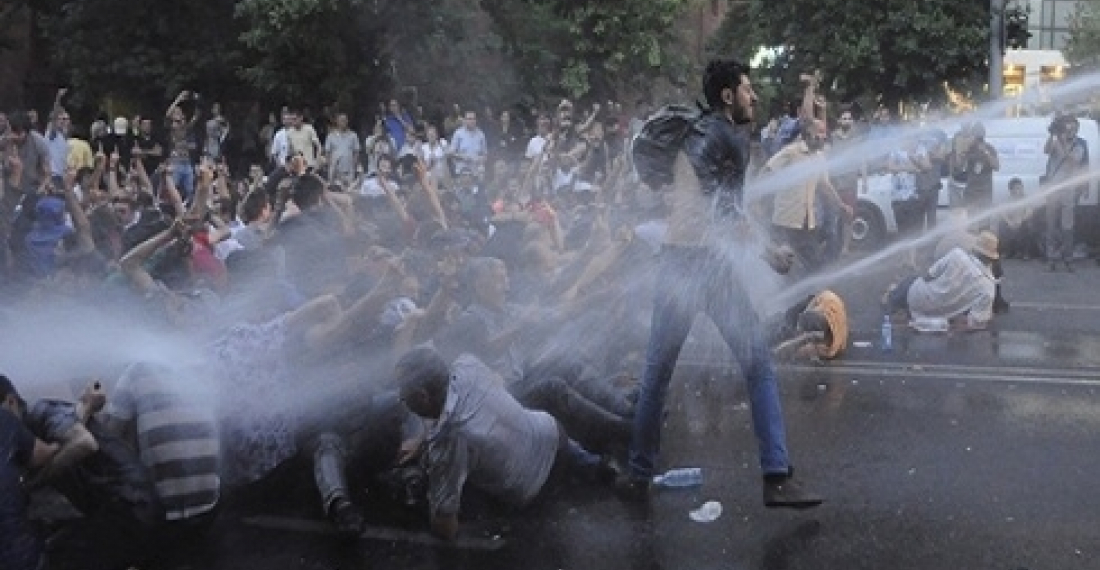
The Armenian capital Yerevan remains tense as demonstrators continue to protest against an increase in electricity rates. Early on Tuesday morning police used batons and water cannons to break up the protest and hundreds were arrested. The demonstrators have regrouped and have now been joined by opposition MPs and other personalities.
In the meantime there has been widespread condemnation of the excessive use of force by the police, and condemnation of the attacks against journalist who were covering the event.The Armenian police attacked or detained more than a dozen reporters and smashed or confiscated their cameras and film.
Johann Bihr, head of the Eastern Europe and Central Asia desk for Reporters Without Borders, also condemned "the police violence against journalists who were just doing their job in a law-abiding manner." He said that "the actions of the police must not be unpunished or else their violent behavior will recur and could become the norm. The policemen who attacked the journalists must be brought to justice."
A senior official from the Organization for Security and Cooperation in Europe was quick to express serious concern at what was the worst instance of state-sanctioned violence against Armenian journalists in years.
"I call on the authorities to promptly investigate these incidents and take steps to ensure restraint on the part of law enforcement representatives toward members of the media," Dunja Mijatovic, the OSCE representative on press freedom, said in a statement issued just hours after riot police broke up a protest against rising electricity prices.
The Armenian authorities did not signal, however, any intention to investigate security forces' treatment of journalists covering their crackdown.
Several journalists working for media outlets not controlled by the government were among more than 230 people that were arrested during the police operation. They all were released from custody in the following hours.
"They detained me on Baghramian Avenue after they were done beating up the protesters," said Mkrtich Karapetian, a correspondent for the "Haykakan Zhamanak" daily.
At least four other reporters, a correspondent for the independent TV station GALA and three cameramen of the 1in.am news service, were beaten up and seriously injured by law-enforcement officers mostly wearing plain clothes. The latter also smashed their digital video cameras or confiscated their memory cards containing dramatic images of the operation.
The violence against journalists appeared to be ordered by high-ranking security officials overseeing the crackdown. General Levon Yeranosian, the commander of Armenia's interior troops, swore at RFE/RL journalists Artur Papian and Sisak Gabrielian and cameraman Garik Azizbekian as they were attacked by his subordinates in the city's Liberty Square.
The officers broke the reporters' mobile phones and smashed a camera that was used for the live streaming of the overnight protests. Azizbekian was also forced to surrender the camera's memory card.
The police seemed particularly anxious to get hold of professional footage of the crowd dispersal. "They didn't let me go until they got hold of the chip," said Hayk Badalian of the Photolur photo news agency.
Hakob Karapetian, a correspondent for Ilur.am, said he was caught by policemen after he took pictures of Yeranosian personally snatching a camera from another reporter and hitting it to the ground. "They took me to the deputy chief of the national police, Hunan Poghosian, and Yeranosian," he wrote on Facebook. "Poghosian ordered to take the memory chip out of the camera and hand it to him. Yeranosian growled with swear words in the meantime."
The police denied any wrongdoing in a statement issued later in the day. The statement claimed that the journalists "consistently ignored legitimate police appeals to keep a reasonable distance from the site of the rally" and thereby "effectively became participants of the rally."
For its part, Armenia's Investigative Committee, another law-enforcement body, made clear that it will not launch criminal proceedings in connection with the police violence against the journalists.
source: Commonspace.eu with Radio Liberty
photo: courtesy of RT