


War of words between Armenia and Azerbaijan intensifies. Recent visit of Minsk Group diplomats to the region fails to tone down the rhetoric.

The recent visit of the representatives of the three co-Chair countries of the OSCE Minsk Process to the South Caucasus has triggered another sharp exchange of words between Armenia and Azerbaijan on the state of relations between them, and the status of the negotiations on the Nagorno-Karabakh conflict.

The diplomats from the United States, France and Russia traveled to the region November 19 to 26 "to continue their efforts to assist the parties in finding a peaceful solution to the Nagorno-Karabakh conflict", according to an OSCE press release.

In Yerevan, they met on November 23 with President Sargsian and Foreign Minister Nalbandian, and in Baku, on November 26, they met with President Aliyev and Foreign Minister Mammadyarov. In Nagorno-Karabakh on November 21-22 they met with de facto authorities. In traveling to Nagorno-Karabakh on November 21, the Co-Chairs visited Zangilan and Jabrail regions to assess developments in those territories since their last visit in October 2010.

The OSCE statement says that the diplomats "reviewed with Presidents Sargsian and Aliyev the results of the separate meetings they held with Foreign Ministers Nalbandian and Mammadyarov in August and September, and discussed the ideas on the continuation of the peace process that they had presented to the Ministers in their joint meeting on October 27. The sides agreed to carry out further work on the level of the Foreign Ministers."

The visit triggered a series of sharp comments by senior officials in both Armenia and Azerbaijan as both sides blamed each other for lack of progress in the negotiations.

In Yerevan Armenian Foreign Minister Edward Nalbandian referred "to the provocative statements continually made by the Azerbaijani high-level leadership and mentioned that although those statements are for the internal use, they seriously harm the negotiations and escalate the situation in the region", according to a statement on the Ministry's website. Earlier, Nalbandian's deputy, Shavarsh Kocharian, in an interview with Reuteurs, accused Azerbaijan of racist ideology, .... unbridled distortion of history and ridiculous territorial claims towards the neighboring states".

By the time the OSCE Minsk Group diplomats arrived in Baku it was the turn of the Azerbaijanis to have a go. The Azerbaijani Foreign Minister, Elmar Mammadyarov, noted with regret that the recent visit to Yerevan did not give a reason to speak in positive tones, according to news.az. "Armenia should abandon the principle of no piece of land, not a step back", he said.

Mammadyarov said that the status quo should be changed, because the unresolved conflict "can lead to development of events in an undesirable way."

Weighing in later, the Head of the Foreign Relations Department of the Azerbaijani Presidential Administration Novruz Mammadov told journalists on Tuesday: "Our position is that the Armenian side should not seek delays of the negotiations by periodically finding excuses. Our requirements for the co-chairs and desire are not to delay the solution to this conflict. They have been conducting negotiations for many years in this regard, and these talks have not yielded any real results," Mammadov noted.

Trend News Agency reported that Mammadov told journalists in Baku that it is impossible for the conflict to remain unsolved. "Azerbaijani occupied territories must be liberated. If this happens, then the future fate of Armenia as a state, and the future of the Armenian people can get a guarantee to a definite sense. If the situation remains unchanged, the future of Armenian state and the Armenian people will be indefinite," he said.

Speaking about possible new initiatives from the OSCE Minsk Group, Mammadov referred to the "Madrid principles", stating that "Within these principles, it is necessary to achieve a constructive solution to the conflict, instead of looking for excuses. In this regard, Armenian leadership must demonstrate its will. One cannot hold the fate of this nation and this country as hostages. The Armenian leadership, by sacrificing fate of the Armenian people and the state, finds certain excuses and prolongs the negotiation process in an effort to stay in power longer. It is their tragedy."

Commonspace.eu political editor said in a comment: "It is clear that the differences between the sides are not narrowing. The OSCE Minsk Group co-Chair countries had hoped that their visit to the region could pave the way for a meeting between the Armenian and Azerbaijani foreign ministers and their own foreign ministers in Dublin next week, in the framework of the OSCE annual Ministerial Meeting. This now looks unlikely. There is a poisoned atmosphere at the moment around the negotiations and unless this is defused it is difficult to imagine meaningful peace negotiations restarting."

source: commonspace.eu with various media outlets

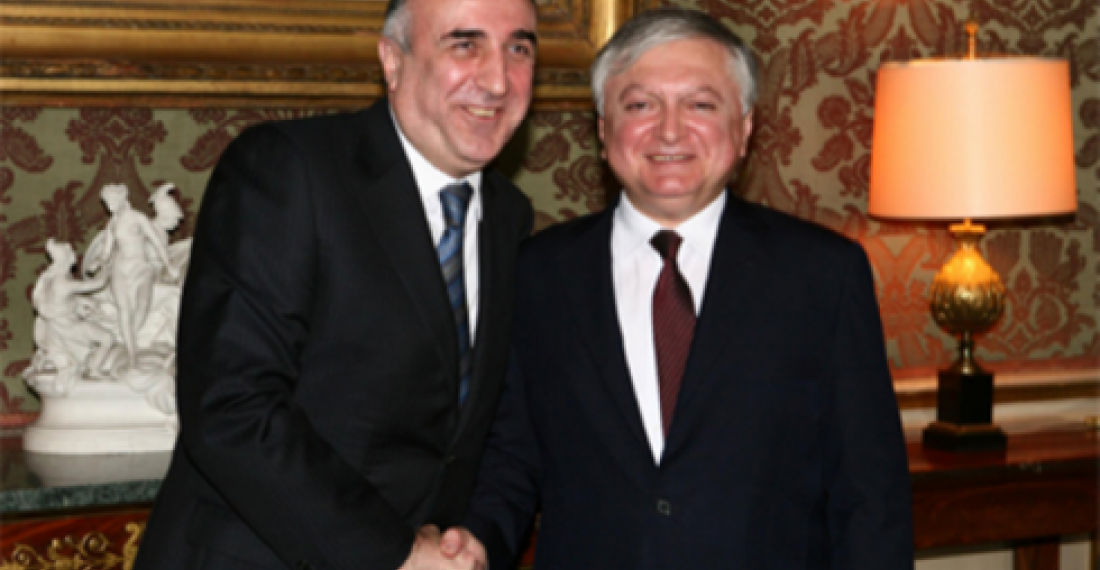
photo: The Foreign Ministers of Azerbaijan and Armenia in Paris on 18 June 2012. (picture courtesy of the French Foreign Ministry).
Related articles

Editor's choice
News
Israeli parliament votes to bring back the death penalty, but only for Palestinians

Israeli parliament votes to bring back the death penalty, but only for Palestinians

srael’s parliament approved a bill on Monday that would allow the execution of Palestinians convicted on terror charges for deadly attacks, a move that has been criticized as discriminatory and immediately drew a court challenge. Sixty-two lawmakers, including Prime Minister Benjamin Netanyahu, voted in favor and 48 against the bill, championed by far-right National Security Minister Itamar Ben Gvir. There was one abstention and the rest of the lawmakers were not present. Ben Gvir in the run-up to the vote had worn a lapel pin in the shape of a noose, symbolising his support for the legislation. “We made history!!! We promised. We delivered,” he posted on X after the vote. The bill would make the death penalty the default punishment for Palestinians in the Israeli-occupied West Bank found guilty of intentionally carrying out deadly attacks deemed “acts of terrorism” by an Israeli military court. The bill says that the sentence may be reduced to life imprisonment under “special circumstances.” Palestinians in the West Bank are automatically tried in Israeli military courts. Meanwhile, under the bill, in Israeli criminal courts anyone “who intentionally causes the death of a person with the aim of harming an Israeli citizen or resident out of an intention to put an end to the existence of the State of Israel shall be sentenced to death or life imprisonment.” Criminal courts try Israeli nationals, including Palestinian citizens and residents of east Jerusalem. The bill sets the execution method as hanging, adding that it should be carried out within 90 days of the sentencing, with a possible postponement of up to 180 days. - ‘Parallel tracks’ - The bill appears to conflict with Israel’s Basic Laws, which prohibit arbitrary discrimination, and shortly after it was passed, a leading human rights group announced that it had filed a petition with the Supreme Court demanding the legislation’s annulment. “The law creates two parallel tracks, both designed to apply to Palestinians,” the Association for Civil Rights in Israel said in a statement. “In military courts — which have jurisdiction over West Bank Palestinians — it establishes a near-mandatory death sentence,” the rights group said. In civilian courts, the law’s stipulation that defendants must have acted “with the aim of negating the existence” of Israel “structurally excludes Jewish perpetrators,” the group added. The association argued the law should be annulled on both jurisdictional and constitutional grounds. During the debate in parliament, opposition lawmaker and former deputy Mossad director, Ram Ben Barak, expressed outrage at the legislation. “Do you understand what it means that there is one law for Arabs in Judea and Samaria, and a different law for the general public for which the State of Israel is responsible?” he asked fellow parliamentarians, using the Israeli name for the West Bank. “It says that Hamas has defeated us. It has defeated us because we have lost all our values.” - ‘Discriminatory application’ - Lawmaker Limor Son Har-Melech from Ben Gvir’s party, who years ago survived an attack by Palestinian militants in which her husband was killed, urged fellow parliamentarians to approve the bill. “For years, we endured a cruel cycle of terror, imprisonment, release in reckless deals, and the return of these human monsters to murder Jews again ... And today, my friends, this cycle has come full circle.” The Palestinian Authority condemned the law’s adoption, saying that “Israel has no sovereignty over Palestinian land.” “This law once again reveals the nature of the Israeli colonial system, which seeks to legitimize extrajudicial killing under legislative cover,” it added. In February, Amnesty International had urged Israeli lawmakers to reject the legislation, citing its “discriminatory application against Palestinians.” On Sunday, Britain, France, Germany and Italy expressed “deep concern” over the bill, which they said risked “undermining Israel’s commitments with regards to democratic principles.” While the death penalty exists for a small number of crimes in Israel, it has become a de facto abolitionist country — the Nazi Holocaust perpetrator Adolf Eichmann was the last person to be executed in 1962. Israel has occupied the West Bank since 1967 and violence there has soared since Hamas’s October 7, 2023 attack on Israel triggered the Gaza war. (read more by clicking the image above).

Popular

Editor's choice
Interview
Thursday Interview: Murad Muradov

Thursday Interview: Murad Muradov

Today, commonspace.eu starts a new regular weekly series. THURSDAY INTERVIEW, conducted by Lauri Nikulainen, will host  persons who are thinkers, opinion shapers, and implementors in their countries and spheres. We start the series with an interview with Murad Muradov, a leading person in Azerbaijan's think tank community. He is also the first co-chair of the Action Committee for a new Armenian-Azerbaijani Dialogue. Last September he made history by being the first Azerbaijani civil society activist to visit Armenia after the 44 day war, and the start of the peace process. Speaking about this visit Murad Muradov said: "My experience was largely positive. My negative expectations luckily didn’t play out. The discussions were respectful, the panel format bringing together experts from Armenia, Azerbaijan, and Turkey was particularly valuable during the NATO Rose-Roth Seminar in Yerevan, and media coverage, while varied in tone, remained largely constructive. Some media outlets though attempted to represent me as more of a government mouthpiece than an independent expert, which was totally misleading.  Overall, I see these initiatives as important steps in rebuilding trust and normalising professional engagement. The fact that soon a larger Azerbaijani civil society visits to Armenia followed, reinforces the sense that this process is moving in the right direction." (click the image to read the interview in full)

