As part of its long-standing commitment to promote dialogue and better understanding among the people of the South Caucasus, commonspace.eu continues to offer a platform for Armenian and Azerbaijani thinkers, activists and opinion shapers to present their perspectives on the Karabakh conflict and its resolution.
In this article, Benyamin Poghosyan gives an Armenian perspective on the outcome of the present hostilities, exploring four possible scenarios
Views and opinions expressed are those of the author, and not necessarily those of commonspace.eu or its partners.
The new war launched by Azerbaijan on September 27 has already brought about numerous policy papers and op-eds on the reasons for it, its timing, and the role and interests of external powers involved in the South Caucasus. Definitely, answers to these questions are important, especially for better understanding the geopolitical context of the war. However, as war enters its fifth week with no apparent sign of a quick end, the most immediate questions faced by experts are not the reasons for the war, but how to end it and its likely outcome. A number of scenarios are possible.
The most unlikely scenario - full victory of Azerbaijan
A full victory for Azerbaijan would entail the establishment of its control over the whole territory of Nagorno Karabakh Republic, including its capital Stepanakert. This scenario is quite unrealistic for several key reasons. First of all its human factor. While some parts of Nagorno Karabakh Republic, especially along the Araks River, were sparsely populated, the territories around the main cities in Karabakh - Stepanakert, Martakert, Askeran, Martuni and Berdzor, are densely populated by local Armenians, who, along with the regular army, will fiercely defend their homes and lands.
The second significant factor is geopolitics. Regardless of how anyone assesses the Russian position prior and during the war, it is clear that complete victory of Azerbaijan goes against core Russian interests in the region. Despite all discussions that Russian security obligations are valid only towards Armenia, defeat of Armenians in Karabakh will send an unequivocal signal to all that Turkey has replaced Russia in the South Caucasus as the key actor. Evidently, the Kremlin will do everything to prevent such developments and has plenty of options here - from increasing arms supplies to Armenia and deploying private military companies, to putting economic pressure on Azerbaijan and pressing Turkey in other battlefields such as Syria and Libya.
Iran's approach here is not clear too. Tehran is happy to see a more independent Turkey under President Erdogan, who is not ready to implement all whims of the US in the region. However, the excessive growth of Turkish influence in the South Caucasus and its full control over Azerbaijan should concern Iran given the existence of 20 million Azeri speaking people along the Azerbaijan - Iran border.
The third factor is geography. Unlike territories along the Araks River which are mainly flatlands, terrain changes significantly in other regions of Karabakh, where it is more mountainous - thus more difficult for tanks, artillery and multiple rocket launch systems to work effectively, and easier for defenders to repel attacks.
Unlikely scenario - return to negotiations and the signing of a deal
The last sixteen years of negotiations have been based on the phased approach solution enshrined in the famous "Basic principles". There were several documents elaborated and presented in this period - "Kazan document", "Lavrov plan" and probably others. However, all of them have common features - return to Azerbaijan of five regions, interim status for Karabakh, security guarantees and deployment of peacekeepers and a legally binding expression of will, sometime in an unspecified future, to determine the final status of Karabakh along with the return of other two regions except for a land corridor connecting Karabakh with Armenia.
These ideas were rejected by Azerbaijan in 2011 and by Armenia and Azerbaijan since the April 2016 four day war. Thus in recent years they have been instruments not for conflict settlement but for conflict management and prevention of war. However, the new Karabakh war has deprived these ideas from any meaning which they may had before. As of today, Azerbaijan has achieved some successes in the battlefield, especially in the South, and will not sign any deal which envisages return of five regions. Most probably, Baku will demand the return of at least six regions and relocation of Azerbaijanis to Shushi.
As for Armenia and Nagorno Karabakh Republic, even before the war any deal which envisaged the return of any territories without fixing the status of Karabakh was highly unpopular. War will harden perceptions among society even more. Even if Azerbaijan agrees to the Kazan document of June 2011, which itself is highly unlikely, any Armenian leader signing such a deal will be immediately forced to resign. Even If anyone signs that deal and resigns, the new forces which will replace him after snap parliamentary elections most probably will refuse to implement the agreement.
A possible option could be to change the logic of negotiations from phased approach solution to package deal, which will include the recognition of Nagorno Karabakh Republic independence or unification with Armenia with secure land corridor and giving other territories to Azerbaijan. However, no Azerbaijani leader will sign such a deal in the foreseeable future.
Likely scenario - back to April 6, 2016
Given the many factors, which prevent Azerbaijan from achieving complete victory and continuing its advance, and the lack of resources that prevent Armenia and Nagorno Karabakh Republic to quickly organize a large scale counter attack and restore the September 26 line of contact, the sides may soon reach an agreement for a ceasefire along the new line of contact. As no agreement is possible, the sides will return back to the situation of April 6, 2016. Negotiations may continue within OSCE Minsk Group, but they will yield no results. The positive sign will be the actual halt of hostilities with only sporadic sniper fire and subversive actions akin to the situation during August 2014-March 2016 and May 2016-August 2020. In the meantime all sides will prepare for the resumption of hostilities which may happen in spring 2021, or much later, depending on development in relations between Russia and Turkey, as well as the results of the November Presidential elections in the US.
Most likely scenario - Road towards Idlib
As conventional wisdom tells us, all wars end, and the new Karabakh war will end also. However, no agreement is feasible and there are growing signs of a Russia-Turkey indirect clash here. We may guess that at least theoretically, the Russia-Turkey clash and the creation of another Donbass-like situation in the Russian neighborhood should be in line with the US strategic interests too.
Meanwhile, other regional adversaries of Turkey, such as UAE, Egypt, and probably France, may be interested to teach President Erdogan a good lesson, defeating him in the South Caucasus. If we add this to the intractable nature of Karabakh conflict and the diametrically opposite views of the conflict sides about the reasons of the conflict as well as ways of its settlement, the odds are quite high that despite a possible agreement on a ceasefire, Nagorno Karabakh will slowly be transformed into another proxy war between Turkey and Russia, with the tacit involvement of the US, UAE and others. In this case, we will witness a long period of low intensity conflict and no return to the relative calm years of May 1994-March 2016 and May 2016-August 2020. Intensity of the conflict will be less than during April four day war of 2016, but more than during other periods.
source: Benyamin Poghosyan is the Founder and Chairman of the Center for Political and Economic Strategic Studies in Yerevan
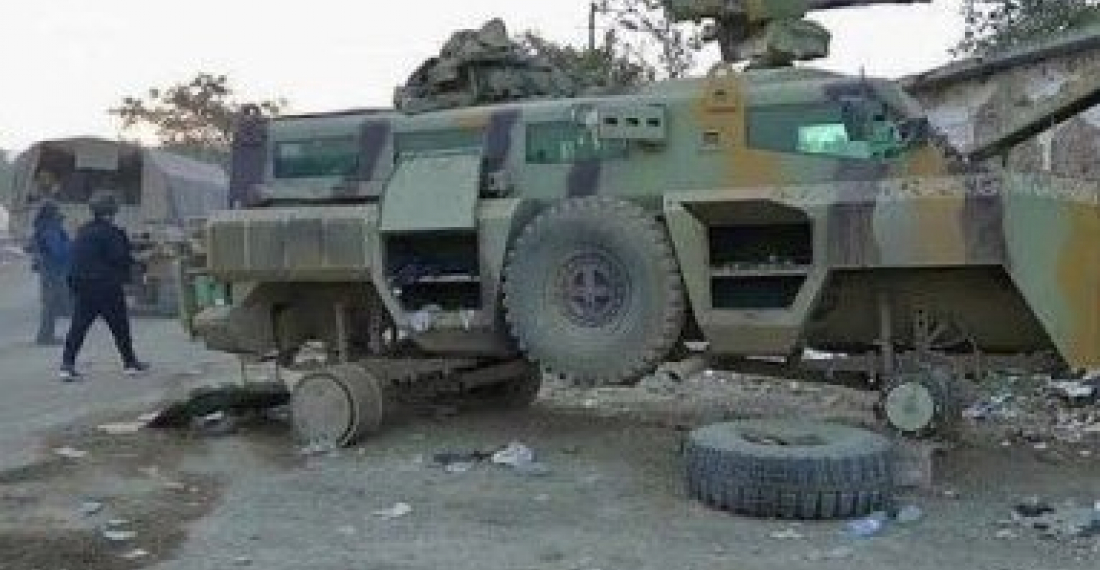
photo: A disused tank in the Nagorno-Karabakh conflict zone
The views expressed in opinion pieces and commentaries do not necessarily reflect the position of commonspace.eu or its partners