


The stand-off at Erebuni presents a dilemma for the Armenian government

This is a commentary prepared by the political editor of commonspace.eu

On Sunday, 17 July, as the world was still digesting the implications of the failed military coup attempt in Turkey, a small group of armed men entered a police station in the district of Erebuni in Armenia's capital Yerevan, killing one police officer, wounding several others and taking hostages. The group claimed to represent a small opposition group whose leader has been imprisoned for a while.

The government at first dismissed the incident as a mere criminal act, but soon it became apparent that the matter was more complicated. Police started a round-up of opposition activists, there were reports that social media was being restricted, and by the evening it became clear that the armed men in the police station had many sympathisers in wider society. Some media outlets that are usually critical of the government described them as war veterans, and others whilst criticising their methods expressed sympathy with their "cause", even though there was some confusion as to quite what this "cause" is. There were suggestions that the group was protesting against any possible deal on Nagorno-Karabakh that would see Armenia returning land it occupied during the war with Azerbaijan in the 1990s. Certainly this point of view has many supporters in Armenia, and among Armenians beyond. The group is also reported to be calling for the resignation of the President, Serzh Sargsyan. Armenian political analyst Mikhail Zolyan, speaking on CivilNet described the current situation as "dangerous and unprecedented in post-Soviet Armenia, having exposed how little the government in Armenia is trusted".

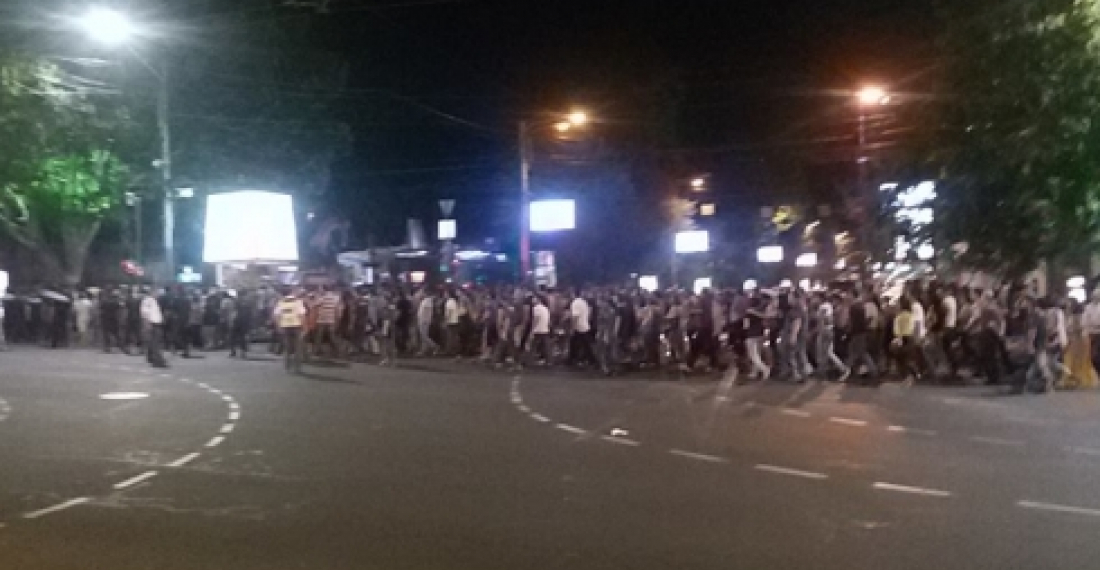
There has been criticism of the government for over reacting in the hours after the incident at the police station and for arresting people unconnected with the event. Some Armenians have now taken to the streets to protest about these detentions. So far the numbers are not critical - dozens of protestors rather than thousands.

The government has by and large been silent on the events, treating it as a law and order matter, but clearly it has wider political implications. There is now an increasing demand in Armenian society for the stand-off at the police station to finish peacefully and without further bloodshed. This means that the storming of the police station by government forces, an option that has been available to the government right from the start, is becoming increasingly unlikely - though it may still happen. The armed group has released some of the hostages they were holding, but claim to remain adamant in their demands. Having already killed one person the government cannot be seen allowing the perpetrators to go free. It seems that equally the government is wary of turning them into martyrs.

The incident, the government's reaction, and the peculiar public sympathy for this brazen act of violence are symptomatic of a more deeper problem. Armenian politics are stagnant, and have been for some years. Both the government and the mainstream opposition have by and large failed to inspire, and there is an increasing sense of frustration, especially among the youth. In recent years some groups, rallying around single issues, have emerged, often taking to the streets to make their voices heard. Usually these protests evaporated soon after.

Nagorno-Karabakh, and the possibility of progress in the negotiations which may require the Armenian government making serious concessions, is one issue that can turn isolated protests into a critical mass. As in Azerbaijan, so in Armenia, the government has failed to prepare society for an eventual peace based on compromise.

Within days, perhaps within hours the stand-off at Erebuni police station will come to an end, one way or the other.  The implications are however likely to linger for some time.

source: This is a commentary prepared by the political editor of commonspace.eu

photo: Dozens of Armenians protesting on Mashot street in yerevan on the evening of Monday, 18 July. (picture courtesy of CivilNet)
 

Related articles

Editor's choice
News
Borrell tells the European Parliament that the situation in Afghanistan was critical, but the EU will remain engaged

Borrell tells the European Parliament that the situation in Afghanistan was critical, but the EU will remain engaged

Borrell underlined that the European Union will make every effort to support the peace process and to remain a committed partner to the Afghan people. "Of course, we will have to take into account the evolving situation, but disengagement is not an option.  We are clear on that: there is no alternative to a negotiated political settlement, through inclusive peace talks.
Editor's choice
News
Germany accuses Russia of cyberattacks and disinformation campaign

Germany accuses Russia of cyberattacks and disinformation campaign

The German government holds Russia responsible for a cyberattack on German air traffic control, and for targeted disinformation campaigns before the last federal election. According to the German Foreign Office in Berlin, the incidents could be clearly attributed to the Russian military intelligence service, the GRU. In response, the Russian ambassador to Berlin was summoned to the Foreign Ministry. "We have been observing a massive increase in threatening hybrid activities by Russia for some time now," a spokesperson for the Foreign Ministry stated. These range from disinformation campaigns and espionage to cyberattacks and sabotage attempts. The aim is to divide society, sow distrust, and undermine confidence in democratic institutions. The spokesperson added that with these actions, Russia is "very concretely threatening our security, not only through its war of aggression against Ukraine, but also here in Germany."  The Foreign Ministry spokesperson explained that the cyberattack on air traffic control in August 2024 was clearly attributed to the hacker collective "APT28," known as "Fancy Bear," and to the responsibility of the Russian military intelligence service, the GRU. Furthermore, it could now be "conclusively stated" that Russia had attempted "to influence and destabilize both the last Federal election and the ongoing internal affairs of the Federal Republic of Germany." There was "absolutely irrefutable evidence" for this". The so-called "Storm 1516" campaign, which has been running since 2024, is allegedly backed by "reliable information" that the Moscow-based think tank "Center for Geopolitical Expertise" is behind it. The Center is also said to be supported by Russian military intelligence. Its primary aim is to influence democratic elections in the West. (Click the image to read more).

Popular

Editor's choice
News
Germany accuses Russia of cyberattacks and disinformation campaign

Germany accuses Russia of cyberattacks and disinformation campaign

The German government holds Russia responsible for a cyberattack on German air traffic control, and for targeted disinformation campaigns before the last federal election. According to the German Foreign Office in Berlin, the incidents could be clearly attributed to the Russian military intelligence service, the GRU. In response, the Russian ambassador to Berlin was summoned to the Foreign Ministry. "We have been observing a massive increase in threatening hybrid activities by Russia for some time now," a spokesperson for the Foreign Ministry stated. These range from disinformation campaigns and espionage to cyberattacks and sabotage attempts. The aim is to divide society, sow distrust, and undermine confidence in democratic institutions. The spokesperson added that with these actions, Russia is "very concretely threatening our security, not only through its war of aggression against Ukraine, but also here in Germany."  The Foreign Ministry spokesperson explained that the cyberattack on air traffic control in August 2024 was clearly attributed to the hacker collective "APT28," known as "Fancy Bear," and to the responsibility of the Russian military intelligence service, the GRU. Furthermore, it could now be "conclusively stated" that Russia had attempted "to influence and destabilize both the last Federal election and the ongoing internal affairs of the Federal Republic of Germany." There was "absolutely irrefutable evidence" for this". The so-called "Storm 1516" campaign, which has been running since 2024, is allegedly backed by "reliable information" that the Moscow-based think tank "Center for Geopolitical Expertise" is behind it. The Center is also said to be supported by Russian military intelligence. Its primary aim is to influence democratic elections in the West. (Click the image to read more).

