This is a commentary prepared by the political editor of commonspace.eu
The return on Sunday to Nagorno-Karabakh of war-lord cum war hero, General Samuel Babayan, is probably the most important political development in the territory in the last decade.
Babayan, who was one of the leaders of the military campaign fought against Azerbaijani in the early 1990s, subsequently became Minister of Defence of the self-declared Nagorno-Karabakh Republic (NKR), and for several years held huge power in the territory. He was fired from the post by NKR president Arkadi Ghoukasian, and was subsequently accused of being behind a car bomb that nearly killed the president. He was arrested in 2000 and subsequently sentenced to 14 years in prison. He was set free in 2004 and lived in Yerevan until moving to Moscow in 2011 where he has been living in self-imposed exile.
Babayan's return to Nagorno-Karabakh is a direct challenge not only to the current leadership in the self-declared republic, but also to the Armenian president Serzh Sargsyan, and there is speculation that Babayan may be joining political forces that aim to unseat Sargsyan.
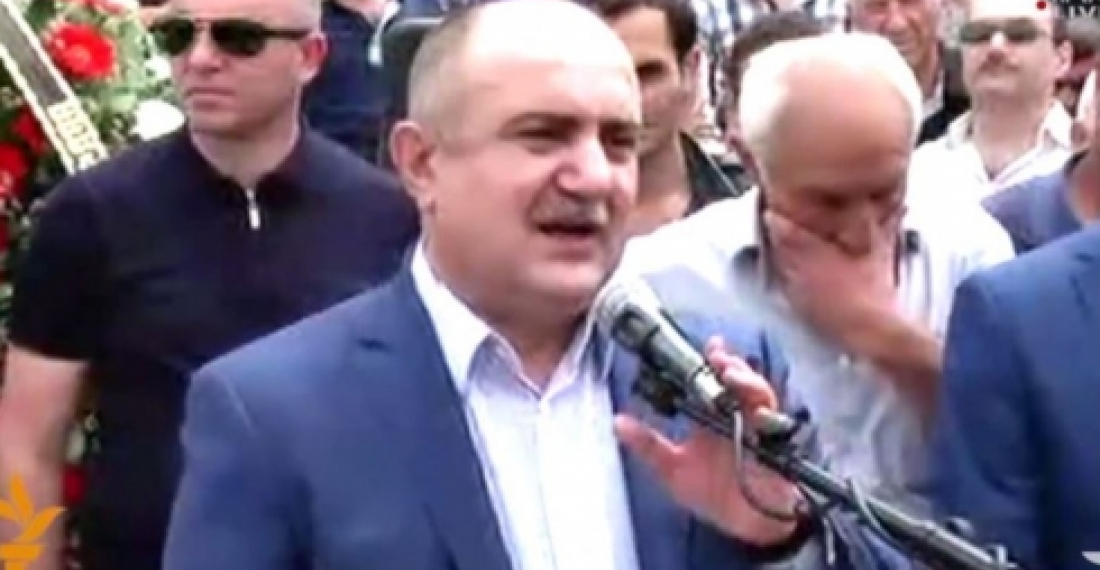
Radio Liberty's Armenian service reported from Stepanakert that on his return on Sunday 'the hardline general was greeted by about a thousand people when he laid flowers at a Stepanakert memorial to Karabakh Armenians killed during the 1991-1994 war with Azerbaijan. The crowd, quite large by Karabakh standards, then escorted him to his old apartment, applauding and chanting "Samvel!" The impromptu procession blocked traffic through major streets in the Karabakh capital. "I will do everything in my power to ensure that your security is properly protected," Babayan told the supporters at the war memorial. But he did not clarify how he will do that, again insisting that he has no political ambitions.'
Radio Liberty further reported that 'Speaking to journalists, Babayan said he is ready to hold "discussions" with Karabakh's political and military leaders. But he stressed that no meetings with them have been scheduled yet.'
Babayan's return is far from universally welcome however. Armenia's leading blogger and political analyst Richard Giragosian wrote on his facebook page,
"After a record of corruption and a reputation for authoritarian abuse of power, the return from disgrace and an end to self-imposed exile in Moscow exile affirms that the return of this "warlord" to Karabakh is an ominous sign of the mounting degree of distress within Karabakh".
The population of Nagorno-Karabakh was rattled in April when the territory seemed to be under threat for the first time in decades as a result of an escalation in the fighting on the line of contact separating Armenian and Azerbaijani forces. Political leaders of Armenia and Nagorno-Karabakh had long assured the population that they had the situation on the line of contact under control. But it subsequently emerged that an influx of new armaments from Russia and Israel had given the Azerbaijani forces an opportunity to inflict serious damage on their Armenian opponents. Some small amount of territory was lost to Azerbaijan during the fighting in April, but more seriously the Armenian claim of military superiority and invincibility was broken. Amid ongoing soul-searching in the Armenian military, which has already resulted in the dismissal of a number of senior generals, Babayan has added insult to injury by warning against complacency and saying that this may lead to the Azerbaijanis ending up drinking coffee in Yerevan.
Babayan may lack the necessary huge popular support, and more importantly support within the Armenian military elite, to present an existential challenge to the current leadership in Yerevan, and its allies in Stepanakert. But his presence and his vocal outbursts at an awkward time for President Sargsyan will not be welcomed. The Armenian political scene, and by extension that in Nagorno-Karabakh, is already under considerable pressure. Babayan's presence will most certainly add some more.
Source: This commentary was prepared by the political editor of commonspace.eu.
Photo: Samuel Babayan addressing supporters in Stepanakert on Sunday, 5 May 2016 following his return from self-imposed exile in Moscow. (picture courtesy of RFE/RL).