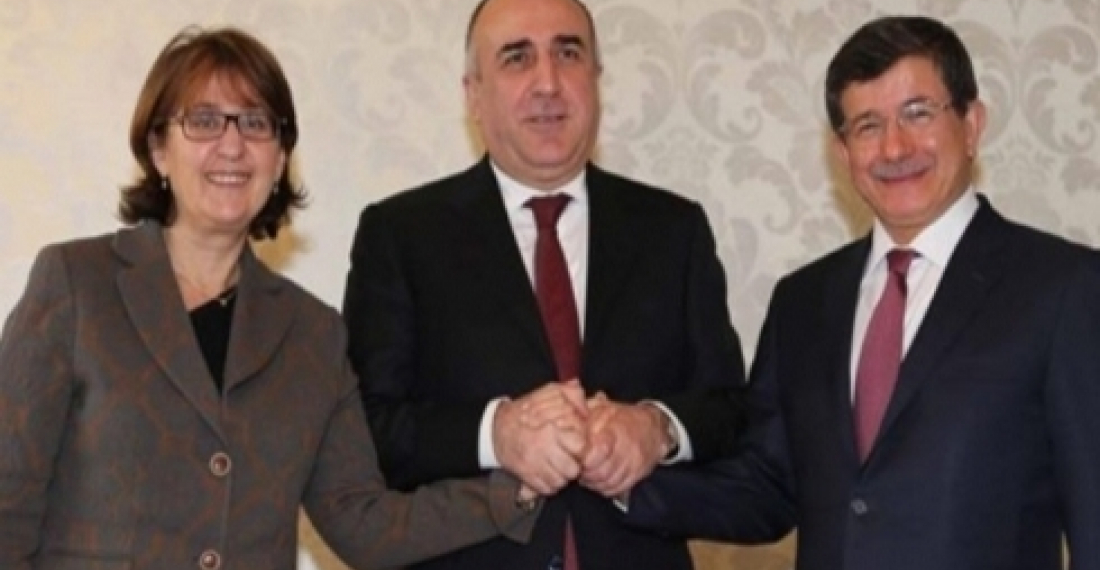
The third trilateral meeting of the Ministers of Foreign Affairs of Turkey, Azerbaijan and Georgia was held in Ganja, Azerbaijan on 19 February 2014.
Ahmet Davutoğlu, Minister of Foreign Affairs of Turkey, Elmar Memmedyarov, Minister of Foreign Affairs of Azerbaijan and Maia Panjikidze, Minister of Foreign Affairs of Georgia, discussed ways of developing regional cooperation.
The "Ganja Statement" which was signed at the end of the meeting reiterated the three countries support to each others' sovereignty and territorial integrity, and underlined the importance of an early peaceful settlement of the conflicts in Nagorno-Karabakh, as well as in Abkhazia and South Ossetia, on the basis of respect for the sovereignty, territorial integrity and inviolability of internationally recognized borders of states, as well as relevant resolutions and decisions of the United Nations, OSCE and Council of Europe. Furthermore, the Foreign Ministers highlighted the importance of the successful implementation of large-scale energy projects, such as Baku-Tbilisi-Ceyhan oil pipeline and the Baku-Tbilisi-Erzurum gas pipeline, and the earliest completion of the construction of the Baku-Tbilisi-Kars Railway.
In the meeting it was also announced that the first summit of the Presidents of the three countries will be held in Georgia later this year.
Asked about the prospect of opening of the border between Turkey and Armenia, Turkish Foreign Minister Davutoğlu said that "full normalisation of relations between Turkey and Armenia will not be possible as long as Armenian occupation of Nagorno-Karabakh continues".
Commonspace.eu political editor said in a comment that relations between Turkey, Georgia and Azerbaijan are now developing in all spheres, and are proving beneficial to all three. The leaders of the three countries are also fully committed to this process and are putting the time and effort for their success. The Ganja meeting was a good example of this. This regional relationship is underpinned by major joint infrastructural projects, initially supporting the energy sector, but which are now expanding in other spheres too. In this relationship the role of Georgia is pivitol, since it provides the physical link between Azerbaijan and Turkey. For Georgia the relationship has some complications since the Georgian government does not want to be seen ganging up with two Turkic nations against Armenia. For Georgia however the benefit is to big too be missed. There is also a feeling that the Armenian government has in the past been clumsy in the way it has approached regional issues, and it is now paying the price for this. Regional co--operation in the Caucasus will not be complete without Armenia, but this remains a far away prospect. Like many other issues in the region it depends on a solution to the Karabakh conflict and there is no expectation that this will happen soon.
source: commonspace.eu with agencies
photo: The Foreign Ministers of Turkey, Georgia and Azerbaijan at their meeting in Ganja on 18 February 2014. (picture courtesy of the Turkish Foreign Ministry.)