Region

South Caucasus

The South Caucasus – a region encompassing Armenia, Azerbaijan and Georgia - is one of strategic importance, not only for adjacent countries, such as Turkiye, Russia, Iran and the Central Asian states, but also for neighbours such as the European Union and the GCC states, and globally for the United States, India, China, Pakistan and Japan.

commonspace.eu team brings decades of experience of working in the South Caucasus and we are pleased to share our insights with our loyal readers through the website, and the sister newsletter, Caucasus Concise.

Editor's choice
Opinion
Opinion: A sustainable peace requires consistent long-term European involvement

Opinion: A sustainable peace requires consistent long-term European involvement

There is no denying that the EU, especially key member states acting in support, helped bring Baku and Yerevan closer to the Washington Declaration of August 8, 2025. But a declaration is not a treaty. Turning principles into a peace deal and eventually to a sustainable peace requires consistent long-term European involvement, writes Yalchin Mammadov in this-op-ed for commonspace.eu Before facilitating trust between Armenia and Azerbaijan, the EU is first expected to address its own credibility gap with Baku. A more balanced approach—such as including Azerbaijan, alongside Armenia, in the European Peace Facility—could be a useful first step. Diplomats can negotiate peace; societies must build peace. In this context, the EU can do what it does the best: long-term societal engagement. By expanding youth and academic exchange programmes, investing in cross-border civil society initiatives, and fostering people-to-people cooperation, Brussels can help shape a new generation equipped to sustain peace beyond political cycles. Such tools are slow and unglamorous, but if ignored, even the strongest treaty risks collapse. And obviously, these aspects require two-way engagement and genuine willingness by both governments to facilitate contact. If Brussels wants to remain influential, it needs to replace outdated one-size-fits-all policies with ambitious, interest-driven and differentiated approaches. Without a clear regional strategy, which appears to be the current situation, the South Caucasus will continue to sit at the margins of Europe’s security architecture—leaving space for other powers to take the lead. (You can read the op-ed in full by clicking the image.)
Editor's choice
Event
LFSC25: Yerevan meeting focuses on issues of landmines and remnants of war in Armenia and the South Caucasus

LFSC25: Yerevan meeting focuses on issues of landmines and remnants of war in Armenia and the South Caucasus

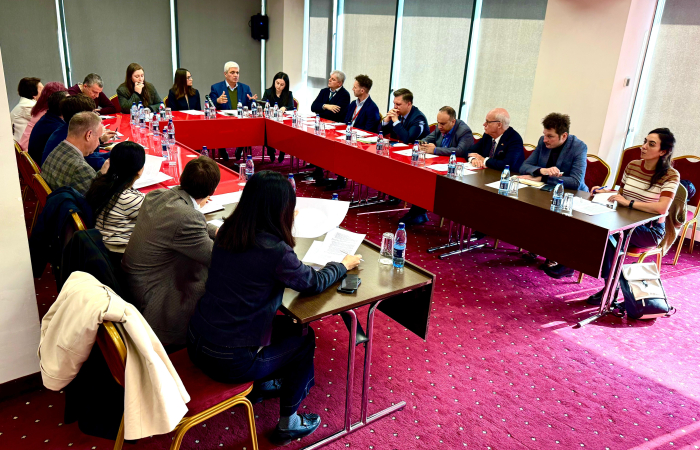
The meeting titled “The residue of conflict: Landmines and other remnants of war in the South Caucasus, and its victims” was held in Yerevan, Armenia, on Monday, 24 November 2025, in the framework of the 2025 regional campaign "Landmine Free South Caucasus" (LFSC25). Addressing the meeting, Mr Stepan Grigoryan, Chairman of the Armenian Analytical Center on Globalisation and Regional Cooperation, emphasized that the problem of landmines is mutual, and it exists in both Armenia and Azerbaijan. He argued that it is important in the peace process to address the humanitarian issues caused by landmines. In addition, he also stressed that it is important for experts to have conversations on the topic of demining, as often it is experts who begin the process that can then be taken further by governments. Stepan Grigoryan said he was happy to be collaborating with LINKS Europe on this important issue, and was glad to associate himself with the LFSC 25 appeal. Anahit Poghosyan, Adviser to the Secretary of the RA Security Council also spoke at the event. Ms Anahit Poghosyan said that the problem of landmines exists in Armenia, and that already around 800 people have been injured or killed due to landmine contamination. The border regions are highly affected, and around 200000 people live in proximity of contaminated areas. She stressed that landmine contamination is an important issue to solve. In addition, she added that Armenia remains committed to humanitarian principles and that experts have been involved in checking the contamination maps to ensure reliability. She ended on an important note that landmines undermine peace and development and pose a grave humanitarian situation in the region. (read more by clicking the image)

Filter archive

Publication date
Editor's choice
Prime Minister of Turkey: Ankara stands for the opening of archives for investigation of the 1915 events

Prime Minister of Turkey: Ankara stands for the opening of archives for investigation of the 1915 events

"Ankara stands for the opening of archives for investigation of the 1915 events," Turkish Prime Minister Recep Tayyip Erdogan said speaking at an international conference titled 'Arab Spring and Peace in the New Middle East: Muslim and Christian Perspectives' in Istanbul, TRT Haber TV channel reports.
Editor's choice
Protest actions against extradition and pardoning of an Azerbaijani killer to be held in front of Hungary's representation and EU building in Brussels on 8 September

Protest actions against extradition and pardoning of an Azerbaijani killer to be held in front of Hungary's representation and EU building in Brussels on 8 September

The protest actions against extradition and pardoning of the Azerbaijani killer, Ramil Safarov, will be held in front of Hungary's representation and EU building in Brussels on 8 September.
Editor's choice
New protest actions in Spain and Canada against extradition and pardoning of Ramil Safarov

New protest actions in Spain and Canada against extradition and pardoning of Ramil Safarov

An action of protest was held in front of the Hungarian Consulate building in Madrid against extradition and pardoning of Ramil Safarov, the Azerbaijani officer who viciously murdered sleeping Armenian officer in 2004.
Editor's choice
Human rights defender: Baku's statement that it was acting within the frames of international norms directly insults international law

Human rights defender: Baku's statement that it was acting within the frames of international norms directly insults international law

The official Baku's statement, that it was acting within the frames of the Azerbaijani legislation and international norms in the matter of Ramil Safarov's pardoning, directly insults international law, Armenian first human rights defender, Larisa Alaverdyan, told Arminfo correspondent.
Editor's choice
Washington is in touch with authorities Armenia and Azerbaijan regarding extradition and pardoning Azerbaijani killer Safarov

Washington is in touch with authorities Armenia and Azerbaijan regarding extradition and pardoning Azerbaijani killer Safarov

The U.S. Department of State has maintained contacts with the authorities of Azerbaijan in connection with pardoning and promoting the Azerbaijani officer Ramil Safarov from Hungary, Patrick Ventrell, Acting Deputy Spokesperson, said at Daily Press Briefing in Washington.
Editor's choice
UN Secretary General: "Tensions between Armenia and Azerbaijan over the pardoned killer of an Armenian soldier would not affect the settlement of the Nagorno-Karabakh issue"

UN Secretary General: "Tensions between Armenia and Azerbaijan over the pardoned killer of an Armenian soldier would not affect the settlement of the Nagorno-Karabakh issue"

UN Secretary General Ban Ki-moon hopes that tensions between Armenia and Azerbaijan over the pardoned killer of an Armenian soldier would not affect the settlement of the Nagorno-Karabakh issue, his spokesman Martin Nesirky said on Thursday.
Editor's choice
Amnesty International: Azerbaijani government should rescind any privileges awarded to Safarov and publicly condemn ethnic violence

Amnesty International: Azerbaijani government should rescind any privileges awarded to Safarov and publicly condemn ethnic violence

"Amnesty International is concerned that the actions of the Azerbaijani government following the extradition of Armed Forces Lieutenant Ramil Safarov will be perceived as an endorsement of ethnically- motivated violence," reads the statement by the Amnesty International.
Editor's choice
NATO Secretary General: "There is no military solution to Karabakh conflict"

NATO Secretary General: "There is no military solution to Karabakh conflict"

"The region still faces great security challenges:And the most pressing regional challenge remains finding a solution to the Nagorno-Karabakh conflict," NATO Secretary General Anders Fogh Rasmussen said in his speech at the Azerbaijan Diplomatic Academy, in Baku, Azerbaijan, Firday, NATO official website reports.