Region

Central Asia

Stories under this heading cover Central Asia – a region of Asia, stretching from the Caspian Sea in the west to Mongolia in the east, from Afghanistan in the south to Russia in the north.

Editor's choice
Opinion
Opinion: The European Union must recognise that the C5 have now become the C6

Opinion: The European Union must recognise that the C5 have now become the C6

In recent years, Eurasia has undergone a structural transformation in how regions connect, trade, and cooperate. The combination of geopolitical shocks, disrupted supply chains, and the search for secure east–west routes has elevated the importance of the Trans-Caspian space. The states of Central Asia, once constrained by geography, have taken unprecedented steps to strengthen regional coordination, modernize infrastructure, and integrate more closely with Europe. Meanwhile, Azerbaijan has rapidly emerged as an indispensable connector linking Central Asia with the South Caucasus, Türkiye, and European markets. This new reality was formally acknowledged in November 2025 when Azerbaijan was unanimously welcomed as a full participant in the Consultative Meeting of Central Asian Heads of State in Tashkent. What had long been a C5 grouping transformed into a C6, marking a historic moment: the Caspian was no longer a frontier separating two regions but the center of a unified geopolitical and geo-economic space. President Ilham Aliyev described this alignment as the emergence of “a single geopolitical and geo-economic region,” while President Shavkat Mirziyoyev called Azerbaijan’s inclusion “historic” and proposed transforming the consultative platform into a structured regional institution capable of shaping security, economic, environmental, and digital policy. The Caspian is no longer a boundary; it is the heart of an integrated region. The transformation of the EU and U.S. C5+1 formats into C6+1 is the logical next step to ensure that both sides of the Caspian advance together – coherently, strategically, and with shared purpose. (click the image to read the full op-ed).
Editor's choice
News
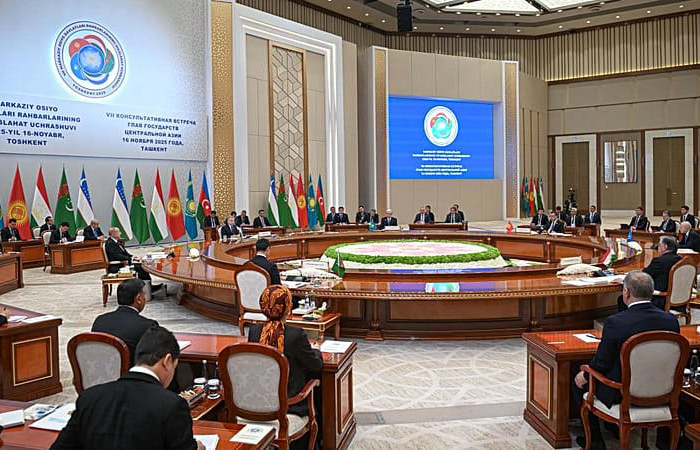
Central Asian leaders meet in Tashkent this weekend for their 7th Consultative  Meeting. Azerbaijan participates for the third year as guest

Central Asian leaders meet in Tashkent this weekend for their 7th Consultative Meeting. Azerbaijan participates for the third year as guest

Central Asian leaders will gather in Tashkent this weekend for the Seventh Consultative Meeting of Heads of State, with plans to adopt a package of multilateral agreements to deepen regional cooperation. The summit brings together the leaders of Uzbekistan, Kazakhstan, Kyrgyzstan, Tajikistan and Turkmenistan, with Azerbaijan participating as a guest of honour for the third consecutive year. The leaders will discuss ways to advance joint projects in priority sectors and exchange views on key regional and international issues, as outlined in the agenda. The consultative meeting format originated from Mirziyoyev's initiative announced at the UN General Assembly in 2017, proposing regular high-level consultations among Central Asian states. The inaugural meeting took place in Astana in 2018. Azerbaijan's President Ilham Aliyev told the Uzbekistan press agency the meeting will be "a significant stage in fostering the centuries-old friendship between our brotherly peoples and expanding multi-level cooperation in the political, economic, transport, investment, energy, cultural and humanitarian spheres, and in the field of digital transformation." He noted that over the past three years, Central Asian heads of state have made nearly 30 visits to Azerbaijan, while he has visited the countries 13 times. Azerbaijan's engagement strengthens regional connectivity, particularly through the Middle Corridor linking Central Asia with Europe.

Filter archive

Publication date
Editor's choice
News
Kazakhstan and Azerbaijan to deepen cooperation as Aliyev meets Tokayev in Astana

Kazakhstan and Azerbaijan to deepen cooperation as Aliyev meets Tokayev in Astana

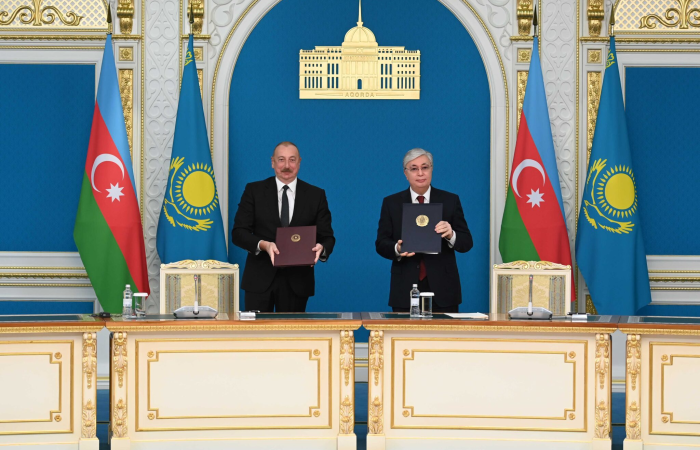
Kazakhstan and Azerbaijan have agreed to significantly increase bilateral cooperation in a number of sectors after the President of Azerbaijan Ilham Aliyev met with his Kazakh counterpart Kassym-Jomart Tokayev in Astana on Monday (10 April). The meeting was comprehensive, focusing on strengthening political, trade, economic, transport and transit, as well as cultural and humanitarian cooperation between the two Caspian Sea states. The two presidents signed several memoranda of understanding on cooperation in sports, diaspora initiatives, science, telecommunications, business and culture. President Aliyev and President Tokayev also signed a joint statement and protocol on the establishment of a Supreme Interstate Council, "which is designed to serve the comprehensive strengthening of bilateral relations", according to Tokayev. He said, "The full deployment of the potential of the Trans-Caspian International Transport Route, the so-called Middle Corridor, is of particular importance." Meanwhile, Aliyev said that Azerbaijan is "truly determined to deepen and expand the multifaceted cooperation" with Kazakhstan.
Editor's choice
News
Kazakhstan and China sign commercial agreements worth $565m

Kazakhstan and China sign commercial agreements worth $565m

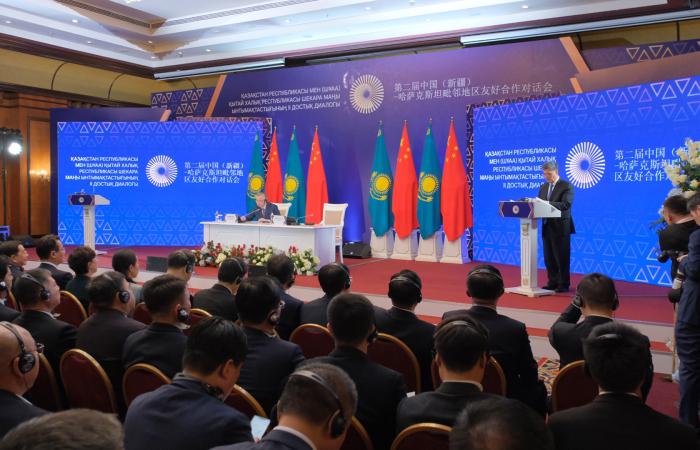
On Tuesday (28 March) it was announced that Kazakh and Chinese business leaders signed 16 different documents strengthening bilateral relations. The agreements were signed on the sidelines of the "Second friendly dialogue of cross-border cooperation between the Republic of Kazakhstan and the Xinjiang Uygur Autonomous Region (XUAR) of the People's Republic of China". The documents included six interregional agreements, five memoranda of understanding, and five commercial agreements totalling a value of $565m. The agreements cover the sectors of construction, energy, mining, agriculture, food industry, engineering, tourism, investment, and others. The forum was held alongside a visit of the Political Bureau of the Central Committee of the Chinese Communist Party and Communist Party Secretary of XUAR, Ma Xingrui, to Kazakhstan. At the meeting, Chinese and Kazakh officials and entrepreneurs discussed ways to improve the efficiency of checkpoints, logistics centers, and transport infrastructure along the almost 1,800km-long border. Speaking at the event, the Kazakh Deputy Prime Minister and Minister of Trade and Integration Serik Zhumangarin said Kazakhstan is ready to export some 135 industrial and agricultural products worth over $1 billion to China.
Editor's choice
News
Ruling Amanat party wins Kazakh parliamentary vote after election reforms

Ruling Amanat party wins Kazakh parliamentary vote after election reforms

Six parties have been elected to the Mazhilis, Kazakhstan's national parliament after elections were held on Sunday (19 March). The six parties are the ruling Amanat party, who won 53.9% of the vote; the Auyl People's Democratic Patriotic Party (10.9%); Respublica Party (8.59%); Aq Jol Democratic Party of Kazakhstan (8.41%); People's Party of Kazakhstan (6.8%); National Social Democratic Party (5.2%). The Baytaq party won only 2.3% of the vote, and, with a 5% threshold necessary to win seats in parliament, will not be represented. 3.9% voted against all parties. The Astana Times reports that over 6.3 million people out of more than 12 million eligible voters cast their ballots in the elections to the parliament and local representative bodies on Sunday, representing a turnout of over 54%.