


Political earthquake in Turkey has overall positive results.

This is a commentary prepared by the political editor of commonspace.eu

There are two ways in which one could read the results of the Turkish elections held on Sunday (7 June). The ruling Justice and Democracy Party(AKP) that supports President Recip Tayip Erdogan has emerged as the largest party but without securing an overall majority. Instead of changing the constitution to give Erdogan more powers, as it had hoped to do, the AK Party now finds itself struggling to keep the government.

Pessimists will say that the uncertainty resulting from the fact that no party won an outright majority will harm the Turkish economy, and will lead to political crisis. Others will point at the dangerous situation that may develop if President Erdogan decides to ride roughshod over parliament, as he surely will be tempted to.

But there is another way to look at the results, and this is much more positive. In Turkey, democracy has won. Whilst the AK Party remains popular, and by far the largest political force in the country, its wings have been trimmed by an electorate that was becoming increasingly concerned at the authoritarian streak that one could start detecting in the actions of President Erdogan and his supporters.  In that sense democracy has prevailed.

These elections, although marred by some violence, were also on the whole free and fair - not something that should be taken for granted in what is after all a reasonably new democracy. In terms of turnout, with more than forty six million people voting, this has probably been the largest expression of popular will in Europe - if one accepts that elections in Russia are far from being free and fair - in a single national election in recent years.

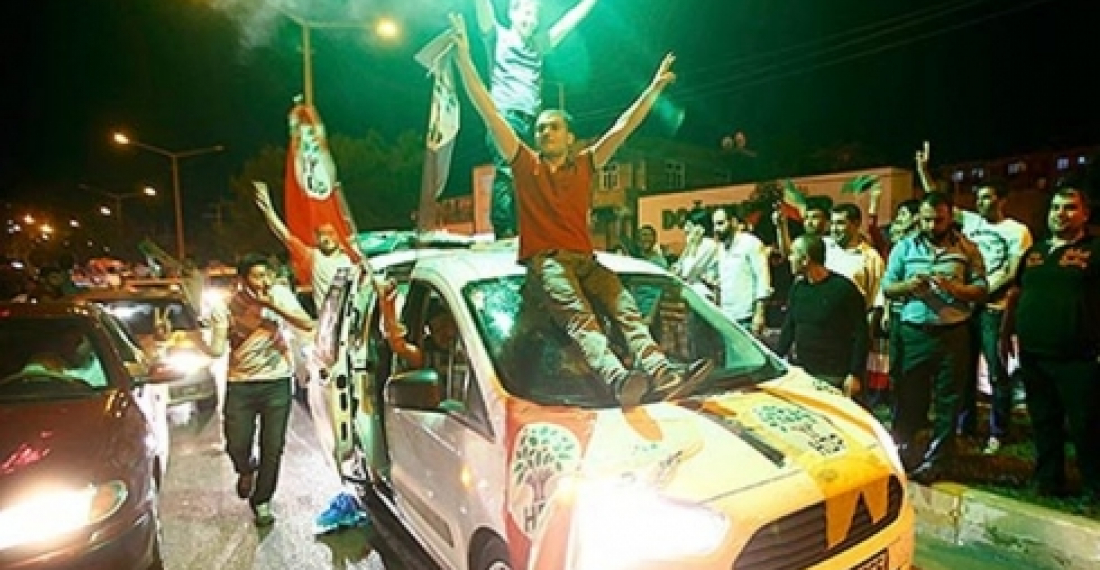
The third reason why the elections should be considered positively is the fact that the new party that represents the interests of Turkey's Kurdish minority, HDP  - the People's Democratic Party  passed the threshold and will have a significant number of MPs. In the current situation of no overall majority this will give the Party an important role in forging the future of Turkey, and that should be welcomed.  The Kurdish minority has for a long time been disenfranchised, due to Turkey's unfair constitutional provision that requires a party to secure 10% of the vote to win seats in Parliament. HDP efforts to broaden its appeal to include leftists and progressive forces, apart from Kurds, has succeeded, and it could be also that there was some tactical voting by other opposition parties who wanted HDP to pass the threshold.

Recip Tayip Erdogan has dominated the Turkish political scene for more than a decade. He remains popular, especially in the heartlands of Anatolia and with the more socially conservative elements of Turkish society. He has presided over a period of radical and long overdue change in Turkey, conducted mostly peacefully and within the legal parameters. Last year Turks elected Erdogan as their president - a post that is hugely symbolic but carries few real powers. It is clear after this election Turks do not support his latest initiative to give the Turkish presidency executive powers. That opinion must now be respected, and Erdogan has to make the effort to be less divisive in his views and opinions. Turkey should continue to modernise and reform in order to secure its place as a modern and prosperous country, a country that has much to give to Europe and to the world.

source: This commentary was prepared by the political editor of commonspace.eu

image: Supporters of the pro-Kurdish HDP in Diyarbakir celebrate their party's entry into Parliament after the Parliamentary elections held in Turkey on 7 June 2015. (Picture courtesy of Todays Zaman).


Related articles

Editor's choice
News
Borrell tells the European Parliament that the situation in Afghanistan was critical, but the EU will remain engaged

Borrell tells the European Parliament that the situation in Afghanistan was critical, but the EU will remain engaged

Borrell underlined that the European Union will make every effort to support the peace process and to remain a committed partner to the Afghan people. "Of course, we will have to take into account the evolving situation, but disengagement is not an option.  We are clear on that: there is no alternative to a negotiated political settlement, through inclusive peace talks.
Editor's choice
News
NATO Chief says war is on Europe's doorstep, and warns against complacency

NATO Chief says war is on Europe's doorstep, and warns against complacency

Russia could attack a Nato country within the next five years, the Secretary General of NATO, Mark Rutte, said in a stark new warning. "Nato's own defences can hold for now," Rutte warned in Berlin, but conflict was "next door" to Europe and he feared "too many are quietly complacent, and too many don't feel the urgency, too many believe that time is on our side. "Russia is already escalating its covert campaign against our societies," Rutte said in a speech in Germany. "We must be prepared for the scale of war our grandparents or great-grandparents endured." Earlier this month, Russia's President Vladimir Putin said his country was not planning to go to war with Europe, but it was ready "right now" if Europe wanted to - or started a war. But similar reassurances were given by Moscow in 2022, just before 200,000 Russian troops crossed the border and invaded Ukraine. Putin has accused European countries of hindering US efforts to bring peace in Ukraine - a reference to the role Ukraine's European allies have recently played in trying to change a US peace plan to end the war, whose initial draft was seen as favouring Russia. But Putin was not sincere, Nato's secretary-general said in the German capital, Berlin. Supporting Ukraine, he added, was a guarantee for European security. "Just imagine if Putin got his way; Ukraine under the boot of Russian occupation, his forces pressing against a longer border with Nato, and the significantly increased risk of an armed attack against us." Russia's economy has been on a war footing for more than three years now - its factories churn out ever more supplies of drones, missiles and artillery shells. According to a recent report by the Kiel Institute for the World Economy, Russia has been producing each month around 150 tanks, 550 infantry fighting vehicles, 120 Lancet drones and more than 50 artillery pieces. The UK, and most of its Western allies, are simply not anywhere near this point. Analysts say it would take years for Western Europe's factories to come close to matching Russia's mass-production of weapons. "Allied defence spending and production must rise rapidly, our armed forces must have what they need to keep us safe," the Nato chief said.

Popular

Editor's choice
News
NATO Chief says war is on Europe's doorstep, and warns against complacency

NATO Chief says war is on Europe's doorstep, and warns against complacency

Russia could attack a Nato country within the next five years, the Secretary General of NATO, Mark Rutte, said in a stark new warning. "Nato's own defences can hold for now," Rutte warned in Berlin, but conflict was "next door" to Europe and he feared "too many are quietly complacent, and too many don't feel the urgency, too many believe that time is on our side. "Russia is already escalating its covert campaign against our societies," Rutte said in a speech in Germany. "We must be prepared for the scale of war our grandparents or great-grandparents endured." Earlier this month, Russia's President Vladimir Putin said his country was not planning to go to war with Europe, but it was ready "right now" if Europe wanted to - or started a war. But similar reassurances were given by Moscow in 2022, just before 200,000 Russian troops crossed the border and invaded Ukraine. Putin has accused European countries of hindering US efforts to bring peace in Ukraine - a reference to the role Ukraine's European allies have recently played in trying to change a US peace plan to end the war, whose initial draft was seen as favouring Russia. But Putin was not sincere, Nato's secretary-general said in the German capital, Berlin. Supporting Ukraine, he added, was a guarantee for European security. "Just imagine if Putin got his way; Ukraine under the boot of Russian occupation, his forces pressing against a longer border with Nato, and the significantly increased risk of an armed attack against us." Russia's economy has been on a war footing for more than three years now - its factories churn out ever more supplies of drones, missiles and artillery shells. According to a recent report by the Kiel Institute for the World Economy, Russia has been producing each month around 150 tanks, 550 infantry fighting vehicles, 120 Lancet drones and more than 50 artillery pieces. The UK, and most of its Western allies, are simply not anywhere near this point. Analysts say it would take years for Western Europe's factories to come close to matching Russia's mass-production of weapons. "Allied defence spending and production must rise rapidly, our armed forces must have what they need to keep us safe," the Nato chief said.

