The ritual of the annual ministerial meeting of the Organisation for Security and Co-operation in Europe (OSCE) has just taken place in Hamburg. There is broad agreement that something in the organisation needs to change, but very little agreement as to how and what. This commentary by the editorial team of Caucasus Concise highlights the need for more outside focus on the work of the organisation
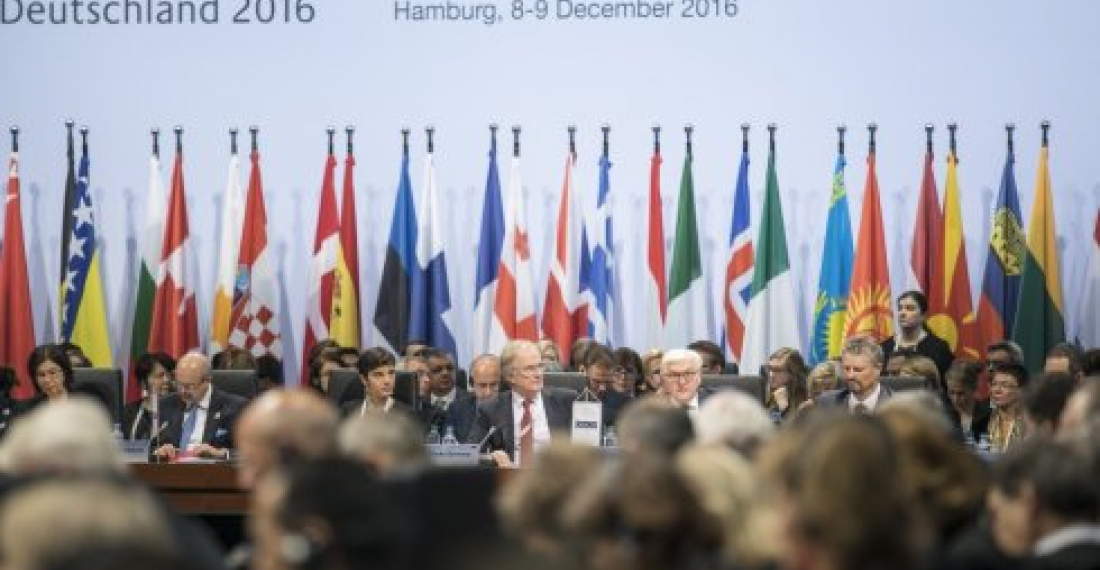
The 23rd Ministerial Council of the Organisation for Security and Co-operation in Europe took place in Hamburg on 8-9 December 2016. As usual hundreds of diplomats from the fifty-seven member states of the organisation which stretches from Vancouver to Vladivostock, led by their foreign ministers, assembled for their annual jamboree.
With the exception of a few bureaucrats, politicians, academics and foreign policy analysts the overwhelming majority of people in the OSCE member states do not have any idea what the organisation is about, and most do not even know that such an organisation exists. Unlike the UN, the EU, NATO and others, which people may like or dislike, the OSCE exists outside the public eye and public interest. One needs to hasten to say that this is not due to lack of effort to boost its public image, both by its permanent bureaucrats, but perhaps more effectively by those countries who occupy the rotating chairmanship of the organisation.
This year that responsibility fell on Germany, and German diplomacy took their job of leading the organisation seriously. But even one of the biggest and strongest countries in Europe could claim only modest success in making the organisation more effective, whilst making it also better understood by the public that needs to bear its costs.
The OSCE is cumbersome and dysfunctional. This is partly due to the way it takes decisions. For historical reasons it operates on a consensus basis Each country has a veto regardless of its size, and this can be exercised on any decision, big or small, including the detailed budget. Some do so shamelessly.
But this is only part of the story. The OSCE has an identity problem. Its main task - some argue its only task, is to be the main security forum in Europe - a region that stretches beyond the continent itself to include Canada and the United States to the west, and the Central Asian states and Mongolia to the East. Throughout its history since it was established in 1994 in Budapest, it has fed on the prestige of its precursor, the Conference for Security and Co-operation in Europe (CSCE) - the forum that gave us the Helsinki Final Act (1975), the Charter of Paris (1990) and the many arms control treaties that helped defuse the tensions of the cold war. However whilst the CSCE can claim much success, the record of the OSCE is more patchy.
There are two schools of thought, the first saying that the OSCE is distracted by too many secondary tasks and needs to re-focus on hard core security issues, and ditch those peripheral elements that were added on over the years as the organisation searched for a role and a mission beyond those elements where it felt it could not make quick progress. Those of this view argue that even the flagship offshoots, such as its Long Term Missions, and the Office for Democratic Institutions and Human Rights (ODIHR) need to be seriously overhauled. The long-term missions used to be warmly welcomed in 1990s. Now most countries see them as a cause of embarrassment and seek to get rid of them as soon as possible. As for ODIHR, whilst nobody doubts the important work that it has done, there are plenty of reasons why it needs now to be re-invented, or so the argument goes.
A second school of thought argues the contrary - the OSCE is not simply the grey diplomats in Vienna, but a much bigger family. German Foreign Minister Frank-Walter Steimeier, even went so far as to list them in his opening speech in Hamburg:
".....the OSCE is not just the Chair, the participating States or Lamberto Zannier's team in the Secretariat. The OSCE family is far more than that. It includes the independent institutions, whose constructive criticism and input guide us every day in implementing our voluntary commitments in the fields of human rights, fundamental freedoms, democracy and the rule of law. It includes the field missions, which play a valuable role in providing concrete support that meets the particular needs of individual participating States. And it includes the OSCE Parliamentary Assembly, which is very highly regarded as the democratic backbone of our system, especially as regards election observation. At the same time, a strong OSCE needs to think beyond the confines of state structures. By this, I mean civil society and academia, which look closely at our day-to-day work. I had a chance to speak with representatives of the Civic Solidarity Platform yesterday. Day in, day out, courageous men and women fight for the protection of human rights and fundamental freedoms in our countries, often under difficult conditions. Thank you very much for your hard work! I am also thinking of the business sector, which plays a key role in improving connectivity in the OSCE area and beyond. Whether we are talking about local border traffic or Europe-wide infrastructure projects, we need to make use of this potential in order to bring about greater security."
Many observers think that Steimeier's assessment was too optimistic - the OSCE is far from being a broad family encompassing all sectors of European society. In fact over the years it has increasingly been uncomfortable in dealing with criticism, and instead locked itself in its own particular comfort zone, which may include all kinds of different elements but which also leaves it somewhat detached from reality.
It is however very important to avoid the danger that in the future someone will by mistake throw the baby out with the bath water. The OSCE may be dysfunctional and it may be a cumbersome organisation that does not always give value for money, yet it is the only pan-European security forum that exists, and the solution is not in its dissolution but in its reform. This, as successive Chairmanships can tell you, is easier said than done. Getting 57 countries to agree on anything is increasingly difficult. "We need a strong OSCE for a secure Europe", Foreign Minister Steinmeier said in Hamburg last week. How to achieve this is however still very much open for discussion. One way to contribute is more attention by media, academia and the expert community that will help focus minds of decision makers. This may cause the organisation some discomfort in the short term, but will help keep the political masters of the fifty seven member states interested and committed to the organisation, not by habit, but by conviction, or at least by political expediency.
This is a commentary prepared by the editorial team of Caucasus Concise, a weekly digital newsletter focusing on the issues related to the wider Caucasus region.