


Opinion: Resolving the crisis of legitimacy in Yemen is essential for any peace process to succeed

For the last six years, Yemen has been engulfed in a war that brought to the surface decades-long political disputes. Regardless of how it is otherwise presented, the Yemen war is a dispute on how and who should govern the country. At the core is the conflict between the Zaidi political system, which over the years took several forms: starting with a monarchical Imamate and ending with the Iranian-inspired Houthi revolutionary model and the modern civil state system that professed to build a republic based on democracy and the rule of law. There are other fault-lines too, and one needs also consider the role that other political factions in the country play, particularly the Southern Movement, play in the wider Yemeni landscape. It is important to assess the conflict and the peace process that seeks to solve it, within the framework of the tension between these various forces. 

The origin and development of the tensions between the political systems in Yemen followed a unique history with a major clash occurring during the anticolonial period and the peak of the Arab nationalist movements that emerged in response to these tensions. At that time, various Republican and revolutionary factions fought against the Zaydi Imamate rule in the North, and against British colonialism in the South. Today, the destructive war in Yemen is reminiscent of the unresolved tension between these systems. On one hand, southern secessionists are dissatisfied with the limited political and economic opportunities in the southern part of Yemen and on the other hand, proponents of the Houthi system are eager to restore a hereditary-based governing system. 

Unlike many conflicts in the post-colonial and post-soviet era, the Yemeni dispute is not based on territorial or ethnic grounds, but on the model of political governance.   Various political and security considerations attracted foreign interference in the country, and this is not something new. There has been foreign intervention in Yemeni internal affairs for several centuries regardless of what political governing system was in place. Most of the intervening actors or policies served their own interests with limited understanding of the local narratives. Regardless, the conflict in Yemen is, and remains, a matter of state legitimacy that neither a local political system nor a foreign actor has been able to positively address. 

Peace attempts to resolve the current conflict have so far failed for two main reasons: Firstly, because they ignored the historical and social depth of the two main disputes (the southern secessionist movement and the Houthis-Republican dispute). Despite the postcolonial achievements, the Republican Yemeni state – the Republic of Yemen – misinterpreted the sociopolitical wealth and depth of two of its largest constituencies: the Zaydis, and more specifically, ‘Ahl al-Bait’ (descendants of Hashemites, the family of Prophet Mohammed); and the southern communities who had an independent political form for almost two centuries. 

Through the use of authoritarian rule and patronage, manifested through a web of corruption and tribal allegiances, the southern communities were marginalised and the Zaydi and dynastic political thought were kept in check. In contrast, external philosophies, such as Salafist Wahhabism, found a path into Yemen with the implicit approval of the statesmen at the helm of the country. It is, however, necessary to highlight that in the Republican state itself, several Zaydis and southerners also held key positions and became part of the ruling elite, but they were often perceived as part of the Republican, Sanaa-based, political establishment. 

The rise of Houthis in the 1990s and early 2000s, and the southern movement in the early 2000s is not surprising. The Houthi clan is part of the wider Zaydi community who sought Zaydi revivalism through sociocultural means. The Houthis argued that Hashemites should be the leaders in charge in a political system similar to that of Wilayet al-faqih based on historical, political, and theological traditions that were in place before the 1960s. Nonetheless, the Houthis were unable to garner mass support through theological and social arguments only. When they failed to do so, their leaders adopted the Iranian revolutionary philosophy and tactics that can be observed in other Arab countries such as Lebanon and Iraq. As for the Southerners, their cause is a culmination of perceived injustices and inequalities in various fields. They were unable to form a sustainable body for resistance until the events in 2011 and 2015 provided an opportunity to create a platform for proper political organisation, resulting in the foundation of the Southern Transitional Council (STC) in 2017. While the Riyadh talks in 2019 included the Southern Transition Council (STC) and integrated the body into the national government, the leaders of the STC continue to advocate for Southerners’ rights. 

Tensions between the national government, Houthis and southerners became inevitable. The Ali Abdullah Saleh government that held power from 1978 to 2012, implicitly led crackdown campaigns on southern media and social establishments following the reunification of north and south in 1990, while only providing undelivered promises. With the Houthis, it was a bit more violent as the government fought six wars against them between (2004-2010). In the aftermath of political instability triggered by nation-wide discontent at the time of regional uprisings (2011-2013), both the Houthis and the southern movement increased their support with various approaches. The Houthis tampered with tribal loyalties which worked in their favour following the demise of the government of Saleh and the first transition of power in 34 years. As for the STC, it capitalised on the national government’s failure to establish security standards in Houthi-liberated areas and provide basic living and economic services. 

The reasons for the rise of the Houthis and the STC can be a topic for wider discussion. Currently, major Yemeni political factions are divided on key governance and political issues that have accumulated for decades. The peace efforts in the past five years have failed to address the question of state legitimacy. Both international and local peace efforts were weak as they dissected the Yemen crisis into smaller issues (connectivity, prisoners, humanitarian work, and economy), missing the wider picture. These peace efforts marginalised the role of Yemen biggest social forces: women, and youth. 

The second main reason for the failure of peace efforts is the existence of an intractable lack of sovereignty where the state did not have full uncontested control over the social and institutional components of the nation. This lack of uncontested sovereignty is caused due to the poor political governance of the state, thereby exposing the weakness of the state’s legitimacy. In North Yemen, Republicans ruled with a tight grip and ignored the multiple tribal and religious identities that exist in the country. In the south, leftist factions, with their differences and never-ending political struggles, kept the country under a dangerous dependence on an already weakening Soviet Union. After unification in 1990, the regime did not secure uncontested sovereignty either, as several political and regional factions continued to challenge the state’s legitimacy. On one hand, there was the Southern movement which crystallized following the 1994 civil war between the north and south. On the other hand, the Houthis emerged as a regional movement, at first simply calling for wider participation in governing and state affairs. Whilst the Yemeni state tried to manage both movements through various methods, its approach – largely authoritarian, uncoordinated and unobjective – exposed the state’s weakened legitimacy, and created blatant gaps in the state’s sovereignty. 

On the state level, vital state apparatus, such as the armed forces, remained subordinate to a narrow social and tribal group that turned the entire army into private property rather than a public asset.  Yemeni governments hence became tools belonging to a political minority that was not recognized by all parts of society, including many Zaydis and southerners. Thus, political tensions thrived under this system that lacked legitimacy. This problem is yet to be addressed.

While a number of humanitarian and economic measures and policies are key to solving the Yemen crisis, the main issue concerns establishing state legitimacy, and the question as to how to achieve this is absent from the peace talks. The debate on resolving the conflict should thus ask how to create undisputed and unquestioned legitimacy for the national (or federal) government, that is inclusive of all social components regardless of their political or religious identity. 

Yemenis must realize the importance of the legitimacy of the state and the role that the absence of this legitimacy plays in fueling old disputes that the Houthis and the STC exploited to their advantage. There is no other way out of this conflict except through social justice and building up the state’s legitimacy that matches not only the political but also the diverse social structure of Yemen. The absence of legitimacy negatively affected the effectiveness of the government during the power transfer in 2012. Peace in Yemen might not be attainable soon, but it is worth first to understand the nature of conflict in Yemen and how the various political factions are benefiting from the absence of full and uncontested sovereignty under this crisis of legitimacy. 


Source: Noman Ahmed Ashraf is Research Associate focusing on Europe’s Southern Neighbourhood at LINKS Europe. An earlier version of this article appeared in Arabic at https://adengd.net/news/501305/


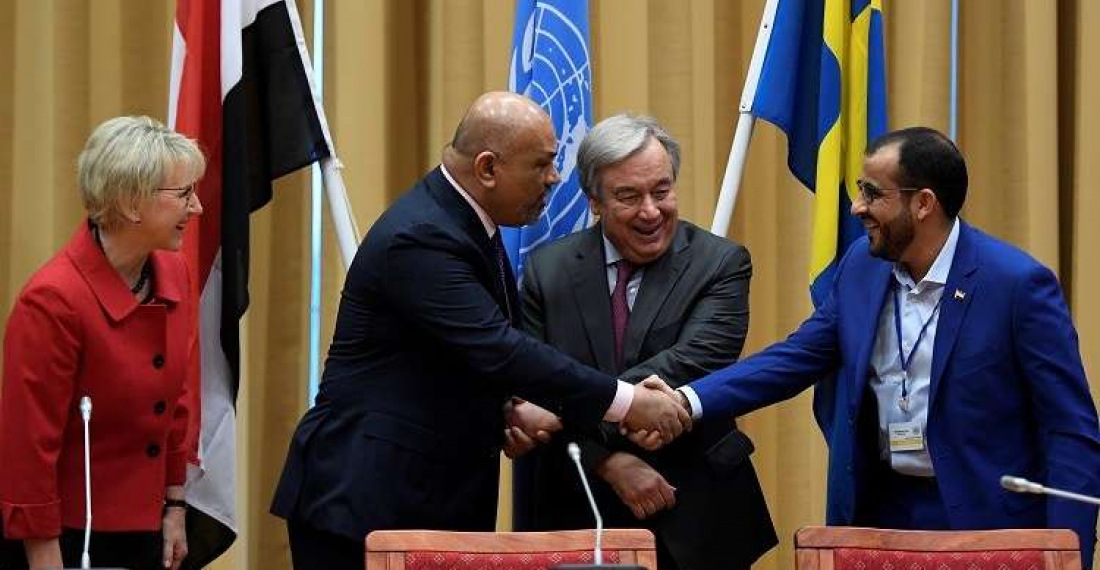
Picture: Representatives of the Yemeni government and the Houthis shake hands during the Stockholm peace talks. 

 

The views expressed in opinion pieces and commentaries do not necessarily reflect the position of commonspace.eu or its partners
 

Related articles

Editor's choice
News
European leaders set out their plan for Ukraine

European leaders set out their plan for Ukraine

The leaders of Germany, Denmark, Finland, France, Italy, Netherlands, Norway, Poland, Sweden, and United Kingdom, together with the President of the European Council, and the President of the European Commission, o  Monday (15 December) issued a statement, outlining their plan for Ukraine. In their statement, Chancellor Merz, Prime Minister Frederiksen, President Stubb, President Macron, Prime Minister Meloni, Prime Minister Schoof, Prime Minister Støre, Prime Minister Tusk, Prime Minister Kristersson, Prime Minister Starmer, as well as President Costa and President von der Leyen spoke about "Peace for Ukraine". The Leaders welcomed significant progress on President Trump’s efforts to secure a just and lasting peace in Ukraine. They also welcomed the close work between President Zelenskyy’s and President Trump’s teams as well as European teams over the recent days and weeks. They agreed to work together with President Trump and President Zelenskyy to get to a lasting peace which preserves Ukrainian sovereignty and European security. Leaders appreciated the strong convergence between the United States, Ukraine and Europe. Leaders agreed that ensuring the security, sovereignty, and prosperity of Ukraine was integral for wider Euro-Atlantic security. They were clear that Ukraine and its people deserved a prosperous, independent, and sovereign future, free from fear of future Russian aggression. Both the US and European leaders committed to work together to provide robust security guarantees and economic recovery support measures for Ukraine in the context of an agreement on ending the war. This would include commitments to: Provide sustained and significant support to Ukraine to build its armed forces, which should remain at a peacetime level of 800,000 to be able to deter conflict and defend Ukraine’s territory. A European-led ‘multinational force Ukraine’ made up from contributions from willing nations within the framework of the Coalition of the Willing and supported by the US. It will assist in the regeneration of Ukraine’s forces, in securing Ukraine’s skies, and in supporting safer seas, including through operating inside Ukraine. A US led ceasefire monitoring and verification mechanism with international participation to provide early warning of any future attack and attribute and respond to any breaches along with a deconfliction mechanism to work on mutual deescalatory actions that can be taken to benefit all parties. A legally binding commitment, subject to national procedures, to take measures to restore peace and security in the case of a future armed attack. These measures may include armed force, intelligence and logistical assistance, economic and diplomatic actions. Invest in the future prosperity of Ukraine, including making major resources available for recovery and reconstruction, mutually beneficial trade agreements, and taking into account the need for Russia to compensate Ukraine for the damage caused. In this vein, Russian sovereign assets in the European Union have been immobilised. Strongly support Ukraine’s accession to the European Union. The leaders expressed their support for President Zelenskyy and agreed to support whatever decisions he ultimately makes on specific Ukrainian issues. They reaffirmed that international borders must not be changed by force. Decisions on territory are for the people of Ukraine, once robust security guarantees are effectively in place. They agreed that some issues would need to be resolved in the final stages of negotiations. They underlined that they would support President Zelenskyy to consult his people if needed. They were clear that as in any deal, nothing is agreed until everything is agreed and that all parties must work intensively towards a solution that could assure a lasting end to the fighting. They were also clear that any deal should protect the long-term security and unity of the Euro-Atlantic and the role of NATO in providing robust deterrence. They stated that any elements affecting the EU and NATO will be discussed among EU and NATO members respectively. It is now incumbent upon Russia to show willingness to work towards a lasting peace by agreeing to President Trump’s peace plan and to demonstrate their commitment to end the fighting by agreeing to a ceasefire. Leaders agreed to continue to increase pressure on Russia to bring Moscow to negotiate in earnest. They all committed to work on rapid further progress in the coming days and weeks to jointly conclude and endorse an agreement for a lasting peace. They reaffirmed their strong support for President Zelenskyy and the people of Ukraine in their fight against Russia’s illegal invasion and in delivering a just and lasting peace. This statement remains open for other countries to join.
Editor's choice
News
Germany accuses Russia of cyberattacks and disinformation campaign

Germany accuses Russia of cyberattacks and disinformation campaign

The German government holds Russia responsible for a cyberattack on German air traffic control, and for targeted disinformation campaigns before the last federal election. According to the German Foreign Office in Berlin, the incidents could be clearly attributed to the Russian military intelligence service, the GRU. In response, the Russian ambassador to Berlin was summoned to the Foreign Ministry. "We have been observing a massive increase in threatening hybrid activities by Russia for some time now," a spokesperson for the Foreign Ministry stated. These range from disinformation campaigns and espionage to cyberattacks and sabotage attempts. The aim is to divide society, sow distrust, and undermine confidence in democratic institutions. The spokesperson added that with these actions, Russia is "very concretely threatening our security, not only through its war of aggression against Ukraine, but also here in Germany."  The Foreign Ministry spokesperson explained that the cyberattack on air traffic control in August 2024 was clearly attributed to the hacker collective "APT28," known as "Fancy Bear," and to the responsibility of the Russian military intelligence service, the GRU. Furthermore, it could now be "conclusively stated" that Russia had attempted "to influence and destabilize both the last Federal election and the ongoing internal affairs of the Federal Republic of Germany." There was "absolutely irrefutable evidence" for this". The so-called "Storm 1516" campaign, which has been running since 2024, is allegedly backed by "reliable information" that the Moscow-based think tank "Center for Geopolitical Expertise" is behind it. The Center is also said to be supported by Russian military intelligence. Its primary aim is to influence democratic elections in the West. (Click the image to read more).

Popular

Editor's choice
News
European leaders set out their plan for Ukraine

European leaders set out their plan for Ukraine

The leaders of Germany, Denmark, Finland, France, Italy, Netherlands, Norway, Poland, Sweden, and United Kingdom, together with the President of the European Council, and the President of the European Commission, o  Monday (15 December) issued a statement, outlining their plan for Ukraine. In their statement, Chancellor Merz, Prime Minister Frederiksen, President Stubb, President Macron, Prime Minister Meloni, Prime Minister Schoof, Prime Minister Støre, Prime Minister Tusk, Prime Minister Kristersson, Prime Minister Starmer, as well as President Costa and President von der Leyen spoke about "Peace for Ukraine". The Leaders welcomed significant progress on President Trump’s efforts to secure a just and lasting peace in Ukraine. They also welcomed the close work between President Zelenskyy’s and President Trump’s teams as well as European teams over the recent days and weeks. They agreed to work together with President Trump and President Zelenskyy to get to a lasting peace which preserves Ukrainian sovereignty and European security. Leaders appreciated the strong convergence between the United States, Ukraine and Europe. Leaders agreed that ensuring the security, sovereignty, and prosperity of Ukraine was integral for wider Euro-Atlantic security. They were clear that Ukraine and its people deserved a prosperous, independent, and sovereign future, free from fear of future Russian aggression. Both the US and European leaders committed to work together to provide robust security guarantees and economic recovery support measures for Ukraine in the context of an agreement on ending the war. This would include commitments to: Provide sustained and significant support to Ukraine to build its armed forces, which should remain at a peacetime level of 800,000 to be able to deter conflict and defend Ukraine’s territory. A European-led ‘multinational force Ukraine’ made up from contributions from willing nations within the framework of the Coalition of the Willing and supported by the US. It will assist in the regeneration of Ukraine’s forces, in securing Ukraine’s skies, and in supporting safer seas, including through operating inside Ukraine. A US led ceasefire monitoring and verification mechanism with international participation to provide early warning of any future attack and attribute and respond to any breaches along with a deconfliction mechanism to work on mutual deescalatory actions that can be taken to benefit all parties. A legally binding commitment, subject to national procedures, to take measures to restore peace and security in the case of a future armed attack. These measures may include armed force, intelligence and logistical assistance, economic and diplomatic actions. Invest in the future prosperity of Ukraine, including making major resources available for recovery and reconstruction, mutually beneficial trade agreements, and taking into account the need for Russia to compensate Ukraine for the damage caused. In this vein, Russian sovereign assets in the European Union have been immobilised. Strongly support Ukraine’s accession to the European Union. The leaders expressed their support for President Zelenskyy and agreed to support whatever decisions he ultimately makes on specific Ukrainian issues. They reaffirmed that international borders must not be changed by force. Decisions on territory are for the people of Ukraine, once robust security guarantees are effectively in place. They agreed that some issues would need to be resolved in the final stages of negotiations. They underlined that they would support President Zelenskyy to consult his people if needed. They were clear that as in any deal, nothing is agreed until everything is agreed and that all parties must work intensively towards a solution that could assure a lasting end to the fighting. They were also clear that any deal should protect the long-term security and unity of the Euro-Atlantic and the role of NATO in providing robust deterrence. They stated that any elements affecting the EU and NATO will be discussed among EU and NATO members respectively. It is now incumbent upon Russia to show willingness to work towards a lasting peace by agreeing to President Trump’s peace plan and to demonstrate their commitment to end the fighting by agreeing to a ceasefire. Leaders agreed to continue to increase pressure on Russia to bring Moscow to negotiate in earnest. They all committed to work on rapid further progress in the coming days and weeks to jointly conclude and endorse an agreement for a lasting peace. They reaffirmed their strong support for President Zelenskyy and the people of Ukraine in their fight against Russia’s illegal invasion and in delivering a just and lasting peace. This statement remains open for other countries to join.


