


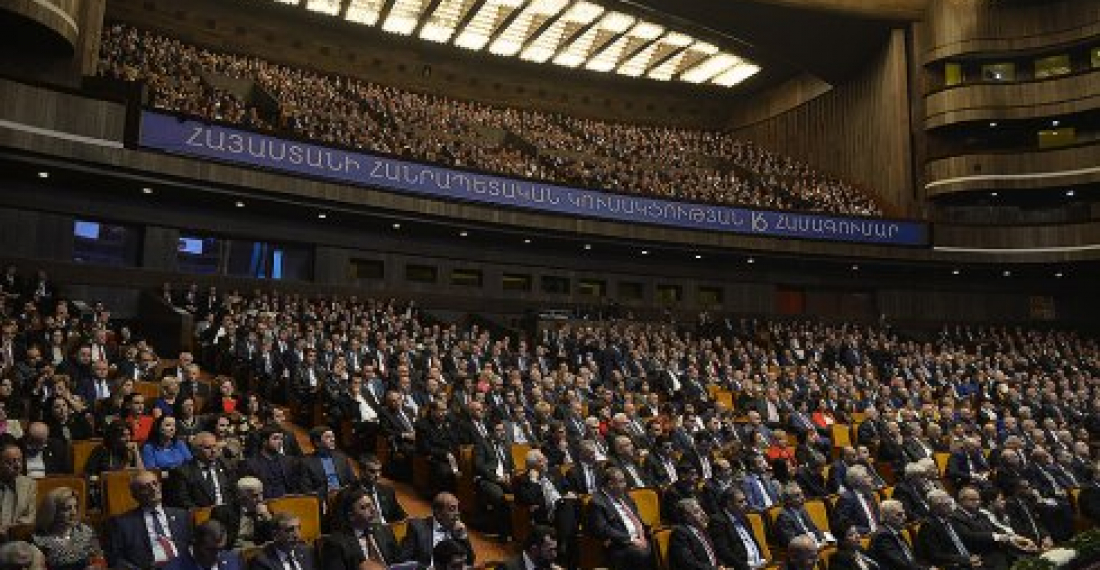
The recently concluded 16th Convention of the Republican Party of Armenia demonstrated the ruling party's ambition to dominate the country's political life for years to come, argues Sos Avetisyan in this op-ed for commonspace.eu
During last two weeks Armenia's newly appointed prime minster, as well as the defense minister, became the members of ruling Republican Party of Armenia (RPA). This effectively marks the beginning of new phase in political processes in Armenia. The appointment of Vigen Sargsyan, a civilian who had no previous direct involvement in Nagorno-Karabakh, as defense minister, has been hailed as positive development. The same is true about appointment of Karen Karapetyan as Armenia's Prime Minister. However, their decision (even if perhaps they did not have much choice) to join the RPA caused some disappointment in the wider public. The recently concluded 16th Party Convention demonstrated RPA's ambition to dominate the political life for years to come.
The question that hanged in the air until the RPA's party congress was whether Karen Karapetyan will continue to be Armenia's PM after the April 2017. The decision of 53-year old Karpetyan, an ex-Gazprom official, to join RPA two days before the convention, gave the first sign that he was to stay on after the parliamentary elections. This was confirmed by President Serzh Sargsan, who was himself unanimously chosen to be the head of RPA.
The head of Armenian Institute of International and Security Affairs, Stepan Safaryan, rightly points out that with Karen Karapetyan remaining as Prime Minister at least up to 2018, Serzh Sargsyan ensures that Russia does not support any other political force in Armenia. At the same time it left open the door for speculation as to whether Sargsyan is ready to yield formal power and not pursue further tenures of office in Armenian politics. While it is too soon to have any definitive answers for this central question, two scenario of possible development can be explored.
The first one is so called "vice-regent" scenario, where Karapetyan will remain PM until 2018, when Serzh Sargsyan will take-over after his presidential term concludes. The second option is "ruling from shadow", where Karapetyan will continue to be Armenia's Prime Minister, and Serzh Sargsyan will influence the political processes through his leadership of the RPA. Something similar has been happening in neighboring Georgia since 2012 after Bidzinia Ivanishivili's Georgian Dream won the parliamentary elections.
"Vice-regent" scenario: the show must go on
One way of thinking about the future of Armenian politics is that Serzh Sargsyan is simply consolidating his power and looks forward to becoming Prime Minister, which will be the most important executive position in the country once the constitutional changes adopted recently come into effect. In this case, the appointment of Karapetyan is a temporary remedy to monopolize Russian support, and perhaps to sooth the drastic economic situation in the country. After the parliamentary elections are concluded, and the presidential term for Sargsyan is over, Karapetyan will be removed. The international as well as domestic costs for such steps are high. For the international community if Sargsyan is to become the new Prime Minister it will simply mean prolongation his personal rule by other means. A sobering statement came from US embassy to Armenia, stating that despite the recent consensus on the electoral code, the US urges Armenian authorities to hold the elections at credible standards. Another silent issue is that traditionally the Armenian presidents have followed the constitutional limitations, which has been an important tool in promoting Armenia as a more democratic country than Azerbaijan.
Domestically, the costs of staying can raise frustration within the political elites, but more importantly among the common people. The economic situation in the country has only worsened under Sargsyan's presidency, and emigration has attained worrying levels. The lack of real change in the country's political leadership can frustrate the population further, and keeping in mind the Erebuni police-station takeover, such development should be avoided.
"Ruling from Shadow"
Since Armenia's independence Serzh Sargsyan has been a central figure both in Karabakhi as well as in Armenian politics. He is a unique figure, with experience of running of all siloviki structures both in Armenia and Karabakh, and for the most part has been considered as éminence grise in Armenian politics. "Ruling from the shadow" is not an unthinkable situation for Sargsyan. With unlimited control over RPA, as well as the power structures, the most important being the defense ministry currently headed by Vigen Sargsyan who until recently was the head of presidential staff, Serzh Sargsyan can opt for such a solution. Very recently, the spokesperson of RPA, Edward Sharmazanov, mentioned that the likely candidate for first deputy chair of RPA will be Karapetyan. Having achieved a foothold in the RPA Karapetyan may remain as Prime Minister after 2018 as well.
However, there are obvious pitfalls in this scenario that Serzh Sargsyan clearly sees. No one, but him knows as well the danger of losing real political leverages. Sargsyan was the key figure in removing Armenia's first president Levon Ter-Petrosyan in 1998, as well as in locking the second president, Robert Kocharyan, out of Armenian politics since 2008. Informal institutions have been predominant in Armenia, however they never operated divorced from formal power institutions. Hence, if Serzh Sargsyan will yield formal power and chooses to govern from the shadow, his current control over almost all aspects of political life might wane rapidly.
Lastly, to recall the power handover from Robert Kocharyan to Serzh Sargsyan in 2008, the important feature was mutual trust and shared experience stemming from their involvement in the Karabakh conflict. Kocharyan was able to accumulate extreme wealth in a very poor post-Soviet state, and Sargsyan guaranteed that his businesses will remain intact. In case Sargsyan is to leave high office, at least his wealth and business interests should be protected by the incoming incumbent, and this is easier said than done. While it is hard to imagine at this stage that the relationship between Serzh Sargsyan and Karen Karapetyan will turn confrontational, they are not bound by the same linkages as Sargsyan and Robert Kocharyan were, and are.
source: Sos Avetisyan is an Armenian political commentator and observer. He recently graduated with an M.Phil in Russian studies from the University of Oxford. He contributed this op-ed for commonspace.eu
photo: Delegates at the recent 16th Convention of the Republican Party of Armenia (picture courtesy of president.am)



