


Ahead of a scheduled meeting between the Foreign Ministers of Armenia and Azerbaijan later this month, Ahmad Alili, in this oped for commonspace.eu, looks at the current state of the Nagorno-Karabakh peace process, and argues that public opinion now requires answers and clarifications
The next meeting between the Ministers of Foreign Affairs of Armenia and Azerbaijan will be held in the upcoming days, most likely during the UN General Assembly in New York. This is the first meeting following Armenian Prime Minister Nikol Pashinyan's "Unification" speech on 5 August in Nagorno-Karabakh, which contained an unprecedented hard-line rhetoric, hurting both 'Track1' and 'Track2' processes, which shocked Baku. Following the speech, Azerbaijani officials called for a reaction from the OSCE Minsk Group co-chairs.
Nikol Pashinyan is truly a 'revolutionary' figure. Although there is no real change in the status quo of the process to resolve the Nagorno-Karabakh conflict, he has surely altered the diplomatic negotiations process itself. At least, he created confusion about the negotiating parties' diplomatic posture. Currently, on the eve of the diplomats' meeting, there are several issues requiring clarification, if the productivity of the peace-making process is to be ensured
First, is Armenian Prime Minister Nikol Pashinyan capable of bringing positive results to the peace process? Pashinyan was a person favoured by Baku when he overthrew Serj Sargsyan, but has since been considered as a less constructive figure. As it was noted by the head of Azerbaijani Presidential Administration Foreign Relations Department, Hikmat Hajiyev, during his recent speech in Chatham House, Baku was expecting Pashinyan to become "a game-changer". Instead the Armenian leadership returned to the "Sargsyan/Nalbandyan style of negotiations". Nevertheless, the recent events demonstrate differences between Pashinyan and his predecessors.
Pashinyan's 'tougher in public, softer at the negotiation table' tactic is a novelty in the negotiations process, although, as it was noted previously, it creates confusion. Alongside claiming Nagorno-Karabakh as part of Armenia and calling for unification, Pashinyan also expressed his vision of sustainable peace, and a need for a solution that would satisfy the people of Azerbaijan. During his interview for 'Azatutyun' (RFE/RL Armenia) he said:
"When I was elected prime minister of the Republic of Armenia, I said that any possible solution to the Karabakh issue should be acceptable for the people of Armenia, for the people of Karabakh, and for the people of Azerbaijan. To some extent, this was an unprecedented statement, since not a single Armenian leader said that the solution should be acceptable also for the people of Azerbaijan"
Armenian Minister of Foreign Affairs Zöhrab Mnatsakanyan also recently expressed his vision of avoiding extreme opinions in peace talks: "Neither side can be guided by a maximalist approach".
In this context, the statement by the Armenian Ministry of Foreign Affairs addressing Azerbaijani officials' frustration regarding the '5 August' speech is also notable. The statement spoke of "the incapacity of the authorities of Azerbaijan to understand the context and the content of the speech". This appears to be based on the premise that the Armenian leadership could deliver populist speeches during mass gatherings and present a softer rhetoric when addressing Azerbaijani counterparts and international mediators. Both Baku and the international mediators are, however, confused which of the narratives to accept as the 'true intention'.
So, how long will the social credit granted by the Armenian population to Nikol Pashinyan allow him to continue this tactic and, as a result, advance the peace process to the next level? Currently, the so-called "constructive ambiguity" is helping Pashinyan to be a populist, a democrat and a diplomat all at the same time. Nevertheless, the time for delivering the initial results of the peace process is approaching fast. Although Nikol Pashinyan's activity has broken the entrenched positions of all parties to the negotiations formed over the last 25 years of diplomatic activity, it certainly created a significant amount of ambiguity too.
Another issue which needs clarification from the expected meeting in New York, is the capacity of the OSCE Minsk Group (MG) to deliver a positive outcome to the negotiations process. From the outset, Armenia and Azerbaijan were not fully cooperative, rational diplomatic actors, adding an element of "Caucasian temperament" to the negotiations process. For sure, the conflicting parties are to blame for the lack of any outcomes in the negotiations process. Azerbaijani and Armenian diplomats' stance on many issues did not allow international mediators to achieve much, yet, it is also true that when there was a chance to act, the mediators missed it. In late 2018, the peacebuilding process received significant positive momentum, also thanks to the activity of the OSCE MG. This progress, which should be valued and built on, faded-away following the Vienna meeting of the two leaders. The lack of an adequate reaction by the co-chairs to the 'unification' speech and other statements hurting 'Track1' and 'Track2' at the same time effectively eroded the earlier positive momentum. The OSCE MG could not sufficiently react to the actions, effectively wiping out the results of continuous mediation efforts that were ongoing since August 2014. If there is another phase of stagnation in the diplomatic process, the OSCE MG tactics themselves will be an issue requiring serious consideration.
The previous stagnation in the peace process took place following the meeting in Kazan in the summer of 2011. It took three years, and three significant military clashes - August 2014, November 2014 and April 2016 - to bring diplomatic efforts back on track. At the same time, war rhetoric is on the rise in both countries. There is a strong urge from the public in both Armenia and Azerbaijan to understand what is going on; more transparency on the part of the OSCE MG, and closer cooperation with civil society experts is strongly required in this period.
The processes following the 'Velvet Revolution' in Armenia, the effect of macroeconomic instability in 2015 in Azerbaijan, Pashinyan's populism, and growing differences between Karabakh Armenians and Yerevan have created a favourable ground for military activity in the region. The chances of new military escalations would be limited if Armenia, Azerbaijan, and the OSCE MG agreed on the openness of the peace process, and to the substantial involvement of public actors in the process.
In this regard, the status of civil society and limitations imposed on some public actors in Azerbaijan is also a key issue. As a result of EU-Azerbaijan rapprochement in the last year, Azerbaijan has demonstrated progress in easing restrictions imposed on local civil society members. Further progress on this issue, civil society actors' unrestricted work with the local public and sensitive groups, and rebuilding ties between societies would all improve the peacebuilding process in the region.
In the end, Nikol Pashinyan's statements increased the public cost for peacebuilding in the region; it has become a harder task to sell the peaceful resolution option to the wider public. Lack of progress in the Nagorno-Karabakh peace talks, despite the widespread belief of positive changes and positive statements earlier of 2019, created additional frustrations. Even a long-time favourite of the Azerbaijani public, Minister of Defence Zakir Hasanov, was harshly criticized in social networks when he avoided commenting on Pashinyan's 'Unification' statement. Thus, another question which needs to be addressed is how the Azerbaijani leadership is going to manage the growing public dissatisfaction in the country about the ongoing negotiation processes.
source: Ahmad Alili is Head of Research at the Caucasus Policy Analysis Center in Baku, and Lecturer at the Azerbaijan Academy of Public Administration. He contributed this op-ed for commonspace.eu
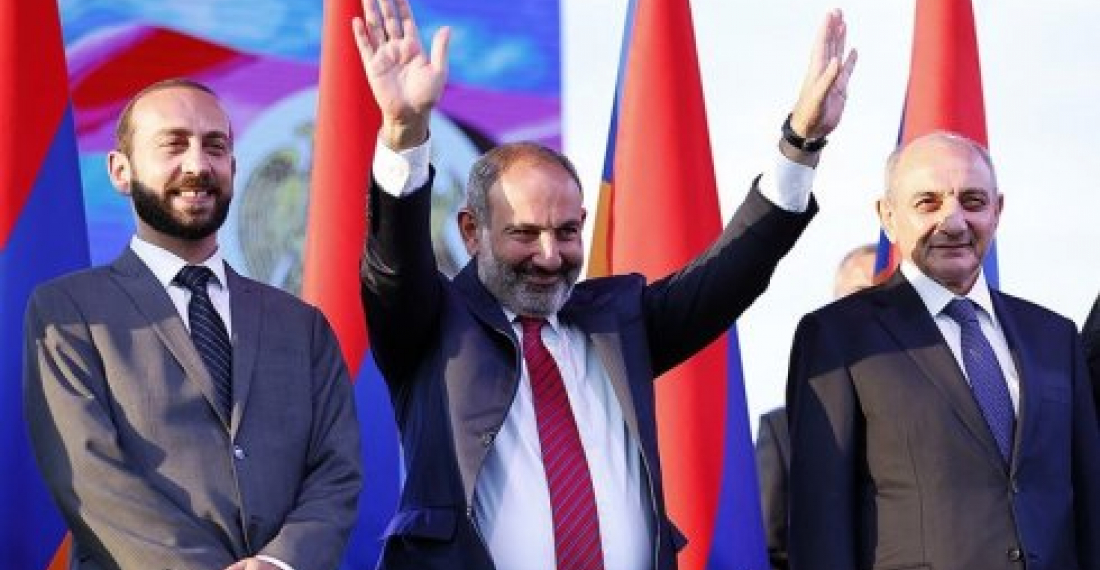
photo: Nikol Pashinyan addressing a crowd in Nagorno-Karabakh in August (picture courtesy of the press service of the government of Armenia)
The views expressed in opinion pieces and commentaries do not necessarily reflect the position of commonspace.eu or its partners



