


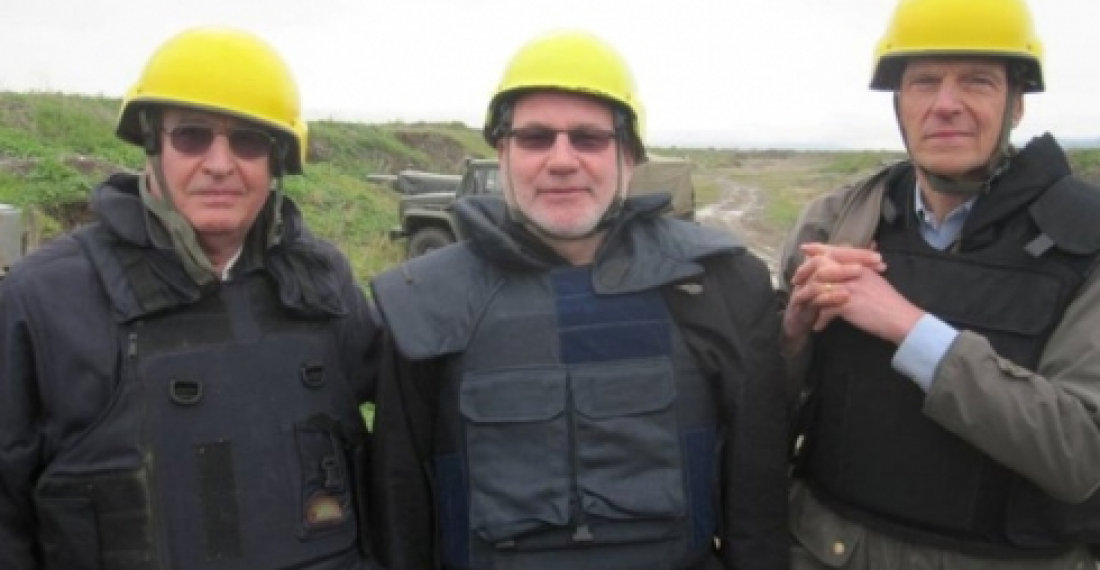
Last week marked the 20th anniversary of the establishment of the Minsk group, the international mechanism established to try to resolve the Nagorno-Karabakh conflict. It was set up within the context of the CSCE (since 1994 known as the OSCE). This was at the time the framework of choice for dealing with all things related with the former Soviet Union. Soon after, three of the countries of the group - Russia, the United States and France, were given the role of co-chair of the process. They have since engaged in a protracted process of negotiations with the leadership of Armenia and Azerbaijan, in great secrecy and at the exclusion of everybody else, even the other members of the group and the OSCE itself.
The fact that the world, and indeed the three co-Chair countries themselves, decided to mark the anniversary of the establishment of the group with a statement by their three foreign ministers is astonishing in itself. You normally mark the start of a conflict, or its end, but I cannot recall ever hearing of the anniversary of a mechanism such as the Minsk Process being marked. Especially one that has for the last twenty years failed to achieve what it set out to achieve, namely resolve the conflict.
The process has over the last two decades gone through different phases, often reflecting not the needs of the situation around the conflict, but mostly the wider international context and the relations between the three co-chair countries, and indeed their domestic politics. At one point George W Bush got interested in the conflict. He got bored with it very quickly and delegated it to junior diplomats. Two French presidents, Chirac and Sarkozy, got interested but also not for long enough. Medvedev picked up the baton in 2008 and ran with it for three years but has at the end of his presidency little to show for his efforts.
Blaming this failure on the process, or on the Minsk co-Chair countries is not right. The conflict has not been resolved because neither Armenia nor Azerbaijan is ready to be flexible enough in their negotiating positions. Both, for different reasons are playing for time. Both talk peace and prepare for war, even if neither wants war because the risk and the cost are just too terrible to imagine. So we are left with brinkmanship, constant talk of bravado, frustration, and a dangerous no peace no war situation. Tens of thousands of Armenian and Azerbaijani soldiers, equipped now with all the tools of modern warfare face each other day after day.
This notwithstanding, the international community is absolutely wrong in treating the Minsk process like some holy cow, above scrutiny or criticism. The Minsk group co-chair now claim that their biggest achievement has been the fact that they have prevented the conflict from flaring up again into a full war. Yet in the same way that they are not to be blamed for not resolving the conflict I do not think that it is to their credit that the conflict has not flared up again either. This is again more to do with what the sides in the conflict think is in their immediate interest. The international consensus of support for the OSCE Minsk Process has slowly started to unravel. This for the moment pleases Azerbaijan, which has been critical of it, but not Armenia which has not been willing to entertain any other alternative. One wants to shoot the messengers, the other one wants to hug it. But the messengers are not the message. It is unlikely that whoever will be facilitating the Karabakh peace process will have anything much different to say or to offer.
The Karabakh peace process needs to come back to the issues that together combine to make the conflict such a difficult one: the problem of the refugees and the IDPs, the occupation by Armenia of Azerbaijani territory; whether or not a territory that has a majority Armenian population should be under Azerbaijani administration given the context; and the geo-political reality of the South Caucasus.
Whichever mechanism is empowered to deal with these issues will find the same problems regardless. Yet it is about time that the world, and not least the populations of the countries involved, are able to make their mind up on who is right and who is wrong on the basis of their conduct in the negotiations. There are lessons to be learned from other peace processes, equally intractable, such as the one in Cyprus, where the parties to the conflict have had to be much more transparent in their dealings, and where the facilitator has not become the story. Unless both sides agree there is at the moment no alternative to the Minsk Process, but its focus should be purely conflict resolution. Other actors need to be delegated the task of conflict management. The process of confidence building should be both top down and bottom up involving a variety of state and non state actors.
In the context of Karabakh the governments of the United States, Russia and France should for a moment put aside their self importance and let the issues become center-stage. They need to engage with a variety of other parties that can also contribute in their different ways to resolving the conflict. The international community has a role to play in resolving the Karabakh conflict but this role should not be that of providing a screen behind which either or both of the sides can hide their intransigence.
Dennis Sammut is the Director of LINKS and writes regularly on the Caucasus Region and international security issues. He can be contacted at dennis@links-dar.org
Photo: Diplomats from France the US and Russia prepare to cross the line of contact between Armenia and Azerbaijan in April 2011. (picture courtesy of the OSCE)



