


Opinion: Does Russia lose Armenia to France?

In an interview with France24 during his February 2024 visit to Paris, Nikol Pashinyan highlighted Azerbaijan's perception of Armenia as "Western Azerbaijan" and expressed concerns about Azerbaijan's preparations for a new war, writes Dr. Anzhela Mnatsakanyan in this op-ed for commonspace.eu. "This interview marked a significant departure as Pashinyan openly scrutinized Russia's policies towards Armenia and hinted at the possibility of a new war. The timing of this interview, a few days before Azerbaijan presented a re-edited version of the so-called "Peace treaty," suggested that the "peace" offered by Azerbaijan is more about the capitulation of Armenia. This interview was a kind of “call for help” from Pashinyan to Western countries on the eve of a possible new war."

What established the asymmetrical partnership between Russia and Armenia? What are the drivers for its Eurasian choice? Armenia’s position towards Russian initiatives was framed by the country’s key security problem, the Nagorno-Karabakh conflict, which has pushed Yerevan toward Russia. The “strategic partnership” between Moscow and Yerevan is completely unequal, and arises in a “3G” form, with Armenia as a recipient of guns and other weapons; gas supplied at beneficial rates; and goods, as both a major trading ally and with Russia as the primary destination for Armenian migrant labour.

After Azerbaijan seized Nagorno-Karabakh, Armenia started to show signs that the country was moving away from Russia’s security umbrella and here France ramped up very quickly the role of Armenia’s possible next strategic partner.

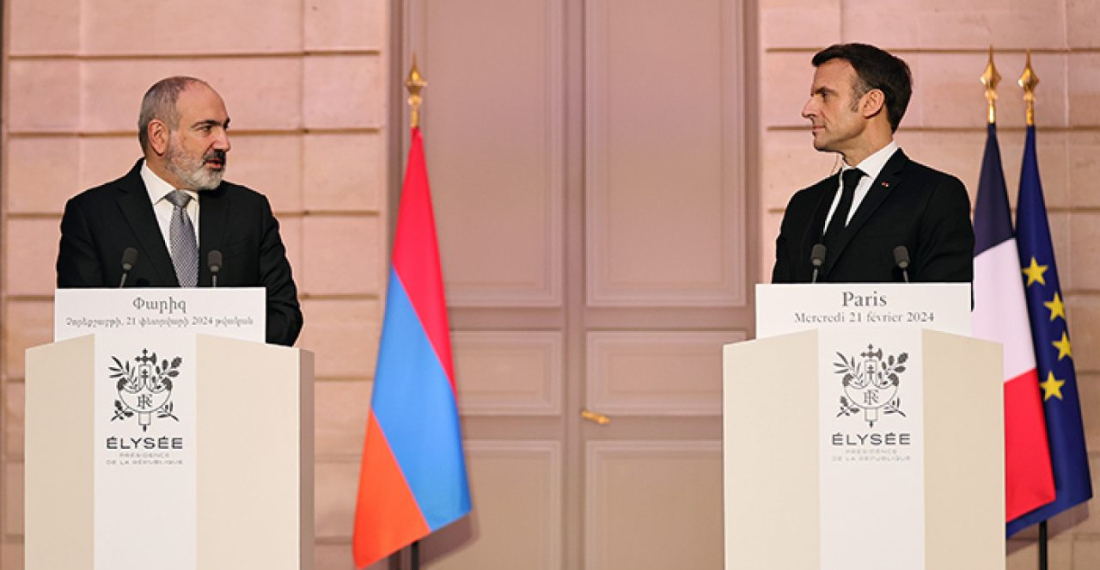
After the Munich Security Conference, Nikol Pashinyan, Prime Minister of Armenia embarked on a two-day working visit to France alongside his wife, Anna Hakobyan. During his time in Paris, Pashinyan engaged with President Macron, and Senate representatives, and partook in the burial ceremony of WWII resistance fighter, Misak Manushyan and his wife at the Pantheon, a momentous event imbued with political significance. This ceremony served as a platform for France to explicitly convey its unwavering support to Armenia.

France strategically sought to underscore the French people's stance towards Armenia, emphasizing the historical importance of the Armenian Community in France. Pashinyan held discussions with leaders of French business, expressing his interest in fostering French business initiatives in Armenia. Noteworthy was Pashinyan's meeting with Anne Hidalgo, the Mayor of Paris and a speculated candidate for the next French Presidency. Hidalgo's prior humanitarian efforts during the Nagorno-Karabakh blockade and her visit to bordering areas of Armenia added a layer of significance to their interaction. Additionally, Pashinyan engaged with the new Prime Minister of France, focusing their discussions on economic collaboration, energy, water resources, and tourism.

A pivotal moment in this diplomatic venture was Prime Minister Pashinyan's interview with French 24, where he conveyed critical messages. Pashinyan highlighted Azerbaijan's perception of Armenia as "Western Azerbaijan" and expressed concerns about Azerbaijan's preparations for a new war. He underscored President Aliyev's reluctance to sign a peace agreement based on the recognition of territorial integrity, emphasizing an arms race initiated by Azerbaijan. Pashinyan also addressed Armenia's frozen participation in the Collective Security Treaty Organisation (CSTO) and raised issues concerning the Russian military base in Armenia. Notably, he disclosed Moscow's alleged encouragement of Armenians to initiate a revolution against the government, attributing it to propagandist efforts directed personally at him. Furthermore, Pashinyan discussed the activities of Russian servicemen in Armenia and the arrest of Dmitry Setrakov in Armenia by the Russian military police.

This interview marked a significant departure as Pashinyan openly scrutinized Russia's policies towards Armenia and hinted at the possibility of a new war. The timing of this interview, a few days before Azerbaijan presented a re-edited version of the so-called "Peace treaty," suggested that the "peace" offered by Azerbaijan is more about the capitulation of Armenia. This interview was a kind of “call for help” from Pashinyan to Western countries on the eve of a possible new war.

Simultaneously, as Pashinyan returned to Armenia, French Armed Forces Minister Sébastien Lecornu arrived to Armenia to personally deliver defence weapons. The arms agreement, initiated in October 2023, materialized in February 2024 with the arrival of weapons in Yerevan. This development contrasted starkly with Armenia's prior attempts to purchase weapons from Russia, where only a limited quantity arrived after a bid submission in 2020. The visit of Minister Lecornu and the discussions with Armenian Defence Minister Suren Papikyan underscored the deepening defence links between France and Armenia. An agreement was reached for the French Army to conduct three mountain combat training sessions in Armenia in 2024. Worth noting is Armenia's withdrawal from hosting CSTO exercises in 2023, indicative of the evolving dynamics in its defence relationships.

On the whole, in Armenia there is a lack of trust in Russia. Armenians feel betrayed by Moscow after Azerbaijan launched an offensive to retake the breakaway Armenian-inhabited region of Nagorno-Karabakh in September. Russia had a peacekeeping contingent stationed there, which stood aside and didn't interfere. Trends in public opinion also impose certain constraints on policymaking in Armenia.

At the same time, CSTO leaders have demonstrated a repeated propensity to shoot themselves in the foot. This pattern is exemplified by President Aleksandr Lukashenko of Belarus, who unequivocally stated that in the event of a conflict between Armenia and Azerbaijan, CSTO members would refrain from intervention. This stance directly contradicts the principles outlined in the CSTO charter. Lukashenko's position seems to be influenced by the perception that Azerbaijan is considered an allied nation by the CSTO member countries, except of course by Armenia.

On the eve of a new possible war, while dialogue with Moscow remains almost completely nonproductive, Armenia needs to find allies, and we can only hope that Yerevan will not overestimate the quality of the cards it is playing in Europe.


source: Dr. Anzhela Mnatsakanyan holds an Advanced Master's Degree of Arts in European Interdisciplinary Studies from the College of Europe in Natolin and a Master's Degree in International Relations from Yerevan State University.
photo: French President Emanuel Macron welcomed Armenian prime minister Nikol Pashinyan at the Elysee Palace in February 2024

Related articles

Editor's choice
News
UAE says it will withdraw from Yemen, but division emerges in Yemeni presidential council

UAE says it will withdraw from Yemen, but division emerges in Yemeni presidential council

In a move seen as an attempt to de-escalate a crises with Saudi Arabia, the United Arab Emirates, on Tuesday (30th December) announced that it was heeding a call to withdraw its troops from Southern Yemen. UAE says that its presence included counter-terrorism teams that were crucial in fighting against Islamist groups. UAE sources said that parts of Yemen not controlled by the Houthis have had Al Qaeda in the Arab Peninsula (AQAP) operatives using the territory to launch attacks on Europe, the US and Middle East. UAE teams have co-ordinated with American and British special forces and intelligence. The sources added that Emirati forces and their Yemeni allies also helped reverse Houthi gains in the south. including the liberation of Aden port. The small UAE contingent has remained in place since the UAE withdrew most of its military personnel in 2019. The leading English-language newspaper in Abu Dhabi, The National, said that the main UAE force was based at Riyan Mukalla International Airport, with access to fixed-wing aircraft and helicopters, but also operated smaller contingents in the port town Balhaf and Shabwa. "It is understood it also flew a number of drones from the airbase that were able to track terrorist movements, pass information back to its allies and assisted special forces' missions." Meanwhile a division has emerged in Yemen's presidential council after four members denounced what they called the 'unilateral decisions' by the chairman. Four of Yemen’s eight Presidential Leadership Council members on Tuesday denounced an announcement by the council’s chairman accusing him of breaching the governing agreement. Tension between Yemeni leaders has been rising for weeks, underscoring the fragility of the country's already fractured political landscape and further complicating efforts to confront the Iran-backed Houthi rebels. The latest rift took an unprecedented turn on Tuesday morning, marked by a Saudi-led coalition “limited operation” striking combat vehicles Riyadh linked to the Southern Transitional Council, which has three members in the PLC. The PLC Chairman, Rashad al Alimi, on Tuesday said that he was seeking to cancel the joint defence agreement with the UAE. “What has been issued … constitutes a clear violation of the Declaration of the Transfer of Power [agreement], which explicitly stipulates that the Presidential Leadership Council is a collective body whose decisions are taken by consensus, or by majority when consensus is not possible,” the statement by the four members said. “It does not, under any circumstances, allow for unilateral decision-making on sovereign, military, or major political matters." The statement was signed by STC chief Aidarous Al Zubaidi, Faraj Al Bahsani, Tariq Saleh and Abu Zaraa al Muharrami. (click the picture to read the full article).

Popular

Editor's choice
News
UAE says it will withdraw from Yemen, but division emerges in Yemeni presidential council

UAE says it will withdraw from Yemen, but division emerges in Yemeni presidential council

In a move seen as an attempt to de-escalate a crises with Saudi Arabia, the United Arab Emirates, on Tuesday (30th December) announced that it was heeding a call to withdraw its troops from Southern Yemen. UAE says that its presence included counter-terrorism teams that were crucial in fighting against Islamist groups. UAE sources said that parts of Yemen not controlled by the Houthis have had Al Qaeda in the Arab Peninsula (AQAP) operatives using the territory to launch attacks on Europe, the US and Middle East. UAE teams have co-ordinated with American and British special forces and intelligence. The sources added that Emirati forces and their Yemeni allies also helped reverse Houthi gains in the south. including the liberation of Aden port. The small UAE contingent has remained in place since the UAE withdrew most of its military personnel in 2019. The leading English-language newspaper in Abu Dhabi, The National, said that the main UAE force was based at Riyan Mukalla International Airport, with access to fixed-wing aircraft and helicopters, but also operated smaller contingents in the port town Balhaf and Shabwa. "It is understood it also flew a number of drones from the airbase that were able to track terrorist movements, pass information back to its allies and assisted special forces' missions." Meanwhile a division has emerged in Yemen's presidential council after four members denounced what they called the 'unilateral decisions' by the chairman. Four of Yemen’s eight Presidential Leadership Council members on Tuesday denounced an announcement by the council’s chairman accusing him of breaching the governing agreement. Tension between Yemeni leaders has been rising for weeks, underscoring the fragility of the country's already fractured political landscape and further complicating efforts to confront the Iran-backed Houthi rebels. The latest rift took an unprecedented turn on Tuesday morning, marked by a Saudi-led coalition “limited operation” striking combat vehicles Riyadh linked to the Southern Transitional Council, which has three members in the PLC. The PLC Chairman, Rashad al Alimi, on Tuesday said that he was seeking to cancel the joint defence agreement with the UAE. “What has been issued … constitutes a clear violation of the Declaration of the Transfer of Power [agreement], which explicitly stipulates that the Presidential Leadership Council is a collective body whose decisions are taken by consensus, or by majority when consensus is not possible,” the statement by the four members said. “It does not, under any circumstances, allow for unilateral decision-making on sovereign, military, or major political matters." The statement was signed by STC chief Aidarous Al Zubaidi, Faraj Al Bahsani, Tariq Saleh and Abu Zaraa al Muharrami. (click the picture to read the full article).

