


Editor's choice
News
Armenia-Azerbaijan Strategic Expert Platform: Members emphasise the importance of the present moment for the South Caucasus and call for the momentum to be used for the long-term peace and prosperity of the region

Armenia-Azerbaijan Strategic Expert Platform: Members emphasise the importance of the present moment for the South Caucasus and call for the momentum to be used for the long-term peace and prosperity of the region

On 27 February 2026, the members of the Armenia-Azerbaijan Strategic Expert Platform met in Antwerp, Belgium, to assess developments in the South Caucasus following the initialling of a peace agreement between Armenia and Azerbaijan on 8 August 2025 at the White House. The members described the present moment as one of major importance for the region and its neighbours, urging leaders and societies alike to use the current momentum to secure long-term peace and prosperity. Established in 2024 with the support of LINKS Europe, the Platform provides a space for direct dialogue and joint analysis between Armenian and Azerbaijani experts. The members also reaffirmed the importance of continued international engagement and expressed strong support for LINKS Europe’s ongoing peacebuilding work in the region. (Click on the image above for the full statement.)
Editor's choice
Interview
Thursday Interview: Dr. Anar Valiyev

Thursday Interview: Dr. Anar Valiyev

Dr. Anar Valiyev is an Associate Professor of Urban and Public Affairs at ADA University in Baku, Azerbaijan, with more than 18 years of experience in higher education. His research focuses on public policy, urban development, governance, and post-Soviet regional affairs. He holds a PhD in Urban and Public Affairs from the University of Louisville and has published widely on urbanisation, policy reform, and regional connectivity in the South Caucasus and beyond. This week, commonspace.eu spoke with Dr. Valiyev in Brussels ahead of a roundtable jointly organised by LINKS Europe Foundation and the European Policy Centre. He is taking part in a panel discussion focusing on the Armenia–Azerbaijan peace process, its implications for both countries and the wider region, the involvement of the European Union and the United States, and the challenges that lie ahead. In this interview, he reflects on how his research has evolved over nearly two decades in academia, examines the transformative potential of regional connectivity and trade, discusses the strategic role of energy in Azerbaijan’s foreign policy, and highlights the importance of people-to-people ties through education as a form of long-term soft power. (Read the full interview by clicking on the image above)

Opinion: China expands its military co-operation with Iran as it emerges as the main counterweight to US influence on the Eurasian landmass

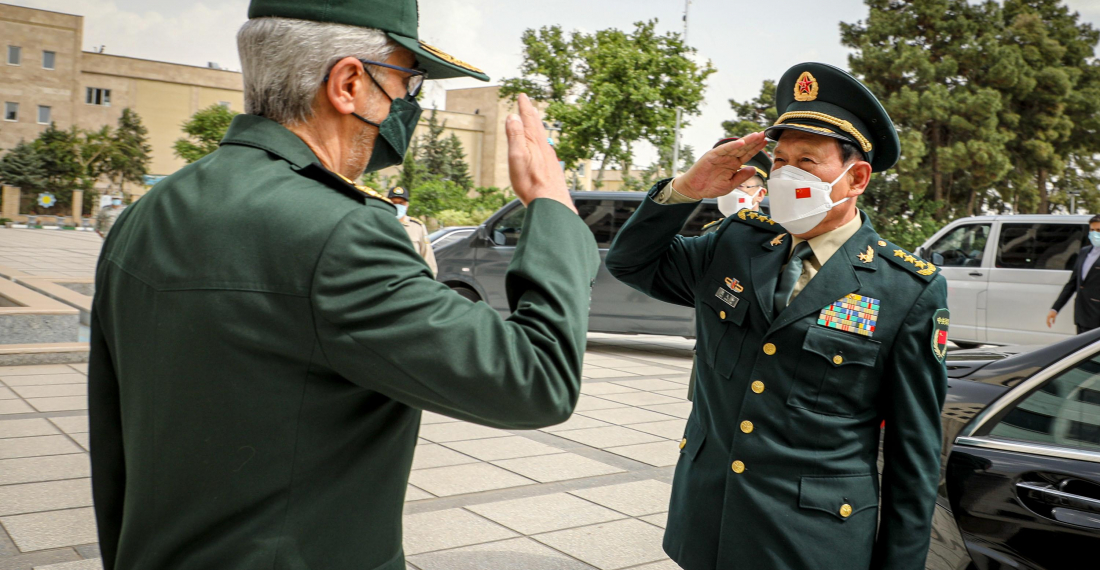
The visit last week of China's Defence Minister, Wei Fenghe, to Tehran marked a significant moment in the development of Chinese-Iranian military co-operation. Iran is becoming an increasingly important factor in Russia and China's efforts to create a partnership on the Eurasian landmass which should balance the US influence, writes Benyamin Poghosyan in this op-ed for commonspace.eu

As Russia – Ukraine war continues to rage without any hope of a quick end, and the West takes steps to increase economic pressure on Russia and expand military assistance to Ukraine, the debates are underway regarding the future of the international security architecture. Perhaps the most common term in this debate is the “post-unipolar world." Experts, academicians, and politicians seek to grasp what this post-unipolar world may look like.

It should be noted that the first discussions about the end of the US global hegemony and the “Unipolar Moment” started back in 2008 when Fareed Zakaria published his famous “The Post American World” book. Many perceived the 2007-2008 global financial crisis, the rise of China, India, and the growing assertiveness of Russia, as the harbingers of the emergence of new world order, with more players, more contradictions, and less stability. The US “pivot to Asia” strategy launched by President Obama, and the Trump administration’s emphasis on the “great power competition”, were clear signs of the upcoming geopolitical battles. Despite the emergence of many potential rivals, the US viewed China as the only near-peer competitor in the last decade. This understanding was underpinned in all US strategic documents, such as the National Security and National Defense Strategies.

After Russia started its war against Ukraine on February 24, 2022, the focus of the West shifted towards containing Russia. However, China remains the primary strategic concern of the US, as was emphasized in the fact sheet of the new National Defense Strategy, published on March 28, 2022. The US made efforts to push China closer to the Western approach on the Ukraine crisis, asking China to use its influence over Russia to persuade the Kremlin to stop the war and simultaneously warning China not to assist Russia in avoiding Western sanctions. During a video call with President Xi held on March 18, 2022, US President Joe Biden informed Chinese President Xi Jinping of the implications and consequences should Beijing provide material support to Moscow in the war in Ukraine. Meanwhile, as China expressed its support for Ukraine’s territorial integrity and sovereignty, President Xi appeared to put some responsibility for Russia’s attack against its neighbor on the West. He stated that the US and NATO should have a dialogue with Russia to address the crux of the Ukraine crisis and ease the security concerns of both Russia and Ukraine.

Regardless of the endgame in Ukraine, it is evident that China will play a significant role in the "Post-unipolar world." Meanwhile, Eastern Europe and the Post –Soviet space are not the only battlefields of the great power competition. With its contentious history and uncertain future, the Middle East is another area of competition. One of the main drivers of tensions here is the contradictions between the US and Iran. Following President Trump withdrawal from the Iran nuclear deal in May 2018, and launch of his “maximum pressure campaign” against Tehran, bilateral relations hit a new low. President Trump’s attempts to trigger regime change in Iran or force Tehran to alter in a significant way its regional foreign policy, did not bring any results. At the same time increased US pressure forced Tehran to foster its relations with Russia and China, and in March 2021, China and Iran signed a 25-year comprehensive strategic partnership agreement.

President Biden on coming to office indicated a change of policy and expressed willingness to restore the Iranian nuclear deal, and negotiations were launched in Vienna. However, Iran also had a new president. Ebrahim Raisi declared his intentions to focus on developing relations with Russia and China. In September 2021, during the Dushanbe summit of the Shanghai Cooperation Organization, Iran saw its application to become a full member finally being processed after over a decade of waiting. During his first visit to China as the new Iranian foreign minister in January 2022, Hossein Amirabdollahian declared that a 25-year comprehensive cooperation agreement signed between Iran and China in 2021 had entered into force. As talks in Vienna on the restoration of the Iran nuclear deal reached an impasse over removing the Islamic Revolutionary Guard Corps from the US State Department list of the foreign terrorist organizations, China and Iran made additional steps to increase their cooperation. China is the number one buyer of Iranian oil, and sides are looking toward expanding their cooperation in the defense area.

Chinese State Councilor and Minister of National Defense Wei Fenghe visited Iran and met with Iranian President Ebrahim Raisi in Tehran on April 27, as both sides agreed to deepen cooperation in military and other areas further. The President of Iran emphasized that Tehran opposed unilateralism, hegemonism, and external interference and expressed gratitude to Beijing for its long-standing support and assistance during Iran's challenging times. The Chinese minister also met with the Chief of Staff of Iran's Armed Forces, Mohammad Bagheri, and Iranian Defense Minister Gharaei Ashtiani.

Given the complete rupture of the Russia – West relations, and the possibility of a long – term Russia - West standoff, China seeks to expand its presence in the Middle East, viewing its relations with Iran as the central pillar of the regional policy. Given the negotiations between Iran and the Russia-led Eurasian Economic Union on the signature of the free trade deal, Iran may become a vital part of Russia and China's efforts to create a partnership on the Eurasian landmass which should balance the US influence.


 

source: Benyamin Poghosyan is the founder and Chairman of the Centre for Political and Economic Strategic Studies in Yerevan.
photo: Iranian Defence Minister Mohammad-Reza Ashtiani (centre) welcomes Chinese Defence Minister Wei Fenghe (right)  to Tehran on April 27. (Photo courtesy of Iranian Ministry of Defence, Tehran)
The views expressed in opinion pieces and commentaries do not necessarily reflect the position of commonspace.eu or its partners

Related articles

Editor's choice
News
Armenia-Azerbaijan Strategic Expert Platform: Members emphasise the importance of the present moment for the South Caucasus and call for the momentum to be used for the long-term peace and prosperity of the region

Armenia-Azerbaijan Strategic Expert Platform: Members emphasise the importance of the present moment for the South Caucasus and call for the momentum to be used for the long-term peace and prosperity of the region

On 27 February 2026, the members of the Armenia-Azerbaijan Strategic Expert Platform met in Antwerp, Belgium, to assess developments in the South Caucasus following the initialling of a peace agreement between Armenia and Azerbaijan on 8 August 2025 at the White House. The members described the present moment as one of major importance for the region and its neighbours, urging leaders and societies alike to use the current momentum to secure long-term peace and prosperity. Established in 2024 with the support of LINKS Europe, the Platform provides a space for direct dialogue and joint analysis between Armenian and Azerbaijani experts. The members also reaffirmed the importance of continued international engagement and expressed strong support for LINKS Europe’s ongoing peacebuilding work in the region. (Click on the image above for the full statement.)

Popular

Editor's choice
Interview
Thursday Interview: Murad Muradov

Thursday Interview: Murad Muradov

Today, commonspace.eu starts a new regular weekly series. THURSDAY INTERVIEW, conducted by Lauri Nikulainen, will host  persons who are thinkers, opinion shapers, and implementors in their countries and spheres. We start the series with an interview with Murad Muradov, a leading person in Azerbaijan's think tank community. He is also the first co-chair of the Action Committee for a new Armenian-Azerbaijani Dialogue. Last September he made history by being the first Azerbaijani civil society activist to visit Armenia after the 44 day war, and the start of the peace process. Speaking about this visit Murad Muradov said: "My experience was largely positive. My negative expectations luckily didn’t play out. The discussions were respectful, the panel format bringing together experts from Armenia, Azerbaijan, and Turkey was particularly valuable during the NATO Rose-Roth Seminar in Yerevan, and media coverage, while varied in tone, remained largely constructive. Some media outlets though attempted to represent me as more of a government mouthpiece than an independent expert, which was totally misleading.  Overall, I see these initiatives as important steps in rebuilding trust and normalising professional engagement. The fact that soon a larger Azerbaijani civil society visits to Armenia followed, reinforces the sense that this process is moving in the right direction." (click the image to read the interview in full)

