


Opinion: In the Caucasus, 2019 will be a year of increased opportunities and heightened risks

Opinion: Dennis Sammut looks back at an eventful 2018 in the South Caucasus and says 2019 will bring many new opportunities, but if these are squandered risks will be considerably higher

A year ago, as 2017 was coming to an end, the leaders of Armenia, Azerbaijan and Georgia - Serzh Sargsyan, Ilham Aliyev and Giorgi Kvirikashvili, appeared on the television sets of their compatriots to wish them new year greetings. 2018 was the centenary anniversary of the establishment of the first republics of their respective nations, so continuity was a prevalent theme.

Half way through the year, two of the three had gone, pushed out rather unceremoniously, and the third, Ilham Aliyev, faced multiple challenges, including a rare religiously inspired mini-rebellion in his country's second city, Ganca, despite having easily secured another term in early elections in April.

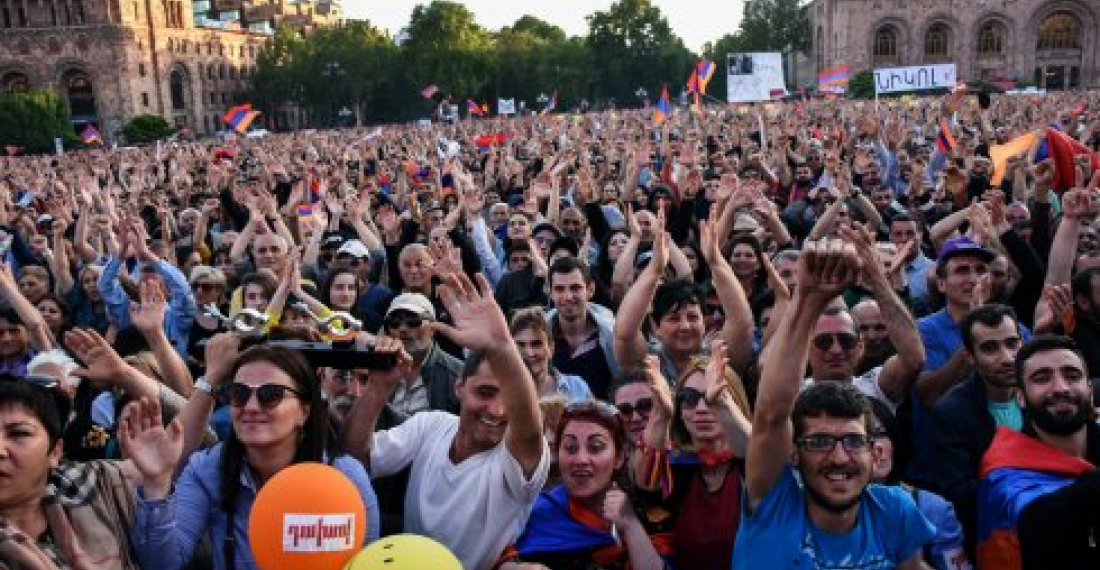
There is no doubt that the unexpected events in Armenian politics in the spring were the highlight of the political year in the region. The elegant way in which Nikol Pashinyan presided over the proceedings was for many as inspiring as it was surprising. It was a game changer - but no one yet knows to what extent. Armenia was not in a good place when Pashinyan took over, and turning it round economically is not going to be easy. Correctly he has prioritised this, but the tools at his disposal are modest, even though now he has been emboldened by a landslide election victory.

The change of government in Yerevan has changed the dynamic around the Nagorno-Karabakh conflict and conflict resolution process. The situation on the line of contact has been quieter than for many years; there are less vitriolic exchanges between the propaganda machines of the two sides, and some steps to prepare for proper negotiations have been taken. But these are simply the first small steps of what needs to be a long journey full of hazards. 2019 will tell us if 2018 was the start of that journey, or simply a blip of little consequence. Things should be clearer by the summer.

This will not depend only on Armenia, but also on Azerbaijan. In the spring, Baku watched events unfolding in Yerevan with curiosity, and in the end decided that anything was better than the status quo. Speculation that the revolutionary contagion will somehow infect Baku was never very serious. Azerbaijan's social and political fabric is very different from that in Armenia. Internal risks for Baku are more likely to come from the mosque than from street protests led by the middle class. Events in Ganca in 2018 provided the leadership with some uncomfortable moments, even if the risk was always containable. On its own the islamist factor is not strong enough to challenge the government. If however it is added to other factors then it may be. Baku will hope for reasonable oil prices in 2019 to enable it to keep the economic and social situation stable. It will also seek to cash in quickly on the new opportunities for moving the Karabakh talks forward. On both fronts 2019 offers new opportunities, but also increased risks.

2018 has been a difficult year for Georgia. In the political and economic spheres it has not been a step backward exactly, but one can hardly say that it has been a step forward either. In May, Bidhzina Ivanishvili returned to frontline politics having concluded that the political project he initiated in 2012 was at risk of unravelling. By October he had understood that the problem was even bigger than he had imagined. The vote for a largely ceremonial president turned into a bitterly fought and acrimonious campaign. The ruling Georgian Dream party candidate for the post came within a whisker of coming second place in the first round. The GD had to throw the kitchen sink at its opponents before it could secure a victory in the second round. Georgia emerged somewhat bruised from it all. Ivanishvili has now to reconcile himself to the fact that the distance he tried to create between himself and the government after he left the post of prime minister in 2013 is gone. 2018 has shown that Ivanishvili's managerial approach to government has reached its limits. In 2019 he will need to revisit the scientific skills and skilful arts of politics if he and his party are to succeed.

The big lesson for South Caucasus politicians from the events in Armenia in the spring is that throughout the region the young generation has new priorities, and new ways of seeking to achieve them. It is more cynical, not ready to accept dogmatic statements, and not ready to be patronised. The most ridiculous statement during the Armenia events was made by Serzh Sargsyan, who at the height of the crisis called on parents to rein in their children protesting on the streets, and take them back home. They soon let him know who was going home!

If this lesson has been learned in Baku, the generational transition in Azerbaijan, which has been ongoing for a while but at a very slow pace, is likely to accelerate in 2019.

As things stand 2019 will be a rare year in which no elections are planned. But speculations persist that early parliamentary elections may take place in Azerbaijan and Georgia. In any case parliaments need to play a bigger role in the future, especially now that both Georgia and Armenia are fully fledged parliamentary republics. In Armenia, all the signs are that the parliament will become the motor for change and reform. This will have a knock-on effect in Azerbaijan where re-energising parliament, and bringing in at least a part of the opposition within the parliamentary framework is now a must.

All in all, while 2018 has been a year of surprises, 2019 is likely to be a year of opportunities. However, if opportunities are missed, risks for those concerned will increase substantially.

source: Dennis Sammut is the Director of LINKS (Dialogue, Analysis and Research) and follows closely events in the South Caucasus (dennis@links-dar.org)

photo: Young people were on the forefront during street protests in Armenia in the spring. (picture courtesy of hetq.am, Yerevan)


Related articles

Editor's choice
News
Germany accuses Russia of cyberattacks and disinformation campaign

Germany accuses Russia of cyberattacks and disinformation campaign

The German government holds Russia responsible for a cyberattack on German air traffic control, and for targeted disinformation campaigns before the last federal election. According to the German Foreign Office in Berlin, the incidents could be clearly attributed to the Russian military intelligence service, the GRU. In response, the Russian ambassador to Berlin was summoned to the Foreign Ministry. "We have been observing a massive increase in threatening hybrid activities by Russia for some time now," a spokesperson for the Foreign Ministry stated. These range from disinformation campaigns and espionage to cyberattacks and sabotage attempts. The aim is to divide society, sow distrust, and undermine confidence in democratic institutions. The spokesperson added that with these actions, Russia is "very concretely threatening our security, not only through its war of aggression against Ukraine, but also here in Germany."  The Foreign Ministry spokesperson explained that the cyberattack on air traffic control in August 2024 was clearly attributed to the hacker collective "APT28," known as "Fancy Bear," and to the responsibility of the Russian military intelligence service, the GRU. Furthermore, it could now be "conclusively stated" that Russia had attempted "to influence and destabilize both the last Federal election and the ongoing internal affairs of the Federal Republic of Germany." There was "absolutely irrefutable evidence" for this". The so-called "Storm 1516" campaign, which has been running since 2024, is allegedly backed by "reliable information" that the Moscow-based think tank "Center for Geopolitical Expertise" is behind it. The Center is also said to be supported by Russian military intelligence. Its primary aim is to influence democratic elections in the West. (Click the image to read more).
Editor's choice
News
NATO Chief says war is on Europe's doorstep, and warns against complacency

NATO Chief says war is on Europe's doorstep, and warns against complacency

Russia could attack a NATO country within the next five years, the Secretary General of NATO, Mark Rutte, said in a stark new warning. "NATO's own defences can hold for now," Rutte warned in Berlin, but conflict was "next door" to Europe, and he feared "too many are quietly complacent, and too many don't feel the urgency, too many believe that time is on our side. "Russia is already escalating its covert campaign against our societies," Rutte said in a speech in Germany. "We must be prepared for the scale of war our grandparents or great-grandparents endured." Earlier this month, Russia's President Vladimir Putin said his country was not planning to go to war with Europe, but it was ready "right now" if Europe wanted to - or started a war. But similar reassurances were given by Moscow in 2022, just before 200,000 Russian troops crossed the border and invaded Ukraine. Putin has accused European countries of hindering US efforts to bring peace in Ukraine - a reference to the role Ukraine's European allies have recently played in trying to change a US peace plan to end the war, whose initial draft was seen as favouring Russia. But Putin was not sincere, Nato's secretary-general said in the German capital, Berlin. Supporting Ukraine, he added, was a guarantee for European security. "Just imagine if Putin got his way; Ukraine under the boot of Russian occupation, his forces pressing against a longer border with Nato, and the significantly increased risk of an armed attack against us." Russia's economy has been on a war footing for more than three years now - its factories churn out ever more supplies of drones, missiles and artillery shells. According to a recent report by the Kiel Institute for the World Economy, Russia has been producing each month around 150 tanks, 550 infantry fighting vehicles, 120 Lancet drones and more than 50 artillery pieces. The UK, and most of its Western allies, are simply not anywhere near this point. Analysts say it would take years for Western Europe's factories to come close to matching Russia's mass-production of weapons. "Allied defence spending and production must rise rapidly, our armed forces must have what they need to keep us safe," the Nato chief said.

Popular

Editor's choice
News
Germany accuses Russia of cyberattacks and disinformation campaign

Germany accuses Russia of cyberattacks and disinformation campaign

The German government holds Russia responsible for a cyberattack on German air traffic control, and for targeted disinformation campaigns before the last federal election. According to the German Foreign Office in Berlin, the incidents could be clearly attributed to the Russian military intelligence service, the GRU. In response, the Russian ambassador to Berlin was summoned to the Foreign Ministry. "We have been observing a massive increase in threatening hybrid activities by Russia for some time now," a spokesperson for the Foreign Ministry stated. These range from disinformation campaigns and espionage to cyberattacks and sabotage attempts. The aim is to divide society, sow distrust, and undermine confidence in democratic institutions. The spokesperson added that with these actions, Russia is "very concretely threatening our security, not only through its war of aggression against Ukraine, but also here in Germany."  The Foreign Ministry spokesperson explained that the cyberattack on air traffic control in August 2024 was clearly attributed to the hacker collective "APT28," known as "Fancy Bear," and to the responsibility of the Russian military intelligence service, the GRU. Furthermore, it could now be "conclusively stated" that Russia had attempted "to influence and destabilize both the last Federal election and the ongoing internal affairs of the Federal Republic of Germany." There was "absolutely irrefutable evidence" for this". The so-called "Storm 1516" campaign, which has been running since 2024, is allegedly backed by "reliable information" that the Moscow-based think tank "Center for Geopolitical Expertise" is behind it. The Center is also said to be supported by Russian military intelligence. Its primary aim is to influence democratic elections in the West. (Click the image to read more).

