


Disillusioned by the attitude of both Russia and the West during the recent Karabakh War, Armenia should look to making China a key partner for economic, political, and defence cooperation, argues Benyamin Poghosyan in this op-ed
The growing global influence of China brings relations with Beijing into the foreign policy agenda of almost every state in the world. Armenia is no exception, and since the launch of the "Belt and Road" initiative (BRI) in September 2013 active discussions have taken place in Yerevan on possible ways to include Armenia into that mega project. The South Caucasus is formally not part of the BRI, however, all regional states seek to offer options to China so that they can share part of the action. Azerbaijan, alongside Georgia and Turkey, is pushing forward the "Middle Corridor" project envisaging the establishment of a new China – Europe route via Kazakhstan, Caspian Sea, Azerbaijan, Georgia, and Turkey.
Since 2016 discussions have been underway in Armenia to create a "Persian Gulf – Black Sea" multimodal transportation corridor connecting Iran with Europe via Armenia, Georgia, the Black Sea, Bulgaria and Greece, and to include it into the BRI. However, the imposition of new US sanctions on Iran in May 2018, and the significant delay in the construction of a new highway in Armenia connecting Armenia with Georgia and Armenia with Iran border, have effectively frozen progress on this multimodal transportation corridor project. As for bilateral Armenia - China trade, its volume was expanding but mainly due to the increase in imports from China. In 2018 Armenia exported 126 million USD of goods to China, the bulk of which was copper ore to the value of 94.8 million USD, while imports from China were equivalent to 482 million USD.
Thus, until recently almost everyone in Armenia was speaking about the necessity to develop relations with China, but no strategy has been elaborated on how to do that at the political or economic level. The key partners of Armenia were Russia, and to a small extent, some EU member states, and it seemed that the Armenian leadership was fully satisfied with that situation.
The 2020 Karabakh war and its consequences were wake-up calls for Armenia. The initially muted reaction of Russia and the absence of any tangible actions to stop the Azerbaijani attack have raised serious suspicions that the Karabakh war was the result of some sort of Russia – Turkey – Azerbaijan understanding to change the status quo and achieve geopolitical goals. The war ended with Azerbaijan, Turkey, and Russia gaining significant benefits, while Armenia and Nagorno Karabakh lost almost everything. Russia established a de facto military base in Karabakh, which has been the Kremlin’s dream for at least the last 5-7 years. Azerbaijan took control of not only the seven regions outside of the Nagorno Karabakh Autonomous Region, (NKAR) but approximately 30 percent of NKAR itself. Turkey has once more proved its capacity to bring about changes through the military means, has significantly increased its influence in Azerbaijan, and through the establishment of a joint Russia – Turkey monitoring center has received an opportunity to justify the deployment of Turkish soldiers on Azerbaijani soil.
Russia seems to be fully supporting Azerbaijan also during the de facto Armenia – Azerbaijan border demarcation process currently underway in the Southern Syunik region of Armenia. As a result of these developments up to 21 km of Goris – Kapan highway in the Syunik region has now come under Azerbaijani control, and border demarcation could soon continue also in the Ararat and Vayots Dzor regions of Armenia. Thus, Yerevan has found itself in a very unpleasant situation, when its key ally Russia is acting in concert with its two main adversaries – Azerbaijan and Turkey.
The de facto absence of the EU and the US during the recent war in Nagorno Karabakh was another blow to the long-term Armenian perceptions of the EU’s role and priorities in the region. Given the fact, that according to almost all international non-governmental organizations ratings (such as Freedom House and others) Armenia and the unrecognized Nagorno Karabakh Republic were more democratic than Azerbaijan, there was a perception in Armenia that the EU and the US will take active steps to prevent Azerbaijan from starting a new large-scale war. The Velvet Revolution in Armenia strengthened that perception as the Armenian leadership perceived Armenia as a new beacon of democracy in the Post-Soviet World. However, there was neither targeted criticism against Azerbaijan nor any EU sanctions imposed during and after the war. Meanwhile, a month after the end of the war the launch of the Southern gas corridor which started to bring Azerbaijani gas to Italy, Bulgaria, and Greece. and statements about the significant role of Azerbaijan in increasing EU's energy independence, were proof that in the current world affairs geostrategic interests matter most.
The shock of the Karabakh war will inevitably force Armenia to re-evaluate its foreign policy priorities and the development of relations with China should be one of the key components of this process. Armenia needs to seriously think about making China a key partner seeking to balance its future relations both with Russia and the West. However, as the first step, Armenia should bid a farewell to the old paradigm, according to which China was perceived as an ATM with limitless cash that is ready to pour money everywhere. Relations with China should have two key dimensions – economic and political. Armenia needs to explore the Chinese market and elaborate a national "Export to China" strategy covering different sectors from agriculture to the mobile application market.
On the political front, Armenia should take action to support China in areas significant for Beijing, and as a minimum requirement to refrain from participation in projects which are viewed as hostile in Beijing. In this context, the first tangible message which Armenia may send to China should be the cancellation of Armenia's participation in the “International Religious Freedom or Belief Alliance”, or a public statement that Armenia will not sign any declaration or statement of the alliance criticizing China. Such steps will create a favourable perception among the Chinese leadership regarding Armenia and will establish a solid base to start serious negotiations with Beijing on issues related to economic, political, and defence cooperation.
Source: This op-ed was prepared for commonspace.eu by Benyamin Poghosyan, Founder and Chairman of the Center for Political and Economic Strategic Studies in Yerevan.
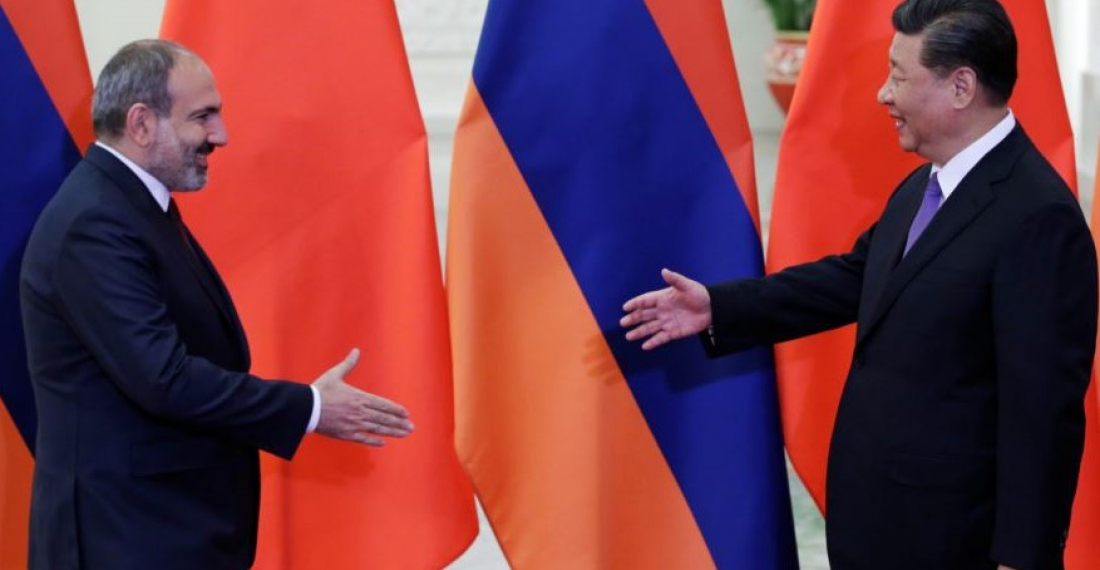
Photo: Chinese President Xi Jinping (R) greets Armenian Prime Minister Nikol Pashinian at the Great Hall of the People, in Beijing, May 14, 2019
The views expressed in opinion pieces and commentaries do not necessarily reflect the position of commonspace.eu or its partners



