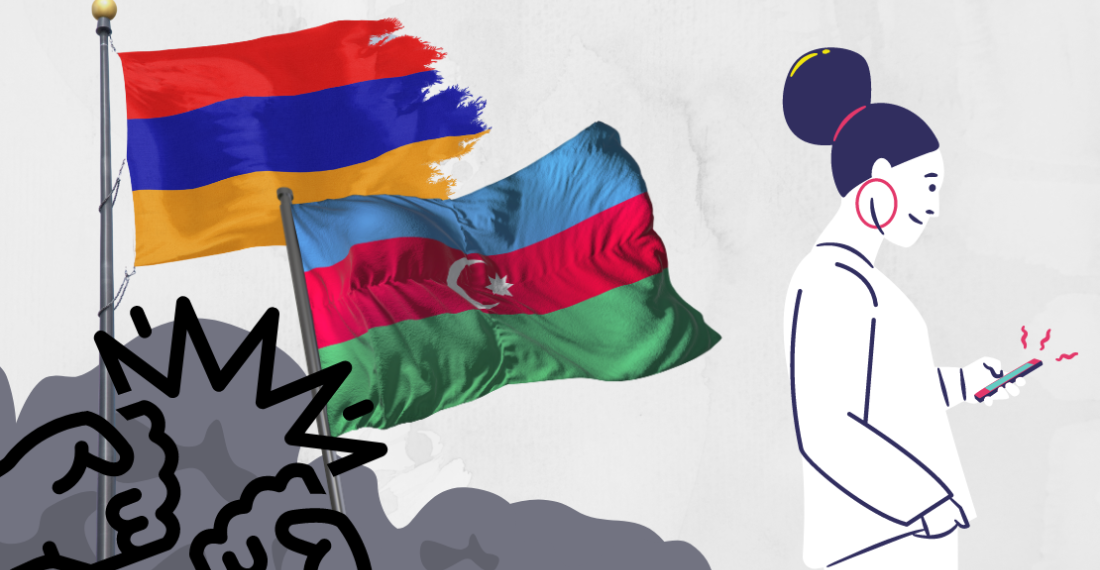
Bridging the divide: the need for unbiased reporting in the Armenia-Azerbaijan conflict

"Today, the media in both Armenia and Azerbaijan, and also among those niche market publications based abroad that report on the region, amplify the negative and nearly always ignore any positive developments or glimmers of hope," writes Onnik James Krikorian in this op-ed for commonspace.eu. "The masses in both countries have already turned off from such coverage. And trust in the media is now at an all-time low, especially given the extent of inaccurate reporting during the 2020 Karabakh war."

"Without more accurate and unbiased information […] free of negative rhetoric and stereotypes, Armenians and Azerbaijanis will continue to see themselves as enemies without any common ground," a 2008 report from the Caucasus Research Resource Centres (CRRC) read. 

"Some argue that those with a strong interest in politics and access to various sources of information are subject to ‘biased processing,’" the CRRC report continued, explaining that people tend to filter information based on already existing views even if they otherwise say they would prefer a more unbiased media.

Regrettably, even after fifteen years, the situation remains largely unchanged. Despite a more diverse information space that includes a plethora of niche outlets funded by international donors, many have now proven themselves more partisan and nationalist than the traditional media to which they were meant to provide an alternative. There are some exceptions, of course, but these are few and far between in the scheme of things and anyway reach a small audience.

Indeed, confirmation bias continues to remain a significant problem with those Armenians and Azerbaijanis eager for information instead seeking out news and commentary that reinforces biases and stereotypes rather than challenging them. Today, the media in both Armenia and Azerbaijan, and also among those niche market publications based abroad that report on the region, amplify the negative and nearly always ignore any positive developments or glimmers of hope.

The masses in both countries have already turned off from such coverage. And trust in the media is now at an all-time low, especially given the extent of inaccurate reporting during the 2020 Karabakh war.

To be fair, the situation resembles that which emerged in established democracies such as the United Kingdom and United States from 2016 onwards. Both the Brexit referendum in the UK and the Trump presidency in the US gave rise to polarisation on an unprecedented scale with the negative exponentially amplified in just seconds on social networks. Both demonstrated how media and digital literacy skills mean little when others manipulate the deepest fears of the audience. 

The advent of social media has also exacerbated the situation. Platforms like Facebook, Telegram, WhatsApp, and TikTok have intensified polarisation among conflicting sides, internally and externally, and have even managed to monetise emotions, with anger being the most potent and effective of all. This trend now drives online engagement and has resulted in a surge of clickbait headlines, even from reputable media outlets compelled to now compete in this environment.    

But that’s not how it should be. 

The media does have a crucial role to act as a bridge, bringing to light the realities and complexities of the conflict rather than fanning the flames that started or reignited it. Unbiased and accurate reporting should instead highlight the root causes of conflict from all sides as well as potential solutions no matter how unpalatable for some. It is essential to present a diverse range of opinions, avoiding cherry-picking only those viewpoints that align solely with maximalist positions.

Sadly, however, that is not the situation today. What mainly exists instead, with few exceptions, is partisan and activist journalism that often resembles an evolved form of politicised blogging. Such an approach is counter-productive and arguably dangerous, especially when it comes from those journalists that can hardly remember the war of the 1990s or the failed mediation process until 2011 when the descent towards war arguably accelerated.

And even when some media outlets or journalists do attempt to demonstrate the nuanced nature of conflicts, presenting the opinions and grievances of both sides, or merely use internationally recognised toponyms, they then face unwavering and coordinated attacks from a virtual army of trolls already poised ready to pounce. These targeted campaigns are fixated on censoring, cancelling, or discrediting anything they disagree with or don’t want discussed, no matter how relevant. 

Consequently, the media space descends into chaos, leaving the public confused, open to manipulation, or simply apathetic. Suffice to say, it shouldn’t be like that. 

Which reminds me. 

Ten years ago, a seasoned foreign journalist was imparting knowledge to a group of young Armenian, Azerbaijani, and Georgian journalists in Tbilisi, focusing on conflict-sensitive reporting. He assigned them the task of preparing an objective report on a conflict between "Country A" and "Country B." The scenario seemed straightforward enough as the warring sides were neutrally named to avoid any possible sensitivities. 

During the class, one student raised her hand. 

"Which country am I?," she asked, as if that should dictate coverage. 

And therein lies the problem.

source: Onnik James Krikorian is a journalist, photojournalist, and consultant from the U.K. who has covered the Armenia-Azerbaijan conflict since 1994.
photo: Fourth Estate
The views expressed in opinion pieces and commentaries do not necessarily reflect the position of commonspace.eu or its partners
 

Related articles

Editor's choice
News
Key European countries back Denmark in the face of Trump's continuing insistence on taking over Greenland

Key European countries back Denmark in the face of Trump's continuing insistence on taking over Greenland

 Six major European countries have declared their support to Denmark following renewed insistence by the US that it must have control over Greenland. "Greenland belongs to its people, and only Denmark and Greenland can decide on matters concerning their relations," said the leaders of the UK, France, Germany, Italy, Poland, and Spain, in a joint statement, issued on Tuesday (6 January), together with Denmark. On Sunday, Donald Trump said the US "needed" Greenland - a semi-autonomous region of fellow Nato member Denmark - for security reasons. He has refused to rule out the use of force to take control of the territory, and Danish Prime Minister Mette Frederiksen warned on Monday that an attack by the US would spell the end of Nato. The issue of Greenland's future resurfaced in the wake of the US military intervention in Venezuela, during which elite troops went in to seize the country's President Nicolás Maduro and take him to face drugs and weapons charges in New York. Following the raid, Trump said the US would "run" Venezuela for an unspecified period of time. He also said the US was returning to an 1823 policy of US supremacy in its sphere of influence in the Western hemisphere - and he warned a number of countries the US could turn its attention to them. The US military raid in Venezuela has reignited fears that the US may consider using force to secure control of Greenland. A day after the raid, Katie Miller - the wife of one of Trump's senior aides - posted on social media a map of Greenland in the colours of the American flag, alongside the word "SOON". On Monday, her husband Stephen Miller said it was "the formal position of the US government that Greenland should be part of the US". In an interview with CNN, he also said the US "is the power of Nato. For the US to secure the Arctic region, to protect and defend Nato and Nato interests, obviously Greenland should be part of the US." Asked repeatedly whether the US would rule out using force to annex it, Miller responded: "Nobody's going to fight the US over the future of Greenland." Stressing they were as keen as the US in Arctic security, the seven European signatories of Tuesday's joint statement said this must be achieved by Nato allies, including the US "collectively" - whilst "upholding the principles of the UN Charter, including sovereignty, territorial integrity and the inviolability of borders". Greenland's Prime Minister Jens-Frederik Nielsen welcomed the statement and called for "respectful dialogue". "The dialogue must take place with respect for the fact that Greenland's status is rooted in international law and the principle of territorial integrity," Nielsen said. Trump has claimed that making Greenland part of the US would serve American security interests due to its strategic location and its abundance of minerals critical to high-tech sectors. Greenland, which has a population of 57,000 people, has had extensive self-government since 1979, though defence and foreign policy remain in Danish hands. While most Greenlanders favour eventual independence from Denmark, opinion polls show overwhelming opposition to becoming part of the US.
Editor's choice
News
Donald Tusk: "One for all, and all for one! Otherwise we are finished."

Donald Tusk: "One for all, and all for one! Otherwise we are finished."

Europe is rattled by events in Venezuela, and there are serious concerns that US disregard for international law may have consequences close to home.  The BBC diplomatic correspondent, James Landale, said, the question is how Europe may respond in the longer term to America's military operation in Venezuela. Will it provide a catalyst for the continent to take greater responsibility for its own security in the face of so much instability from what many see as an unreliable ally? Polish prime minister, Donald Tusk, appears to have answered the question, saying on social media: "No-one will take seriously a weak and divided Europe: neither enemy nor ally. It is already clear now. "We must finally believe in our own strength, we must continue to arm ourselves, we must stay united like never before. One for all, and all for one. Otherwise, we are finished." The US seizing of Venezuela's leader has faced strong criticism from both America's friends and foes at an emergency meeting of the United Nations Security Council, held on Monday, 5 January. Many member states agreed with the US that Nicolás Maduro had been an illegitimate and repressive leader. But many also condemned the US military action as a breach of international law and the UN Charter, and they demanded a democratic transition that reflected the will of the Venezuelan people. (click the image to read the full article).

Popular

Editor's choice
News
Key European countries back Denmark in the face of Trump's continuing insistence on taking over Greenland

Key European countries back Denmark in the face of Trump's continuing insistence on taking over Greenland

 Six major European countries have declared their support to Denmark following renewed insistence by the US that it must have control over Greenland. "Greenland belongs to its people, and only Denmark and Greenland can decide on matters concerning their relations," said the leaders of the UK, France, Germany, Italy, Poland, and Spain, in a joint statement, issued on Tuesday (6 January), together with Denmark. On Sunday, Donald Trump said the US "needed" Greenland - a semi-autonomous region of fellow Nato member Denmark - for security reasons. He has refused to rule out the use of force to take control of the territory, and Danish Prime Minister Mette Frederiksen warned on Monday that an attack by the US would spell the end of Nato. The issue of Greenland's future resurfaced in the wake of the US military intervention in Venezuela, during which elite troops went in to seize the country's President Nicolás Maduro and take him to face drugs and weapons charges in New York. Following the raid, Trump said the US would "run" Venezuela for an unspecified period of time. He also said the US was returning to an 1823 policy of US supremacy in its sphere of influence in the Western hemisphere - and he warned a number of countries the US could turn its attention to them. The US military raid in Venezuela has reignited fears that the US may consider using force to secure control of Greenland. A day after the raid, Katie Miller - the wife of one of Trump's senior aides - posted on social media a map of Greenland in the colours of the American flag, alongside the word "SOON". On Monday, her husband Stephen Miller said it was "the formal position of the US government that Greenland should be part of the US". In an interview with CNN, he also said the US "is the power of Nato. For the US to secure the Arctic region, to protect and defend Nato and Nato interests, obviously Greenland should be part of the US." Asked repeatedly whether the US would rule out using force to annex it, Miller responded: "Nobody's going to fight the US over the future of Greenland." Stressing they were as keen as the US in Arctic security, the seven European signatories of Tuesday's joint statement said this must be achieved by Nato allies, including the US "collectively" - whilst "upholding the principles of the UN Charter, including sovereignty, territorial integrity and the inviolability of borders". Greenland's Prime Minister Jens-Frederik Nielsen welcomed the statement and called for "respectful dialogue". "The dialogue must take place with respect for the fact that Greenland's status is rooted in international law and the principle of territorial integrity," Nielsen said. Trump has claimed that making Greenland part of the US would serve American security interests due to its strategic location and its abundance of minerals critical to high-tech sectors. Greenland, which has a population of 57,000 people, has had extensive self-government since 1979, though defence and foreign policy remain in Danish hands. While most Greenlanders favour eventual independence from Denmark, opinion polls show overwhelming opposition to becoming part of the US.