UN Security Council finally adopts resolution on Gaza

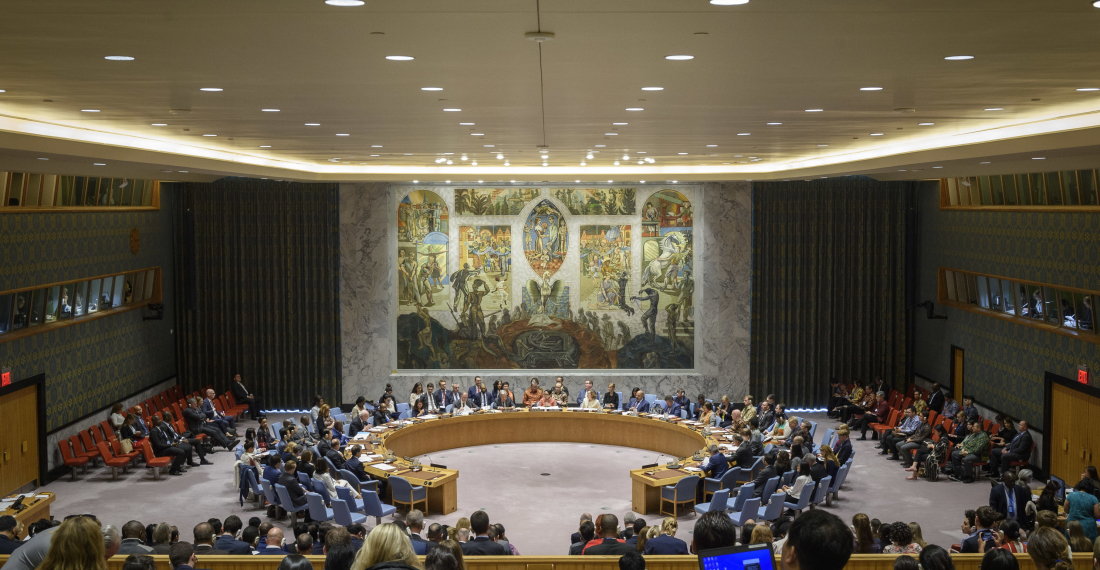
The UN security council on Wednesday adopted a resolution calling for urgent and extended humanitarian pauses and aid corridors throughout the Gaza Strip.

They should remain in place for a sufficient number of days so that aid is able to reach civilians who need it, the council said, especially children, who are mentioned in almost every paragraph of the resolution.

The vote marked the first time council members have managed to adopt a resolution related to the war in Gaza.

The resolution also calls for the release of all hostages and for all sides to refrain from depriving Gazan civilians of the basic goods and services that are critical to their survival.

It further demands the urgent implementation of recovery efforts to find those trapped under rubble of damaged and destroyed buildings. Throughout the resolution, the council also rejected the forced displacement of Palestinians.

Twelve of the 15 council members voted in favor of the resolution, with US, UK and Russia abstaining.

Before the vote, Russia’s representative, Vassily Nebenzia, proposed an amendment calling for “an immediate, durable and sustained humanitarian truce leading to the cessation of hostilities.” This was voted down by the council, with only five members voting for it, including the UAE. The US voted against it and the nine remaining members abstained.

The US and Russia have both accused each other of blocking attempts to agree on action related to the conflict in Gaza. The council, the UN body responsible for maintaining international peace and security, failed to adopt four previous draft resolutions, exposing the bitter divisions between members.

The US has been adamant about rejecting any language that calls for a ceasefire, does not assert what Washington describes as “Israel’s right to self-defense,” or fails to unequivocally condemn Hamas for its actions.

The twelve members of the UN Security Council who voted for the resolution were: Albania, Brazil, China, Ecuador, France, Gabon, Ghana, Japan, Malta, Mozambique, Switzerland and the United Arab Emirates.

Before the vote, Lana Nusseibeh, the UAE’s permanent representative to the UN, warned that to the outside world the Security Council appears “indifferent to carnage and dismissive of the suffering.” She added that “the protection of children has been the North Star that has guided this council’s approach on (the Maltese) draft.”
source: commonspace.eu with agencies

Related articles

Editor's choice
News
European leaders set out their plan for Ukraine

European leaders set out their plan for Ukraine

The leaders of Germany, Denmark, Finland, France, Italy, Netherlands, Norway, Poland, Sweden, and United Kingdom, together with the President of the European Council, and the President of the European Commission, o  Monday (15 December) issued a statement, outlining their plan for Ukraine. In their statement, Chancellor Merz, Prime Minister Frederiksen, President Stubb, President Macron, Prime Minister Meloni, Prime Minister Schoof, Prime Minister Støre, Prime Minister Tusk, Prime Minister Kristersson, Prime Minister Starmer, as well as President Costa and President von der Leyen spoke about "Peace for Ukraine". The Leaders welcomed significant progress on President Trump’s efforts to secure a just and lasting peace in Ukraine. They also welcomed the close work between President Zelenskyy’s and President Trump’s teams as well as European teams over the recent days and weeks. They agreed to work together with President Trump and President Zelenskyy to get to a lasting peace which preserves Ukrainian sovereignty and European security. Leaders appreciated the strong convergence between the United States, Ukraine and Europe. Leaders agreed that ensuring the security, sovereignty, and prosperity of Ukraine was integral for wider Euro-Atlantic security. They were clear that Ukraine and its people deserved a prosperous, independent, and sovereign future, free from fear of future Russian aggression. Both the US and European leaders committed to work together to provide robust security guarantees and economic recovery support measures for Ukraine in the context of an agreement on ending the war. This would include commitments to: Provide sustained and significant support to Ukraine to build its armed forces, which should remain at a peacetime level of 800,000 to be able to deter conflict and defend Ukraine’s territory. A European-led ‘multinational force Ukraine’ made up from contributions from willing nations within the framework of the Coalition of the Willing and supported by the US. It will assist in the regeneration of Ukraine’s forces, in securing Ukraine’s skies, and in supporting safer seas, including through operating inside Ukraine. (Click the image to read the statement in full).

Popular