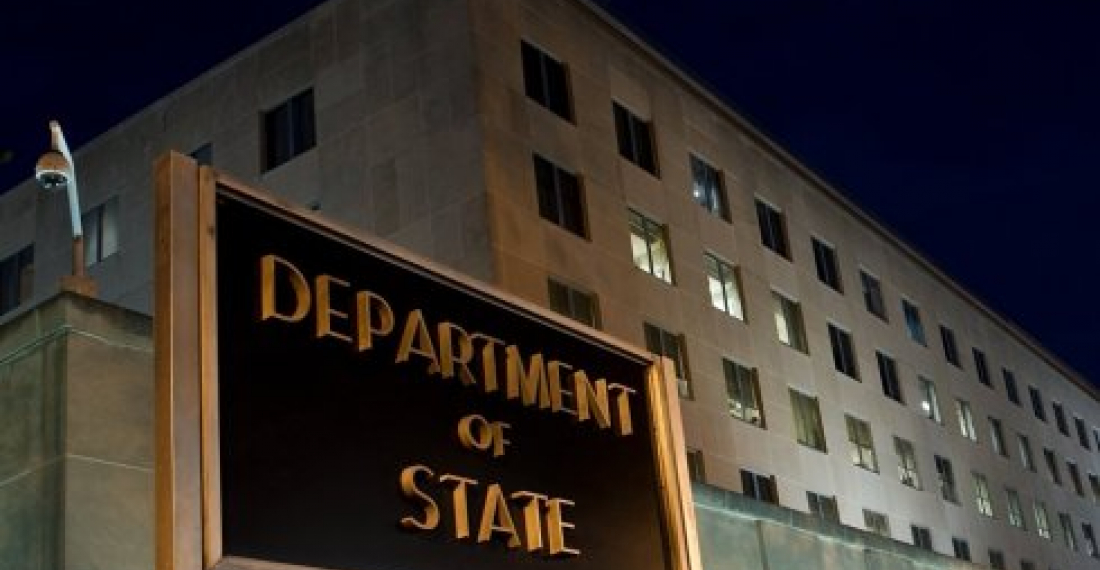
The US State Deparment has slamed the human rights record of Armenia and Azerbaijan in its annual report on the human rights situation in the world. The report, published on Friday, 3 March, carries an introduction by the new US Secretary of State, Roy Tillerson, in which he says that "the Department of State hopes these reports will help other governments, civil society leaders, activists, and individuals reflect on the situation of human rights in their respective countries and work to promote accountability for violations and abuses." The report has now been sent to the US Congress.
On Armenia the report highlights "law enforcement impunity; officials' use of government resources to maintain the political dominance of the ruling RPA combined with the use of economic and political power by the country's elite to enrich supporters and corrupt the law enforcement and judicial systems; and limited judicial independence", as the more serious problems. On Azerbaijan the report says the government Increased restrictions on fundamental freedoms: Authorities limited the freedoms of expression, assembly, and association through intimidation, incarceration on questionable charges, and harsh abuse of selected activists and secular and religious opposition figures. The operating space for activists and nongovernmental organizations (NGOs) remained severely constrained. There was a continuing crackdown on civil society, including intimidation, arrest, and conviction on charges widely considered politically motivated; criminal investigations into NGO activities; restrictive laws; and the freezing of bank accounts that rendered many groups unable to function.
On Armenia, the report says:
Armenia's constitution provides for a republic with an elected head of state and a unicameral legislature, the National Assembly. According to a constitutional referendum conducted in December 2015, the country is expected to transition gradually to a parliamentary republic by the end of the existing presidential term in 2018. The Republican Party of Armenia (RPA) held a majority of seats in the National Assembly and, with President Serzh Sargsyan as leader, continued to dominate the country's political scene. The country had a presidential election in 2013 and legislative elections in 2012. The Organization for Security and Cooperation in Europe (OSCE) described the presidential election as well administered but with shortcomings, including an uneven playing field, serious election-day violations, and concerns regarding the integrity of the electoral process. Similar flaws marred the 2012 National Assembly elections and the 2015 constitutional referendum.
Civilian authorities maintained effective control over the security forces.
On July 17, the armed group Sasna Tsrer stormed and occupied a police compound in Yerevan, taking police hostages. During the two-week standoff that followed, Sasna Tsrer took additional police and medical personnel hostage, demanding political changes. Group members allegedly killed three police officers during the incident. During the standoff, numerous protests and demonstrations in support of Sasna Tsrer took place in Yerevan and other parts of the country. Law enforcement officers engaged in illegal detentions, disproportionate and excessive use of force toward peaceful demonstrators, abusive treatment of journalists, and other serious human rights abuses, especially on the night of July 29, when police charged crowds supporting Sasna Tsrer's political demands. While police suspended or applied disciplinary measures against more than a dozen officers, these measures did not adequately provide for accountability for the widespread abuses.
The most significant human rights problems during the year were law enforcement impunity; officials' use of government resources to maintain the political dominance of the ruling RPA combined with the use of economic and political power by the country's elite to enrich supporters and corrupt the law enforcement and judicial systems; and limited judicial independence.
Other reported problems included suspicious deaths in the military under noncombat conditions; bullying and mistreatment of conscripts by officers and fellow soldiers; allegations of abusive police behavior during arrest and interrogation; and harsh and overcrowded prison conditions. Arbitrary arrests and lengthy pretrial detention with a lack of transparency for the reasons for detention, a distrust of the veracity of testimony, unclear criteria for release, and an uneven application of rights such as family visitation for detainees occurred. Trials were often lengthy, and courts failed to enforce laws providing for fair trials. Inadequate law enforcement regarding violations of privacy and unlawful searches remained problems. Print and broadcast media lacked diversity of political opinion, and most television outlets reflected government views. Self-censorship was a problem. Police reportedly targeted journalists at citizens' protests. The politicization of both academic institutions and student activities inhibited academic freedom. Respect for freedom of assembly worsened. Authorities restricted freedom to participate in the political process and political pluralism. Government restrictions affected some minority religious groups, and members of religious minorities suffered from societal discrimination. Domestic violence remained a problem. An imbalance in the birth ratio of boys to girls pointed to gender-biased sex selection. Persons with disabilities experienced widespread discrimination. Lesbian, gay, bisexual, transgender, and intersex (LGBTI) persons experienced official abuse and discrimination as well as societal violence and discrimination. Society stigmatized persons with HIV/AIDS. The government limited workers' rights and weakly enforced labor laws.
The government conducted only cursory investigations into reports of abuses by officials. Law enforcement officers often committed abuses with impunity, at times under direct orders from law enforcement chiefs. Authorities did not hold anyone accountable for the 10 deaths that occurred following postelection clashes in 2008.
You can read the full US Department of State report on the human rights situation in Armenia here
On Azerbaijan the report says:
The Azerbaijani constitution provides for a republic with a presidential form of government. Legislative authority is vested in the Milli Mejlis. The president dominated the executive, legislative, and judicial branches of government. On September 26, constitutional amendments were approved that, inter alia, increased the president's term in office from five to seven years and expanded the powers of the president. Other amendments included a provision permitting the further restriction of freedom of assembly. The constitutional referendum was marked by widespread credible complaints of irregularities. Legislative elections in November 2015 could not be fully assessed due to the absence of an Organization for Security and Cooperation in Europe (OSCE) election observation mission; independent observers alleged irregularities throughout the country. The 2013 presidential election did not meet a number of key OSCE standards for democratic elections.
Civilian authorities maintained effective control over the security forces.
Separatists, with Armenia's support, continued to control most of Nagorno-Karabakh and seven other Azerbaijani territories. The final status of Nagorno-Karabakh remained the subject of international mediation by the OSCE Minsk Group, cochaired by France, Russia, and the United States. There was an increase in violence along the Line of Contact and the Armenia-Azerbaijan border April 1-5. The heavy clashes led to the highest death toll since the signing of the 1994 cease-fire agreement. There were allegations of atrocities committed by the sides of the Nagorno-Karabakh conflict during an April 1-5 outbreak of violence. The sides in the conflict also submitted to the European Court of Human Rights complaints accusing each other of committing atrocities during this period.
The most significant human rights problems during the year included:
Increased government restrictions on fundamental freedoms: Authorities limited the freedoms of expression, assembly, and association through intimidation, incarceration on questionable charges, and harsh abuse of selected activists and secular and religious opposition figures. The operating space for activists and nongovernmental organizations (NGOs) remained severely constrained. There was a continuing crackdown on civil society, including intimidation, arrest, and conviction on charges widely considered politically motivated; criminal investigations into NGO activities; restrictive laws; and the freezing of bank accounts that rendered many groups unable to function. Authorities also restricted freedom of expression by closing a semi-independent television station that had been the country's sole independent broadcaster until late 2006, when its independence began to decline, and by taking actions that resulted in the end of the print edition of a leading opposition newspaper.
Government use of the judicial system to punish dissent: Authorities arbitrarily arrested and detained activists, engaged in politically motivated imprisonment, conducted trials that lacked due process, and subjected activists to lengthy pretrial detention with impunity. Authorities used different pretexts to decrease the number of defense lawyers willing and able to defend the rights of peaceful activists. While authorities released 17 individuals widely considered to be incarcerated for exercising their fundamental freedoms, they held an even larger number of others.
Government restrictions continued on the ability of citizens to choose their government in free and fair elections.
Other problems reported included physical abuse in the military; alleged torture and abuse of detainees, at times leading to death; police violence against peaceful citizens; abuse of inmates in prisons; harsh and sometimes life-threatening prison conditions; detentions without warrants; and incommunicado detention. Authorities often failed to provide due process, including with regard to property rights. There were reports of arbitrary government invasions of privacy, incarceration of religious figures, and restrictions on the religious freedom of some unregistered groups. Authorities restricted freedom of movement for a growing number of journalists and activists. Constraints on political participation persisted. While the government took continued measures towards reducing low-level corruption in government services, allegations of systemic corruption at all levels of government continued. Violence against women, gender-biased sex selection, and trafficking in persons were reported. Societal intolerance, violence, and discrimination based on sexual orientation and gender identity remained problems, as did societal stigma against persons with HIV/AIDS. Authorities did not effectively enforce laws prohibiting discrimination in employment or occupation.
The government did not prosecute or punish most officials who committed human rights abuses; impunity remained a problem.
You can read the full report of the US State Department on the human rights situation in Azerbaijan in 2016 here
On Georgia the report is much less critical, and focuses primarily on the situation in the separatists territories of Abkhazia and South Ossetia. You can read the US State Department report on the human rights situation in Georgia here
The full report of the US State Department is available in pdf format on its website here
source: commonspace.eu with state.gov