


US and Ukraine sign deal giving US access to country’s valuable mineral wealth

The United States and Ukraine have signed a minerals deal after a two-month delay, in what President Donald Trump's administration called a new form of US commitment to Kyiv after the end of military aid. Ukraine said it secured key interests after protracted negotiations, including full sovereignty over its own rare earths, which are vital for new technologies and largely untapped. Trump had initially demanded rights to Ukraine's mineral wealth as compensation for US weapons sent under former president Joe Biden after Russia invaded just over three years ago.

After initial hesitation, Ukraine has accepted a minerals accord as a way to secure long-term investment by the United States, as Trump tries to drastically scale back US security commitments around the world. Announcing the deal in Washington, Treasury Secretary Scott Bessent said it showed "both sides' commitment to lasting peace and prosperity in Ukraine." "This agreement signals clearly to Russia that the Trump administration is committed to a peace process centred on a free, sovereign and prosperous Ukraine over the long term," Bessent said.

"And to be clear, no state or person who financed or supplied the Russian war machine will be allowed to benefit from the reconstruction of Ukraine." The Treasury statement notably mentioned Russia's "full-scale invasion" of Ukraine - diverging from the Trump administration's usual formulation of a "conflict" for which Kyiv bears a large degree of responsibility.

In Kyiv, Prime Minister Denys Shmygal said the agreement was "good, equal and beneficial." Shmygal said the two countries would establish a Reconstruction Investment Fund with each side having equal voting rights, and Ukraine would retain "full control over its subsoil, infrastructure and natural resources."

Meeting a key concern for Kyiv, he said Ukraine would not be asked to pay back any "debt" for billions of dollars in US support since Russia invaded in February 2022. "The fund's profits will be reinvested exclusively in Ukraine," he said. Ukrainian Economy Minister Yulia Svyrydenko said the deal would finance mineral and oil, and gas projects as well as "related infrastructure or processing."

Trump had originally sought $500 billion in mineral wealth -- around four times what the United States has contributed to Ukraine since the war. Trump has baulked at offering security guarantees to Ukraine and has rejected its aspiration to join NATO.

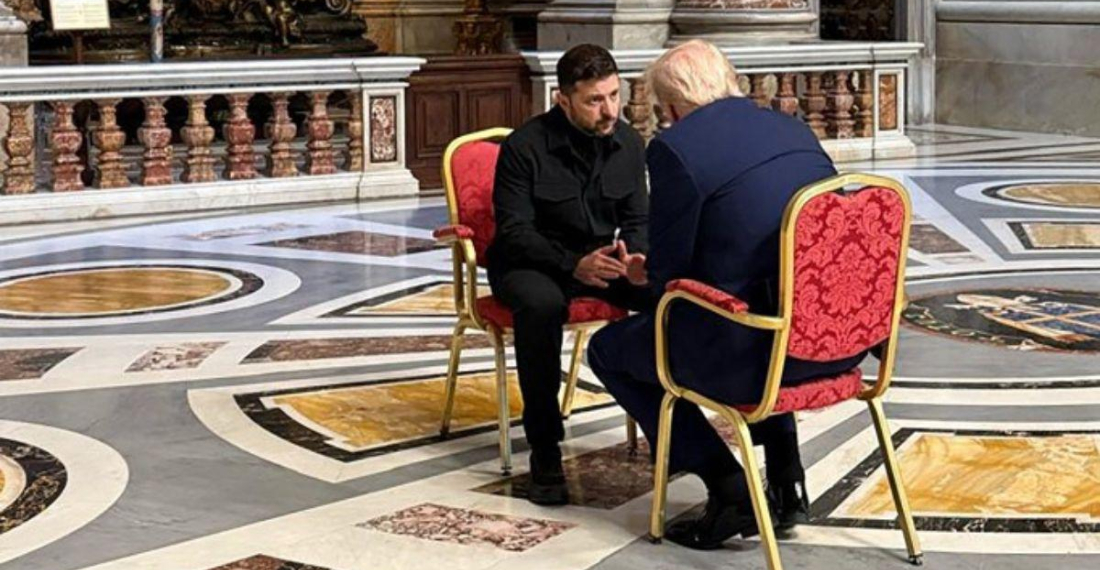
But he said on Wednesday that a US presence on the ground would benefit Ukraine. "The American presence will, I think, keep a lot of bad actors out of the country or certainly out of the area where we're doing the digging," Trump said at a cabinet meeting. Speaking later at a town hall with NewsNation, Trump said he told Ukrainian President Volodymyr Zelensky during a recent meeting at the Vatican that signing the deal  would be a "very good thing" because "Russia is much bigger and much stronger." Asked whether the minerals deal is going to "inhibit" Russian leader Vladimir Putin, Trump said: "well, it could".

Calling the agreement "Trump's extortion of Ukraine deal," US Congressman Gregory Meeks, ranking Democrat on the House Foreign Affairs Committee, said Trump should now focus his efforts on pressuring Putin rather than "fixating" on Zelensky and Ukraine.

Ukraine holds some five per cent of the world's mineral resources and rare earths, according to various estimates. But work has not yet started on tapping many of the resources, and many sites are in territory now controlled by Russian forces. Notably, Ukraine has around 20 per cent of the world's graphite, an essential material for electric batteries, according to France's Bureau of Geological and Mining Research.  Ukraine is also a major producer of manganese and titanium, and says it possesses the largest lithium deposits in Europe
Source: commonspace.eu with agencies. Photo: AFP - Volodymyr Zelenskyy and Donald Trump meet at Pope Francis’s funeral.

Related articles

Editor's choice
News
Borrell tells the European Parliament that the situation in Afghanistan was critical, but the EU will remain engaged

Borrell tells the European Parliament that the situation in Afghanistan was critical, but the EU will remain engaged

Borrell underlined that the European Union will make every effort to support the peace process and to remain a committed partner to the Afghan people. "Of course, we will have to take into account the evolving situation, but disengagement is not an option.  We are clear on that: there is no alternative to a negotiated political settlement, through inclusive peace talks.
Editor's choice
News
NATO Chief says war is on Europe's doorstep, and warns against complacency

NATO Chief says war is on Europe's doorstep, and warns against complacency

Russia could attack a Nato country within the next five years, the Secretary General of NATO, Mark Rutte, said in a stark new warning. "Nato's own defences can hold for now," Rutte warned in Berlin, but conflict was "next door" to Europe and he feared "too many are quietly complacent, and too many don't feel the urgency, too many believe that time is on our side. "Russia is already escalating its covert campaign against our societies," Rutte said in a speech in Germany. "We must be prepared for the scale of war our grandparents or great-grandparents endured." Earlier this month, Russia's President Vladimir Putin said his country was not planning to go to war with Europe, but it was ready "right now" if Europe wanted to - or started a war. But similar reassurances were given by Moscow in 2022, just before 200,000 Russian troops crossed the border and invaded Ukraine. Putin has accused European countries of hindering US efforts to bring peace in Ukraine - a reference to the role Ukraine's European allies have recently played in trying to change a US peace plan to end the war, whose initial draft was seen as favouring Russia. But Putin was not sincere, Nato's secretary-general said in the German capital, Berlin. Supporting Ukraine, he added, was a guarantee for European security. "Just imagine if Putin got his way; Ukraine under the boot of Russian occupation, his forces pressing against a longer border with Nato, and the significantly increased risk of an armed attack against us." Russia's economy has been on a war footing for more than three years now - its factories churn out ever more supplies of drones, missiles and artillery shells. According to a recent report by the Kiel Institute for the World Economy, Russia has been producing each month around 150 tanks, 550 infantry fighting vehicles, 120 Lancet drones and more than 50 artillery pieces. The UK, and most of its Western allies, are simply not anywhere near this point. Analysts say it would take years for Western Europe's factories to come close to matching Russia's mass-production of weapons. "Allied defence spending and production must rise rapidly, our armed forces must have what they need to keep us safe," the Nato chief said.

Popular

Editor's choice
News
NATO Chief says war is on Europe's doorstep, and warns against complacency

NATO Chief says war is on Europe's doorstep, and warns against complacency

Russia could attack a Nato country within the next five years, the Secretary General of NATO, Mark Rutte, said in a stark new warning. "Nato's own defences can hold for now," Rutte warned in Berlin, but conflict was "next door" to Europe and he feared "too many are quietly complacent, and too many don't feel the urgency, too many believe that time is on our side. "Russia is already escalating its covert campaign against our societies," Rutte said in a speech in Germany. "We must be prepared for the scale of war our grandparents or great-grandparents endured." Earlier this month, Russia's President Vladimir Putin said his country was not planning to go to war with Europe, but it was ready "right now" if Europe wanted to - or started a war. But similar reassurances were given by Moscow in 2022, just before 200,000 Russian troops crossed the border and invaded Ukraine. Putin has accused European countries of hindering US efforts to bring peace in Ukraine - a reference to the role Ukraine's European allies have recently played in trying to change a US peace plan to end the war, whose initial draft was seen as favouring Russia. But Putin was not sincere, Nato's secretary-general said in the German capital, Berlin. Supporting Ukraine, he added, was a guarantee for European security. "Just imagine if Putin got his way; Ukraine under the boot of Russian occupation, his forces pressing against a longer border with Nato, and the significantly increased risk of an armed attack against us." Russia's economy has been on a war footing for more than three years now - its factories churn out ever more supplies of drones, missiles and artillery shells. According to a recent report by the Kiel Institute for the World Economy, Russia has been producing each month around 150 tanks, 550 infantry fighting vehicles, 120 Lancet drones and more than 50 artillery pieces. The UK, and most of its Western allies, are simply not anywhere near this point. Analysts say it would take years for Western Europe's factories to come close to matching Russia's mass-production of weapons. "Allied defence spending and production must rise rapidly, our armed forces must have what they need to keep us safe," the Nato chief said.

