


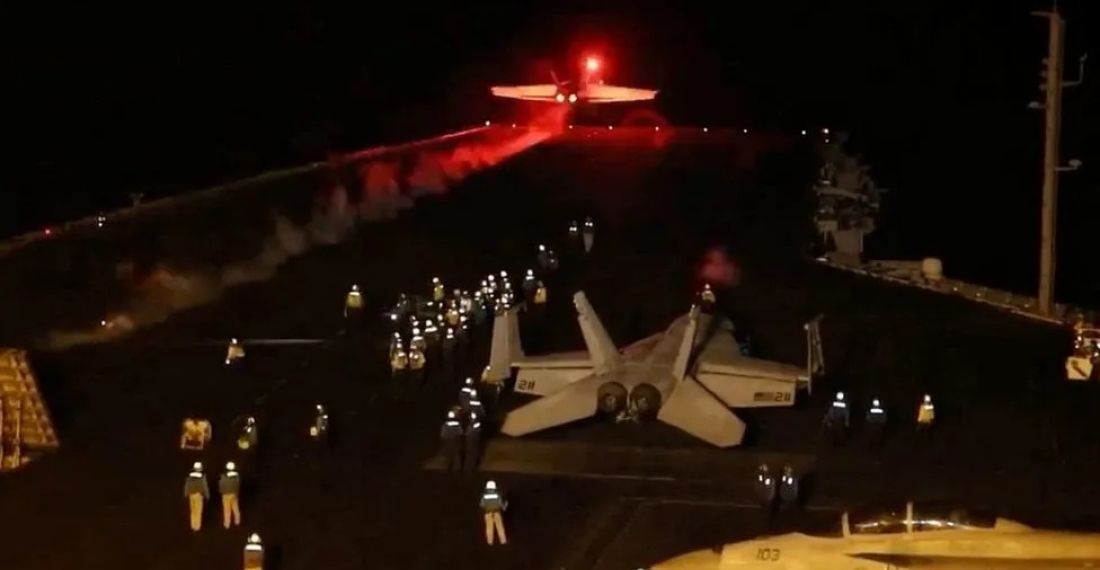
The United States and the United Kingdom have conducted overnight a series of strikes on territory in Yemen controlled by the Houthi Movement. Other countries, including Australia, Bahrain, The Netherlands and Canada provided support. Saudi Arabia allowed overflight over its territory by the attacking aircraft.
The strikes were led and coordinated by the US. The Pentagon said they were intended to disrupt and degrade the Houthis' military capabilities – specifically drone and missiles sites which they’ve been using in Yemen to target international shipping in the Red Sea.
In the early hours of the morning, jets from a US aircraft carrier already in the region - backed up by a tomahawk fired from US warships hit more than 12 sites - including in the capital Sanaa and the port of Hudaydah.
President Biden defended the action saying the strikes were in direct response to unprecedented Houthi attacks against international shipping.
The British contribution in the attack was in the form of four Typhoon jets that flew from RAF Akrotiri in Cyprus - a round trip of several thousand miles - which required refuelling. They used paveway bombs to hit 2 targets – a site said to be used for launching drones and an airfield from where the Houthis have fired missiles.
In a statement soon after the strikes, Rishi Sunak said Britain would always stand up for the freedom of navigation and the free flow of trade.
The Houthis were defiant before the threat of airstrikes – and also now after. One of its officials posted “the battle will be bigger and beyond the imagination and expectation of the Americans and British”.
“Our country was subjected to a massive aggressive attack by American and British ships, submarines and warplanes,” Houthi Deputy Foreign Minister Hussein Al-Ezzi said, according to official rebel media.
“America and Britain will have to prepare to pay a heavy price and bear all the dire consequences of this blatant aggression,” he said.
US Central Command described military strikes against Houthi sites as a ‘success’ in a statement on Friday morning.
The US Central Command said they hold the Iranian-backed Houthis responsible for attacks on international shipping over the past few weeks. These strikes aimed to undermine the Houthi ability to carry out more attacks.
Sixty targets at 16 Houthi locations were hit by more than 100 precision-guided munitions, it said.
Adding “We hold the Houthi militants and their destabilizing Iranian sponsors responsible for the illegal, indiscriminate, and reckless attacks on international shipping that have impacted 55 nations so far, including endangering the lives of hundreds of mariners, including the United States,” said General Michael Erik Kurilla, USCENTCOM Commander.
International reaction
There has so far been a mixed international reaction to the attacks on Friday morning. Russia has called for an urgent meeting of the UN Security Council.
Saudi Arabia, Yemen's neighbour and an opponent of the Houthi Movement, called for restraint.
“The Kingdom of Saudi Arabia is following with great concern the military operations taking place in the Red Sea region and the air strikes on a number of sites in the Republic of Yemen,” a statement from the Saudi Foreign Ministry said, whilst also calling for “self-restraint and avoiding escalation.”
The statement stressed the "importance of maintaining the security and stability of the Red Sea region, where freedom of navigation is crucial."
Iran's foreign ministry has condemned the strikes on Yemen as a "clear violation of Yemen's sovereignty and territorial integrity" and a violation of international laws.
The attacks "will have no result other than fuelling insecurity and instability in the region", the ministry's spokesman Nasser Kanani said in a post on the ministry's Telegram group.
Meanwhile the Iran-backed Lebanese armed group Hezbollah also condemned the strikes on Yemen.
"The American aggression confirms once again that the US is a full partner in the tragedies and massacres committed by the Zionist enemy in Gaza and the region", said the Iran-backed group, according to a Reuters report.



