Sudan leader in Moscow to discuss Russian use of naval base

The Sudanese authorities released, on Sunday 115 of the 135 anti-coup activists who had been held for weeks in the capital's prisons. These releases are the result of pressure exerted by the lawyers of political parties, civil society organisations, families of the victims and the international community.

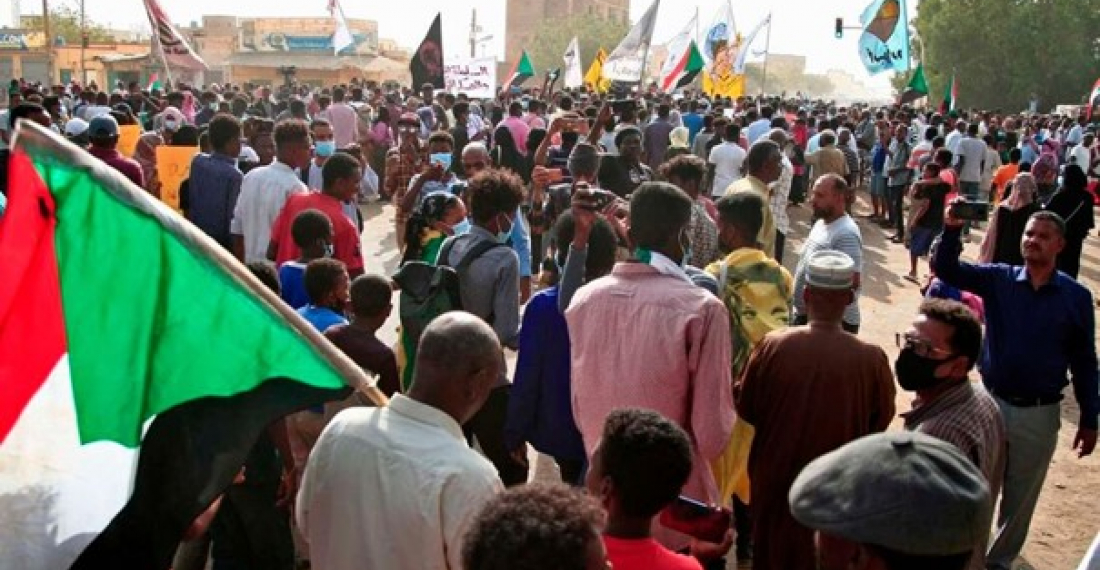
Human rights advocates, politicians, and members of the resistance committees opposed to the coup d'état of 25 October which enabled General Hemedti to seize power, had been arrested during night raids at their homes or during peaceful demonstrations.

These protests had continued despite a drastic repression by the new Junta security services, leaving 82 civilians dead and injuring more than 2,000 citizens, according to local doctors.

According to the lawyers' collective defending the detainees, the protesters were arrested without any charges being brought against them and without any legal procedure being followed. Among the 20 protesters still held are some political figures. Most of them are former members of the regime of former head of state Omar al-Bashir, who prior to the coup were investigating the corruption of elites close to the deposed regime.

General Hemedti, (full name Mohamed Hamdan Dagalo), is currently on an official visit to Russia where he will meet Russian President Vladimir Putin to discuss future military cooperation between the two countries.

Under pressure from the international community after the military coup of October 25, the arrival of the Sudanese colonel in Russia puts the creation of a naval basis in Sudan back on the table. Indeed, an agreement was signed in 2020 between both parties, but has so far been put on the sidelines.

This agreement would allow Russia to further assert its geopolitical return to the African continent, by allowing 300 Russian troops and four military ships, including a nuclear-powered vessel, into its base in Port Sudan.

Still, Khartoum also sees its benefit in this strategic and military partnership. This would represent a way to break the diplomatic isolation of the Sudanese junta, which is facing a popular mobilization that does not seem to fade.

Russia is indeed with Egypt one of the few countries that did not condemn the putsch last October in Khartoum, which put an end to the 30-year long former regime of Omar al-Bashir in Sudan.

Sources: CommonSpace.eu with Reuters (London), RFI (Paris) and other media outlets

Picture: Anti-coup protesters in Khartoum ; Twitter: @ADFmagazine



Related articles

Editor's choice
News
Aden under curfew, as problem in Yemen's south deepens

Aden under curfew, as problem in Yemen's south deepens

The port city of Aden, in Yemen's south, has been put under curfew, as the rift in the country between  the Saudi led coalition which  backs Yemen's presidential governing council, and the southern forces led by the Southern Transitional Council (STC), deepens. Abdul Rahman al-Mahrami, a member of the Yemeni Presidential Governing Council and commander of the al-Amalik brigades, has ordered a curfew in the temporary capital, Aden, "to maintain security". "A curfew has been imposed throughout Aden Governorate from 9:00 p.m. to 6:00 a.m., in accordance with the instructions of Commander Abdul Rahman al-Mahrami, a member of the Presidential Management Council," the statement said. It states that only security and military personnel, as well as medical and technical teams with approved permits, will be allowed to move in the area during these hours. Yemen's presidential council, which is backed by Saudi Arabia and which already is in a struggle with the Houthi Movement in the north of the country who also occupy the capital Sanaa, two days ago issued an order for the arrest of the head of the Southern Transitional Council (STC),, Aidarous al Zubaidi. The STC have wide support among people in the South, and advocate that South Yemen restores its independence. The coalition warned of further escalation in Aden, long regarded as an STC stronghold, as the Presidential Leadership Council (PLC) chief accused STC leader Aidarous Al Zubaidi of “high treason” and announced the revocation of his membership in the governing body. The moves mark a sharp escalation in tensions within the anti-Houthi camp, despite National Shield Forces, rivals of the STC and former allies, having recently retaken control of Hadhramaut and Mahra from southern fighters. The STC’s takeover of the two regions last month angered Saudi Arabia and contributed to igniting the current internal conflict. (click the picture to read more)

Popular

Editor's choice
Analysis
Analysis: Why what happens in Greenland matters

Analysis: Why what happens in Greenland matters

The snap elections for the parliament of Greenland last Tuesday (6 April 2021) attracted unusual interest from major powers who have been watching the political and economic impact of the election results on their interests in the Arctic region. Among them, the Chinese, who have invested in the Kvanefjeld mine on the island. Maximiliaan van Lange analyses the background to the recent Greenlandic general elections, and the Island's geostrategic position in the Arctic in this article for commonspace.eu.