


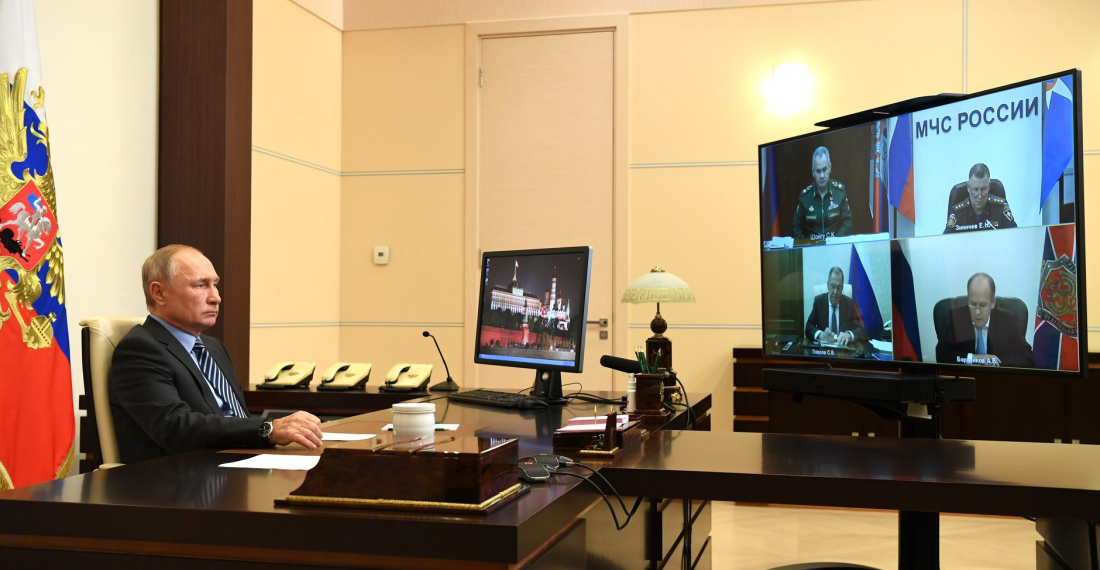
Russian President Vladimir Putin on Friday (13 November) chaired a meeting of his top security advisors to discuss the humanitarian aspects of the recent war in Nagorno-Karabakh. During the meeting, the President announced the creation of an Interdepartmental Center for Humanitarian Response in order to facilitate the solution of humanitarian issues and the restoration of civil infrastructure in Nagorno-Karabakh.
The meeting was attended by Defence Minister Sergei Shoigu, Foreign Minister Sergei Lavrov, Emergencies Minister Yevgeny Zinichev and FSB Director Alexander Bortnikov.
However, the president started the meeting by insisting that the term "Nagorno-Karabakh conflict" should not be used any more.
"We have met to discuss the situation that has taken shape in the Nagorno-Karabakh conflict zone. I hope we will no longer use the term - 'the Nagorno-Karabakh conflict'."
Referring to the humanitarian situation the president added, I hope that we will soon move on to the discussion of other issues but one of them is fairly topical."
Lavrov on international contacts
During the meeting, Russian Foreign Minister Sergei Lavrov reported about the contacts that Russia has had with the international community following the signing of the agreement to stop the Karabakh War by the leaders of Armenia, Azerbaija and Russia. Lavrov said,
We briefed our colleagues in detail, primarily from France and the United States as co-chairs - together with us - of the OSCE Minsk Group.
I spoke with the Minister of Foreign Affairs of France and explained to him in detail the situation and the efforts that you made. We also spoke with our American colleagues. In New York, the UN Security Council was fully informed of the efforts that were undertaken by Russia and led to the conclusion of the November 9 agreement.
We are also in contact with international organizations that are involved in humanitarian activities. These are primarily the Office of the [UN] High Commissioner for Refugees, the UN Office for the Coordination of Humanitarian Affairs and the UN Development Program.
All these structures have their presence in the region, but not directly in Nagorno-Karabakh. And now, in contacts with our Armenian and Azerbaijani colleagues, at the request of the UN structures, we are agreeing so that they can deploy their presence directly in Nagorno-Karabakh.
In the event of such a deployment, the UN is very interested in coordinating its actions with our peacekeepers, with our border guards and with those who will solve humanitarian tasks along the line of the mission that Russia is carrying out.
In addition to the UN structures and in addition to the requests that come from them, namely, to provide access to Karabakh to those in need, it is also important for them to have accurate data on how many refugees, how many displaced persons have moved where. It is also important for us to assess this on our own and, of course, also in contact with the Azerbaijani and Armenian sides.
Outside the UN, there is also the International Committee of the Red Cross, which has been working in the region for a long time, it had a permanent presence for many years in Stepanakert itself. After the outbreak of hostilities, they were forced to evacuate this presence to Yerevan, now they have returned there and are again resuming their work there, they are also interested in establishing coordination with our representatives.
The President of the International Committee of the Red Cross Peter Maurer will be in the Russian Federation on Tuesday, we expect to organize a meeting for him not only at the Ministry of Foreign Affairs, but also with our military, with representatives of the Ministry of Emergency Situations and border guards.
Russia to deploy additional 150 personnel from Ministry of Emergency Situations
During the meeting it also emerged that Russia will deploy as well as 150 personnel from its Ministry of Emergency Situations rescue centers, as well as 17 pieces of equipment, and was on standby to deploy an an emergency hospital and 50 personnel, including medical workers.
Putin announces the creation of a Humanitarian Response Centre
Concluding the meeting, president Putin announced the creation of a Humanitarian Response Centre
"In order to help the residents of the region in solving the most pressing problems, I consider it necessary to create an Interdepartmental Center for Humanitarian Response. Its work will involve the resources of the Ministry of Defense, the Ministry of Emergency Situations, the Ministry of Foreign Affairs, the border service of the FSB of Russia, and other departments of the Russian Federation.
The center will be engaged in operational support of the process of returning refugees to their places of permanent residence; interaction with state bodies of Azerbaijan and Armenia to restore civil infrastructure and create conditions for normal life in Nagorno-Karabakh; coordination of the work of government agencies and - I hope, I really count on it - of public organizations to provide humanitarian assistance to residents of areas affected by the war; providing assistance to the government bodies of Azerbaijan and Armenia, if, of course, they need it - and it seems to me that such assistance will be very useful, bearing in mind the complex prehistory of relations between the republics - in establishing interaction with international humanitarian organizations and among themselves ...
I ask the Russian Foreign Ministry to continue its work on informing the partners in the OSCE Minsk Group about the decisions taken, as well as the International Red Cross, the Red Cross Committee, it is necessary to inform the Office of the UN High Commissioner for Human Rights. We need to establish constructive full-fledged work with these structures, including with the Office of the UN High Commissioner for Refugees. UNESCO - we need to get in touch with them, with our colleagues from UNESCO, and I really count on their support.
I express the hope that the activities of the [Interdepartmental] Center will receive full support from all these structures.
We also count on the contribution and assistance from the Commonwealth of Independent States. We will maintain close interaction with all possible participants in this important work."
source: commonspace.eu with the press service of the president of Russia
photo: Russian president Vladimir Putin chairing a meeting on the humanitarian response to the consequences of the Nagorno-Karabakh War on 13 November 2020 (picture courtesy of kremlin.ru)



