


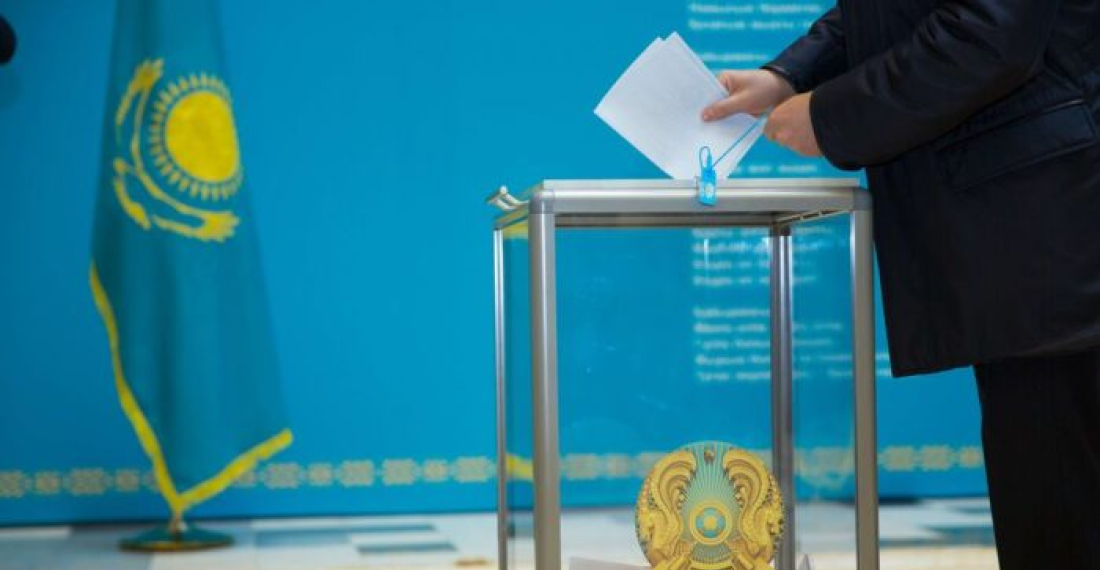
Kazakh parliamentary election polls project victory for ruling party despite big losses

A poll released by the Strategy Center for Social and Political Studies in Kazakhstan has projected victory for the ruling Amanat party despite heavy losses in the upcoming 19 March parliamentary election.

In the poll that surveyed 1,600 people between 17 and 27 February, 43.6% said they would vote for the ruling Amanat party, the former party of the current president Kassym-Jomart Tokayev.

This is however considerably lower than what the party received in the 2021 elections, when it received 71.09% of the vote, according to the Central Electoral Commission.

Madi Omarov, political scientist and project coordinator at the Strategy Center, said that the "significant decrease in the support for the party is most likely due to several factors, including President Tokayev’s resignation as party leader, rebranding, and the decline in popularity after the events of January 2022."

Meanwhile, 11.3% said they would vote for the Aq Jol party, 9.9% said they would vote for the Auyl party, 6.3% said they would vote for the People's Party, and 6.2% would vote for the Respublika party.

Click here to read more about the parties and their priorities

In order to win seats in the parliament, known as the Mazhilis, parties must pass a 5% threshold.

Speaking to The Astana Times, Omarov said that "the number of MPs of the ruling Amanat party should significantly decrease. They will probably manage to reach the required number to get a majority through single-mandate constituencies."

He did suggest, however, that it could be possible "for the first time in the history of Kazakhstan’s parliamentarism, this party [Amanat] will have to form a majority coalition with another party.”

In the same poll, turnout was predicted at 59%. 

22.7% respondents said they would "definitely go to the polls", while 36.3% said they would "probably vote".

38.6% of the respondents do not intend to vote, including 25% who are likely not to vote and 13.6% who said they will definitely not vote.
source: commonspace.eu with The Astana Times
photo: The Astana Times

Related articles

Editor's choice
News
Situation in South Yemen strains relations between Saudi Arabia and UAE

Situation in South Yemen strains relations between Saudi Arabia and UAE

The relations between Saudi Arabia and the United Arab Emirates (UAE) are increasingly strained as a result of the different approach of the two countries towards Yemen. Whilst both countries were initially together in resisting the Houthi take over in Yemen, the UAE subsequently focused on the South of the country, backing the Southern Movement (STC), which seeks to restore the independence of South Yemen. South Yemen became an independent country in 1967, at the end of British rule, and only unified with the north in 1990. The Saudi-led “Coalition to Support Legitimacy in Yemen” on Tuesday, 30 December, said it conducted a “limited” airstrike targeting two ships “that smuggled weapons and other military hardware into Mukalla in southern Yemen”. The ships originated in the UAE port of Furjeirah. In a statement carried by the Saudi Press Agency (SPA), the Coalition Forces spokesman, Major General Turki Al-Maliki, said that two ships coming from the port of Fujairah in the United Arab Emirates entered the Port of Mukalla in Hadramaut without obtaining official permits from the Joint Forces Command of the Coalition. He stressed the Coalition's "continued commitment to de-escalation and enforcing calm in the governorates of Hadramawt and Al-Mahra, and to prevent any military support from any country to any Yemeni faction without coordination with the legitimate Yemeni government and the Coalition. The Southern Transitional Council (STC), launched a sweeping military campaign early in December, seizing the governorates of Hadramaut along the Saudi border and the eastern governorate of Al-Mahra in Yemen’s border with Oman. The UAE-backed STC forces captured the city of Seiyun, including its international airport and the presidential palace. They also took control of the strategic PetroMasila oilfields, which account for a massive portion of Yemen’s remaining oil wealth. (click the image to read the article in full).

Popular

