Just when we thought the news from Gaza could not get bleaker, something new about the Israeli actions in the territory has emerged. Israel is arming “criminal gangs” in the war-torn Gaza Strip. Former Defence Minister, Avigdor Lieberman, revealed this on Thursday (5 June).
"Israel transferred assault rifles and light weapons to criminal gangs in Gaza,” Lieberman, leader of the right-wing Yisrael Beiteinu Party, told the public broadcaster KAN.
He said the weapons were transferred to the gangs upon orders of Israeli Prime Minister Benjamin Netanyahu.
“In my opinion, the Cabinet hasn’t approved the transfer of weapons, but the head of the General Security Service (Shin Bet) was aware,” he added.
“We are talking about what is equivalent to ISIS (Daesh) in Gaza. No one guarantees that these weapons will not be directed at Israel. We have no means of monitoring or tracking,” Lieberman said.
According to KAN, Netanyahu’s office did not deny arming groups in Gaza.
“Israel is working to defeat Hamas through various means, based on the recommendations of all the heads of the security establishment,” the office said in its response to KAN.
Shin Bet refused to comment on Lieberman’s statements.
KAN later reported that the decision to arm Palestinian militias in the Gaza Strip originated from the Shin Bet security agency and was approved by Netanyahu.
The operation was also reportedly carried out in coordination with Shin Bet chief Ronen Bar, Defence Minister Israel Katz, and Israeli Chief of Staff Eyal Zamir. The channel noted that the decision was not brought before the security cabinet, but rather made within a tight circle consisting of Netanyahu, Bar, Katz, and Zamir.
Yair Golan, head of the opposition “Democrats” party, warned that Netanyahu is "creating a new ticking time bomb in Gaza" by arming what he called "criminal militias."
Opposition leader Yair Lapid also issued a sharp warning on X, stating that the weapons Netanyahu provided to armed groups in Gaza could one day be used against Israeli soldiers themselves and called on the current government to resign.
In response, the Interior Ministry in Gaza stated that Israel’s announcement of forming groups inside the Gaza Strip amounts to an “official admission” of its responsibility for the chaos and looting, stressing that it will not allow disorder to prevail and will confront it.
In a statement, the ministry affirmed that “this admission reflects the occupation’s failure and inability after 20 months of aggression and continuous targeting of police and security personnel.”
Israeli media earlier reported the rise of “armed criminal groups” in Gaza that attack Palestinians under Israeli army protection.
The Israeli army, rejecting international calls for a ceasefire, has pursued a brutal offensive against Gaza since October 2023, killing more than 54,600 Palestinians, most of them women and children.
Last November, the International Criminal Court issued arrest warrants for Israeli Prime Minister Benjamin Netanyahu and his former Defense Minister Yoav Gallant for war crimes and crimes against humanity in Gaza.
Israel also faces a genocide case at the International Court of Justice for its war crimes against civilians in the enclave.
source: commonspace.eu with Anadolou Agency (Ankara) and other agencies
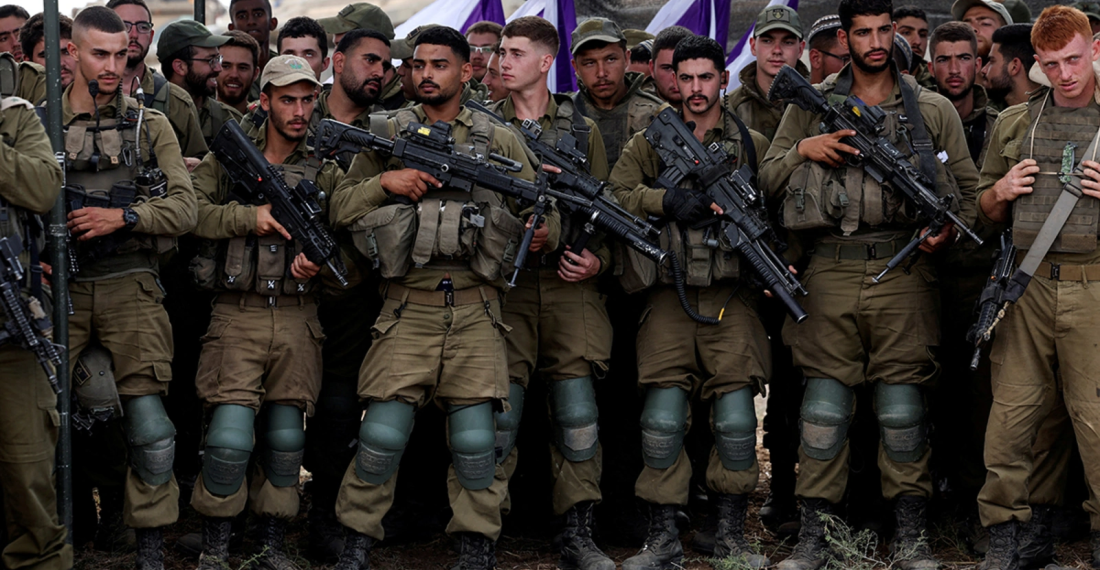
photo: Israeli troops in Gaza (archive picture)