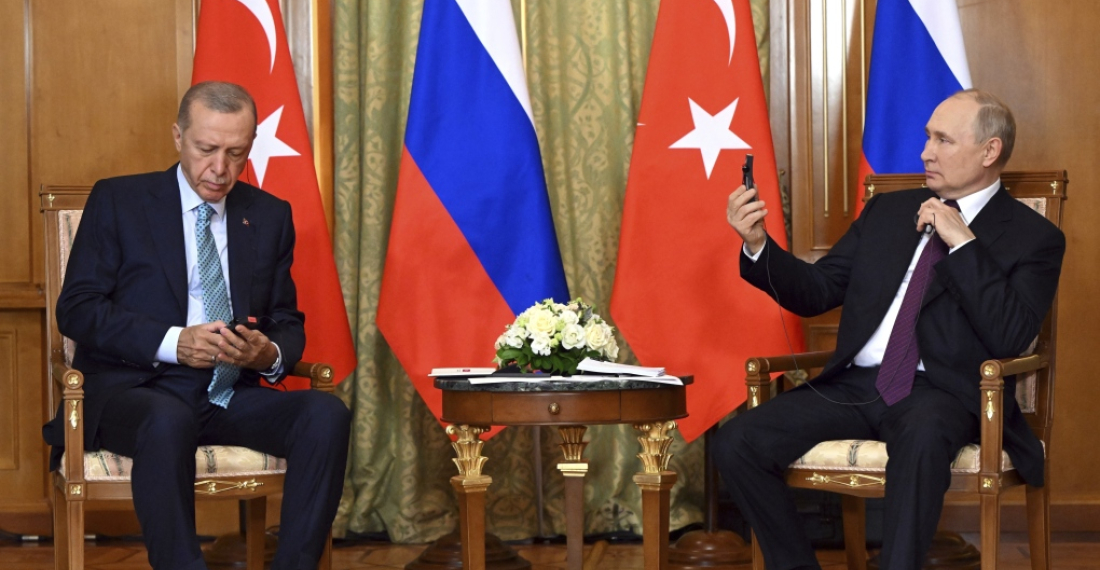
Turkish President Recep Tayyip Erdoğan on Monday (4 September) is holding a long-awaited summit meeting with Russian President Vladimir Putin in the Black Sea resort of Sochi.
Central to the discussions is the question of the export of Ukrainian grain to world markets. Türkiye and the United Nations seek to revive a key agreement that allowed Ukraine to export grain and other commodities from three Black Sea ports despite the 18-month war.
The visit comes more than one month after Moscow suspended the deal, which was brokered by Türkiye and the U.N. and was seen as vital for global food supplies, especially in Africa, the Middle East and Asia. Ukraine and Russia are major suppliers of wheat, barley, sunflower oil and other goods that developing nations rely on.
President Erdoğan said the grain deal was the headline issue at the daylong talks between the two leaders.
"Everyone is looking at the grain corridor issue," Erdoğan said in opening remarks. A lot is riding on the talks for the world food supply. "I believe that the message we will give after our meeting will constitute an important step for the world, especially for the underdeveloped African countries," the Turkish leader said.
Russia broke off the deal, complaining that a parallel deal promising to remove obstacles to Russian exports of food and fertiliser hadn't been honoured and that not enough Ukrainian grain was going to countries in need. It said restrictions on shipping and insurance hampered its agricultural trade even though it has shipped record amounts of wheat since last year.
Putin told Erdoğan that Russia was "open" to talks on restoring the Black Sea initiative. "I know you intend to raise the issue of the grain deal. We are open to negotiations on this issue," he said in televised comments.
But whilst the grain deal may be the centre-piece of today's discussions there are other issues on the agenda too. Turkiye and Russia have an extensive and complex bilateral agenda which the two presidents are bound to review.
There are also issues related to regional peace and security, including the situation in Syria, where Russian and Turkish interests have often clashed, and the situation in the South Caucasus, where ongoing tensions between Armenia and Azerbaijan mar the prospects of a peace deal.
The trip to the Black Sea resort city marks a rare visit by a leader of a NATO country to Russia amid Moscow's all-out war in Ukraine. Erdogan has kept open his lines of communication with Putin
Monday's talks mark the first meeting between the two leaders since Erdoğan's reelection for a third term as president in May.
Erdoğan is accompanied on his trip to Sochi by a large delegation that included Türkiye's defense, foreign, energy and finance ministers.
Türkiye and Russia have enjoyed growing ties in several areas, including energy.
Erdoğan said his government wanted to boost annual trade with Russia to $100 billion from $62 billion, adding that he supported Moscow's push to switch a part of that trade into Turkish liras and rubles.
"I believe that switching to local currencies is extremely important in bilateral relations," he said.
For his part, Putin said the two leaders had raised relations between the two countries to a "very good, high level."
He mentioned various areas of bilateral cooperation, such as a proposed Russian gas hub in Türkiye and the construction of the first nuclear power plant, Akkuyu, in which Moscow is actively involved.
He also said he hoped they would wrap up talks soon on creating a hub in Türkiye for exports of Russian gas.
The talks are expected to last all day.
Source: commonspace.eu with Daily Sabah (Ankara) and agencies
Photo: President Erdogan of Turkey met President Putin of Russia in Sochi on 4 September 2023 (picture courtesy of Kremlin Pool)