


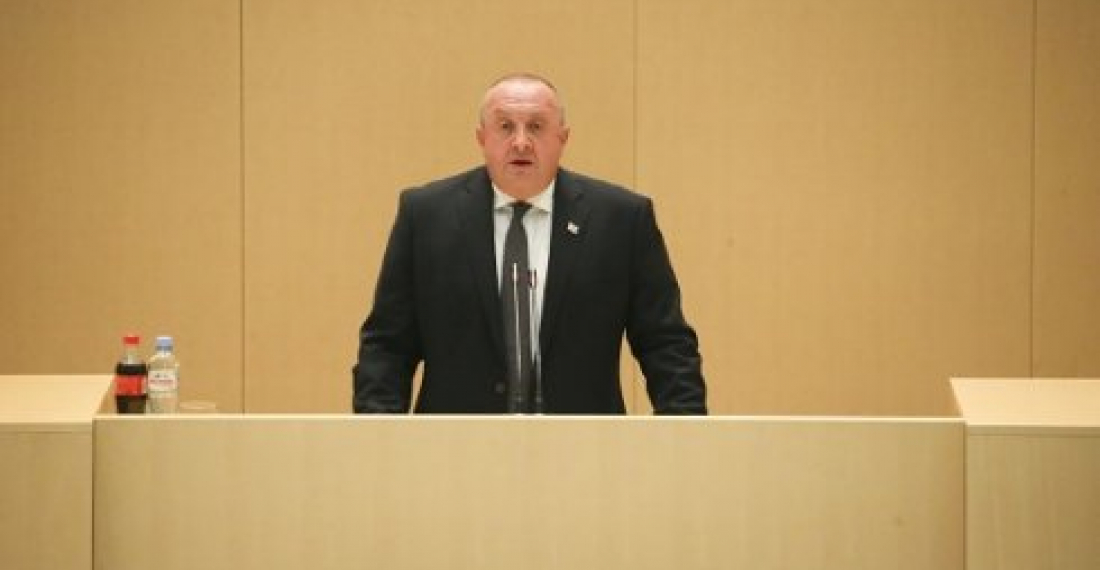
Georgian President calls for an anti-annexation policy to be developed with allies

The President of Georgia, Giorgi Marghvelashvili has called for the development of an anti-annexation policy, developed with the active engagement of Georgia's allies to counter Russian moves to annexe the separatist regions of Abkhazia and South Ossetia. Speaking in Kutaisi on Friday (7 April), in his annual address to the Georgian Parliament, President Marghvelashvili addressed a wide range of domestic and international issues, and called on politicians to listen to the people.

You can read the full speech of the president of Georgia here

Referring to the situation in Abkhazia and South Ossetia, the President of Georgia said,

The non-recognition policy is an excellent example of cooperation and efficient policy with our partners, which is successfully pursued by the Georgian state and its partners. In response to our success, the Russian Federation takes actions towards the factual annexation of Georgia's occupied territories. Therefore, as in the case of the non-recognition policy, it is necessary to create the Anti-Annexation policy of Georgia's occupied territories with an active engagement of our allies and take coordinated steps to deter the annexation.

At the same time, we have to react promptly on new dividing lines and installation policy of barbwires, cases on the prohibition of education in Georgian language in Gali schools, as well as kidnapping and destructions of our cultural heritages. We have to be firm and united on such important issues of our country.

Marghvelashvili used the speech to also address directly people in Abkhazia and South Ossetia,

Hereby, I would like to address our citizens in the occupied territories - no one would have imagined the fall of Berlin Wall and the leader of the united Germany, becoming a citizen of the Eastern Germany. I hope that one day artificially built walls will be destroyed and the leader of the united Georgia, living beyond the wall will become a Georgian citizen. Time will come when divided society of Abkhazia and Tskhinvali regions will be united, when Georgians, Abkhazians and Ossetians will be able to find the one, who will unite us, when the refugees will return home safely.

The speech came only days before voting is taking place in the self-declared republic of South Ossetia to elect a President, and change the name of the territory. The move has been condemned by the international community. A statement by the spokesperson of the European Union stated:

The European Union does not recognise the framework in which the so-called Presidential elections and the referendum on amending the name of the Georgian breakaway region of South Ossetia are due to take place on 9 April.

The European Union reaffirms its commitment to a peaceful resolution of the conflict in Georgia, including through its co-chairmanship of the Geneva International Discussions and the EU Monitoring Mission.

The European Union reiterates its firm support for the sovereignty and territorial integrity of Georgia within its internationally recognised borders.

A statement by the United States Embassy in Tbilisi on Friday said,

The United States condemns and does not recognize the results of the illegitimate elections conducted in Abkhazia on March 12 and March 26 or the election planned for April 9 in South Ossetia. The United States also condemns the decision to hold a referendum on April 9 regarding the amendment of South Ossetia's constitutional name to the Republic of South Ossetia-Alania.

These illegitimate elections and referenda are being conducted in Georgian territory without the consent of the government of Georgia. The United States fully supports the territorial integrity of Georgia and its sovereignty within its internationally recognized borders. Our position on Abkhazia and South Ossetia is clear and consistent. These regions are integral parts of Georgia.

source: commonspace.eu

photo: President Giorgi Marghvelashvili of Georgia making his annual address to the Georgian Parliament, in Kutaisi on 7 April 2017. (Picture courtesy of the press office of the president of Georgia)

Related articles

Editor's choice
News
Women emerge favourite to lead United Nations from next year, after straw-poll of UN Security Council members

Women emerge favourite to lead United Nations from next year, after straw-poll of UN Security Council members

​ Two women have emerged as favourite to lead the United Nations as Secretary-General from 1 January 2027, when the term of the present incumbent, Antonio Gutteres, expires. A straw poll of the members of the UN Security Council, held on Thursday, 30 July showed that of the seven candidates, Rebecca Grynspan of Costa Rica and Carolyn Rodriguez-Birkett of Guyana received ten and nine positive endorsements respectively, by the 15 members UN Security Council Although the poll and its result are supposed to be secret, the result leaked within minutes, and was carried on world media outlets, such as Reuters. The result was as follows   Michelle Bachelet 6 encourage 5  discourage   4 no opinion María Fernanda Espinosa 5 2 8 Rafael Grossi 7 2 6 Rebeca Grynspan 10 1 4 Olara Otunnu 2 5 8 Carolyn Rodrigues-Birkett 9 2 4 Macky Sall 6 7 2   Article 97 of the UN Charter states that the “Secretary-General shall be appointed by the General Assembly upon the recommendation of the Security Council”. Straw polls are informal ballots used to determine the viability of Secretary-General candidates.  The seven current candidates are: Michelle Bachelet Jeria (Chile), who was nominated by Brazil, Chile, and Mexico on 2 February, with Chile withdrawing its nomination on 24 March; María Fernanda Espinosa Garcés (Ecuador), who was nominated by Antigua and Barbuda on 11 May; Rafael Mariano Grossi (Argentina), who was nominated by Argentina on 26 November 2025; Rebeca Grynspan Mayufis (Costa Rica), who was nominated by Costa Rica on 3 March; Olara Otunnu (Uganda), who was nominated by Uganda on 24 July; Carolyn Rodrigues Birkett (Guyana), who was nominated by Guyana on 15 June; and Macky Sall (Senegal), who was nominated by Burundi on 2 March. At Thursday's straw poll, there was no difference between the ballots presented to the five permanent members (P5) and the ten elected members (E10). Council members received one ballot per candidate, containing the candidate’s name followed by three options: “encouraged”, “discouraged”, and “no opinion expressed”.   It is ofcourse early days, and the straw poll is just an informal indication of the mood of the UN Security Council, but the strong showwing by the two womencandidates may be an indication that for the first time, the head of the UN can be a women. (click image to read more) ​

Popular

Editor's choice
Interview
Thursday Interview: Murad Muradov

Thursday Interview: Murad Muradov

Today, commonspace.eu starts a new regular weekly series. THURSDAY INTERVIEW, conducted by Lauri Nikulainen, will host  persons who are thinkers, opinion shapers, and implementors in their countries and spheres. We start the series with an interview with Murad Muradov, a leading person in Azerbaijan's think tank community. He is also the first co-chair of the Action Committee for a new Armenian-Azerbaijani Dialogue. Last September he made history by being the first Azerbaijani civil society activist to visit Armenia after the 44 day war, and the start of the peace process. Speaking about this visit Murad Muradov said: "My experience was largely positive. My negative expectations luckily didn’t play out. The discussions were respectful, the panel format bringing together experts from Armenia, Azerbaijan, and Turkey was particularly valuable during the NATO Rose-Roth Seminar in Yerevan, and media coverage, while varied in tone, remained largely constructive. Some media outlets though attempted to represent me as more of a government mouthpiece than an independent expert, which was totally misleading.  Overall, I see these initiatives as important steps in rebuilding trust and normalising professional engagement. The fact that soon a larger Azerbaijani civil society visits to Armenia followed, reinforces the sense that this process is moving in the right direction." (click the image to read the interview in full)

