


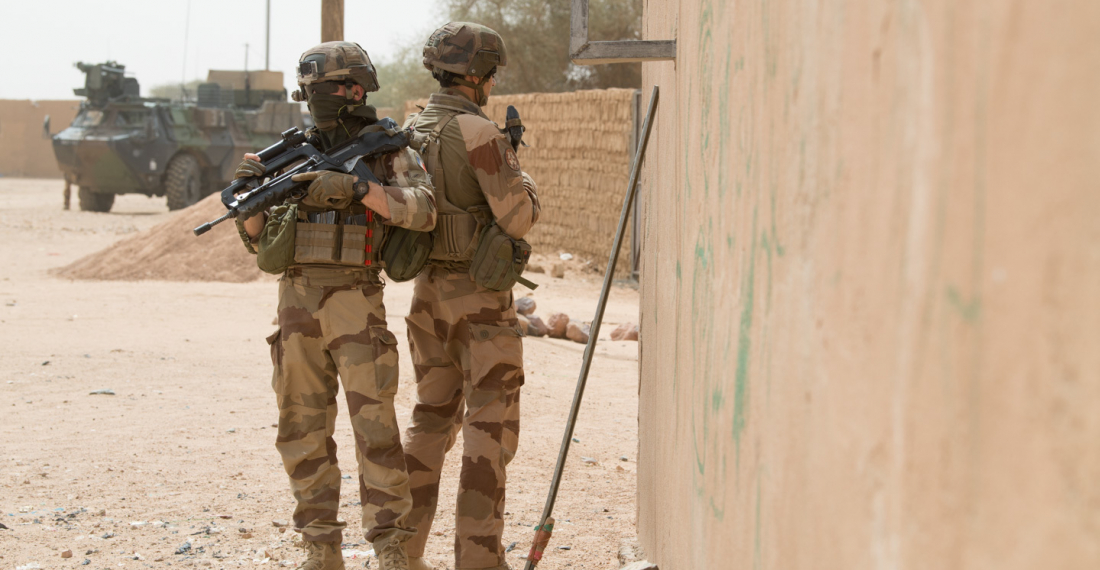
French army kills two terrorist leaders in northeastern Mali

The French minister of the Armed Forces, Florence Parly, announced in a statement on 22 July that France's operation Barkhane had killed two leaders of the Islamic State in the Greater Sahara (IS-GS) during the night of the 21-22 July.

"In co-ordination with the US military, the Barkhane force launched last night, at very short notice, an operation against a camp of the IS-GS, an organisation affiliated with Daesh, in the Ménaka region" in northeastern Mali, the statement said.

On July 23, Parly indicated that the leaders were Issa Al Sahraoui, "logistics and financial co-ordinator of the IS-GS", and Abu Abderahmane Al Sahraoui, "who was responsible for pronouncing judgments".

The first “had been rife in the Sahel for many years. He notably took part in the Inates attack against the Nigerian armed forces in December 2019 and recruited and trained jihadists." The second “was known to order death sentences. This jihadist had been active in armed terrorist groups in Mali for 10 years," she added.

In its statement, the ministry recalled that “several high-ranking IS-GS executives had already been neutralised in June, including one of the group leaders, Dadi Ould Chaib, better known as Abu Dardar, as well as Almahmoud ag Baye alias Ikaray, important executive of the IS-GS, close to the leader of the IS-GS Adnan Abou Walid al Sahraoui”.

Additionally, Parly stated that this new operation falls within the framework of France's strategy to target “terrorist leaders and cadres” and “illustrates [its] determination to continue the fight against armed terrorist groups, alongside [its] Sahelian partners and in co-ordination with [its] European and American allies".

After more than eight years of significant engagement, French President Emmanuel Macron announced in June a reduction of the French military presence in the Sahel and the end of the anti-jihadist operation Barkhane (currently 5,100 soldiers) in favour of a tightened device, refocused on counterterrorism operations and combat support for local armies, around an international alliance associating Europeans within the Takuba Force.
 

source: commonspace.eu with agencies.
photo: French soldiers from the Barkhane force in Liptako, Mali, 2019; French Ministry of Defence.

Related articles

Editor's choice
News
European leaders set out their plan for Ukraine

European leaders set out their plan for Ukraine

The leaders of Germany, Denmark, Finland, France, Italy, Netherlands, Norway, Poland, Sweden, and United Kingdom, together with the President of the European Council, and the President of the European Commission, o  Monday (15 December) issued a statement, outlining their plan for Ukraine. In their statement, Chancellor Merz, Prime Minister Frederiksen, President Stubb, President Macron, Prime Minister Meloni, Prime Minister Schoof, Prime Minister Støre, Prime Minister Tusk, Prime Minister Kristersson, Prime Minister Starmer, as well as President Costa and President von der Leyen spoke about "Peace for Ukraine". The Leaders welcomed significant progress on President Trump’s efforts to secure a just and lasting peace in Ukraine. They also welcomed the close work between President Zelenskyy’s and President Trump’s teams as well as European teams over the recent days and weeks. They agreed to work together with President Trump and President Zelenskyy to get to a lasting peace which preserves Ukrainian sovereignty and European security. Leaders appreciated the strong convergence between the United States, Ukraine and Europe. Leaders agreed that ensuring the security, sovereignty, and prosperity of Ukraine was integral for wider Euro-Atlantic security. They were clear that Ukraine and its people deserved a prosperous, independent, and sovereign future, free from fear of future Russian aggression. Both the US and European leaders committed to work together to provide robust security guarantees and economic recovery support measures for Ukraine in the context of an agreement on ending the war. This would include commitments to: Provide sustained and significant support to Ukraine to build its armed forces, which should remain at a peacetime level of 800,000 to be able to deter conflict and defend Ukraine’s territory. A European-led ‘multinational force Ukraine’ made up from contributions from willing nations within the framework of the Coalition of the Willing and supported by the US. It will assist in the regeneration of Ukraine’s forces, in securing Ukraine’s skies, and in supporting safer seas, including through operating inside Ukraine. (Click the image to read the statement in full).

Popular

