France is hosting in Paris on Friday (12 November), a conference to support the holding planned elections Libya in December. The international community hopes the elections can help end a decade long chaos in Libya that followed the overthrow of Muammar Gadhaffi. There are, however, fears that certain Libyan factions may not accept the result of the elections and could possibly plunge Libya back to crisis.
A source close to the French presidency, speaking on a condition of anonymity, told reporters that while the elections are close, the situation remains tense and fragile and some actors are ready to seize on any pre-elections ambiguities to advance their own interests.
It is likely that the final communique will include a warning to such spoilers, including the threat of sanctions against parties disrupting the process. Concerns about the elections have recently also been voiced by the group Human Rights Watch who expressed concern about the chances of holding free and fair elections. The group criticised what it described as Libya’s restrictive laws as well as the presence of armed groups accused of intimidating, attacking and detaining journalists and political activists.
Key leaders attending the Paris conference include US Vice President Kamala Harris, Egyptian President Abdel Fattah El Sisi, German Chancellor Angela Merkel, Italian Prime Minister Mario Draghi, and United Nations Secretary-General Antonio Guterres and representatives of Turkey and Greece.
Ankara and Moscow are sending lower-level representatives. Russian Foreign Minister Sergei Lavrov and Turkish deputy foreign minister Sedat Onal will be attending. Algeria's President Abdelmadjid Tebboune will also not attend due to the tensions of his country with France but other officials will be present.
Libya will be represented by Mohamed al-Menfi, the head of the transitional presidential council that carries out head-of-state functions ahead of the elections, as well as Prime Minister Abdelhamid Dbeibah.
For Macron, success in Libya is a high priority given that he faces re-election in April. France will also assume the European Union’s presidency on 1 January 2022..
Source: commonspace.eu with Al Jazeera (Doha), AMNA (Athens), France24 (Paris).
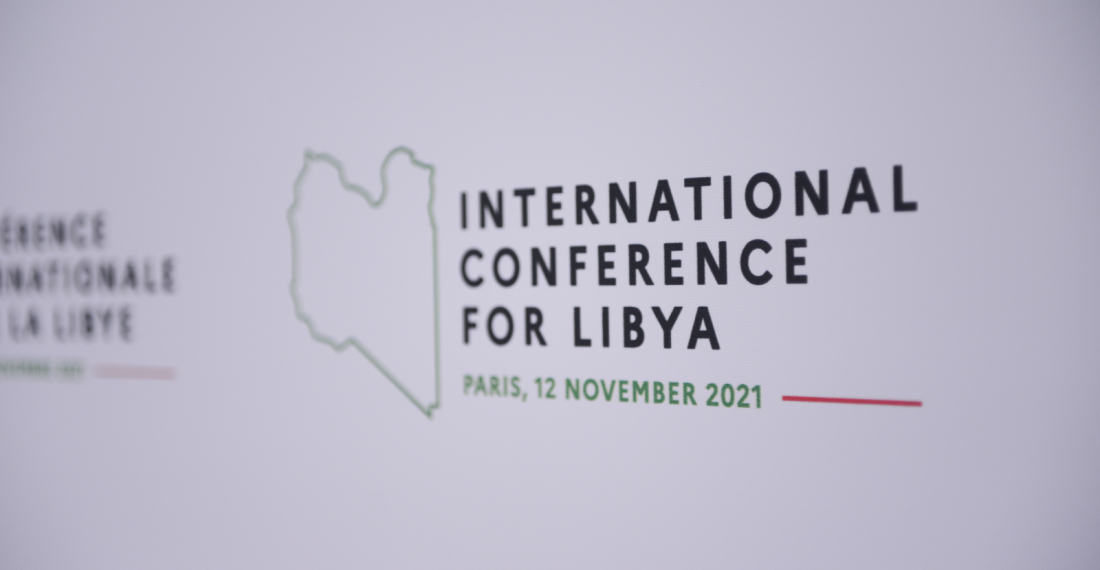
Picture: Banner of the conference on Libya held today in Paris; Twitter: @ObervatoryLY.