


EU tariffs on China are not punishment, says German economy minister

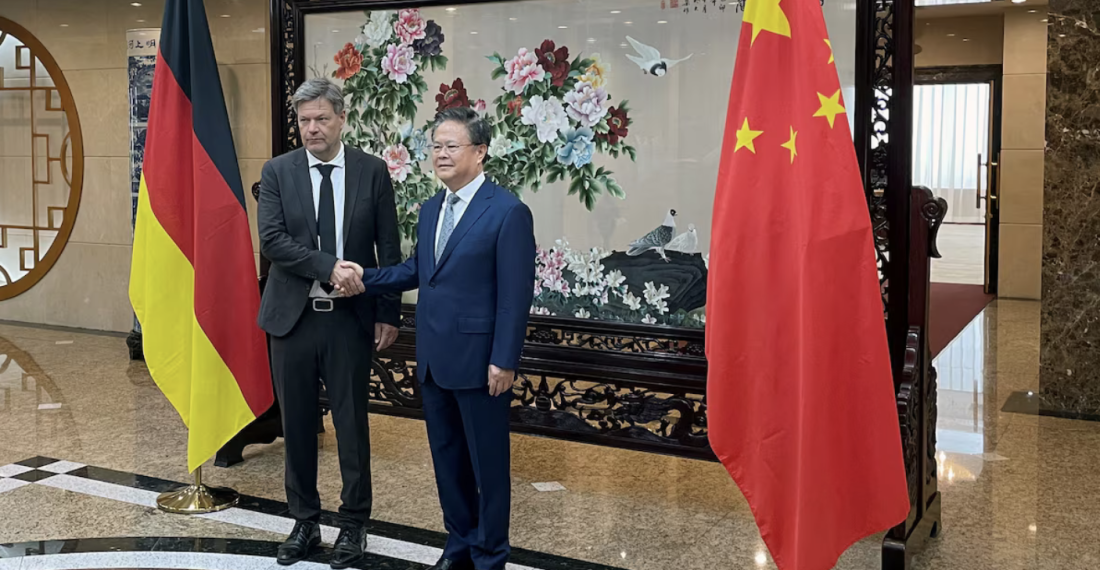
Proposed European Union tariffs on Chinese goods are not a "punishment", German Federal Minister for Economic Affairs and Climate Action Robert Habeck assured Chinese officials in Beijing on Saturday (22 June). The visit is the first by a senior European official since Brussels proposed significant tariffs on imports of Chinese-made electric vehicles (EVs) in response to what the EU sees as excessive subsidies. Ahead of Habeck's arrival, China warned that rising tensions over EVs could spark a trade war. "It is important to understand that these are not punitive tariffs," Habeck told the opening session of a dialogue on climate and transformation. He stressed that unlike the US, Brazil and Turkey, which have used punitive tariffs, the EU is taking a different approach.

The European Commission spent nine months investigating whether Chinese companies had received unfair subsidies. Habeck explained that any countervailing duties resulting from the EU's review are not punitive but are intended to offset the advantages that Beijing has granted to Chinese companies. "Achieving common, equal standards for market access is essential," he added. During a meeting with Zheng Shanjie, chairman of China's National Development and Reform Commission, Habeck explained that the proposed EU tariffs aimed to create a level playing field. Zheng countered, "We will do everything to protect Chinese companies," arguing that the tariffs would hurt both sides. He urged Germany to take the lead within the EU and "do the right thing". Zheng rejected accusations of unfair subsidies, arguing that the growth of China's new energy industry was due to competitive advantages in technology, market and industry chains. This growth was the result of competition, not subsidies, Zheng said. Following his meeting with Zheng, Habeck spoke with Chinese Commerce Minister Wang Wentao, who was due to discuss the tariffs with EU Commissioner Valdis Dombrovskis via video conference on Saturday evening.

Although trade tensions were a key issue, the main aim of the meeting was to strengthen cooperation on the green transition between the two industrialised nations. This was the first plenary meeting of the Climate and Transformation Dialogue since Germany and China signed a memorandum of understanding in June last year to cooperate on climate change and the green transition. China will add nearly 350 gigawatts (GW) of new renewable capacity in 2023, more than half the global total. At this rate, China is likely to exceed its 2030 target this year, according to a June report by the International Energy Agency (IEA). While Habeck praised China's expansion of renewable energy, he stressed the importance of looking at overall CO2 emissions. Coal will still account for almost 60% of China's electricity supply 2023. "China has a coal-based energy mix," Zheng acknowledged, with China, India and Indonesia accounting for nearly 75% of global coal consumption, prioritising energy security, availability and cost over carbon emissions. Zheng noted that China is building coal-fired power plants as a security measure. "I still believe that the massive expansion of coal power can be approached differently if you consider the role of renewables in the system," Habeck replied.

Source: commonspace.eu and Reuters with other agencies

Related articles

Editor's choice
News
Borrell tells the European Parliament that the situation in Afghanistan was critical, but the EU will remain engaged

Borrell tells the European Parliament that the situation in Afghanistan was critical, but the EU will remain engaged

Borrell underlined that the European Union will make every effort to support the peace process and to remain a committed partner to the Afghan people. "Of course, we will have to take into account the evolving situation, but disengagement is not an option.  We are clear on that: there is no alternative to a negotiated political settlement, through inclusive peace talks.
Editor's choice
News
NATO Chief says war is on Europe's doorstep, and warns against complacency

NATO Chief says war is on Europe's doorstep, and warns against complacency

Russia could attack a NATO country within the next five years, the Secretary General of NATO, Mark Rutte, said in a stark new warning. "NATO's own defences can hold for now," Rutte warned in Berlin, but conflict was "next door" to Europe, and he feared "too many are quietly complacent, and too many don't feel the urgency, too many believe that time is on our side. "Russia is already escalating its covert campaign against our societies," Rutte said in a speech in Germany. "We must be prepared for the scale of war our grandparents or great-grandparents endured." Earlier this month, Russia's President Vladimir Putin said his country was not planning to go to war with Europe, but it was ready "right now" if Europe wanted to - or started a war. But similar reassurances were given by Moscow in 2022, just before 200,000 Russian troops crossed the border and invaded Ukraine. Putin has accused European countries of hindering US efforts to bring peace in Ukraine - a reference to the role Ukraine's European allies have recently played in trying to change a US peace plan to end the war, whose initial draft was seen as favouring Russia. But Putin was not sincere, Nato's secretary-general said in the German capital, Berlin. Supporting Ukraine, he added, was a guarantee for European security. "Just imagine if Putin got his way; Ukraine under the boot of Russian occupation, his forces pressing against a longer border with Nato, and the significantly increased risk of an armed attack against us." Russia's economy has been on a war footing for more than three years now - its factories churn out ever more supplies of drones, missiles and artillery shells. According to a recent report by the Kiel Institute for the World Economy, Russia has been producing each month around 150 tanks, 550 infantry fighting vehicles, 120 Lancet drones and more than 50 artillery pieces. The UK, and most of its Western allies, are simply not anywhere near this point. Analysts say it would take years for Western Europe's factories to come close to matching Russia's mass-production of weapons. "Allied defence spending and production must rise rapidly, our armed forces must have what they need to keep us safe," the Nato chief said.

Popular

Editor's choice
News
NATO Chief says war is on Europe's doorstep, and warns against complacency

NATO Chief says war is on Europe's doorstep, and warns against complacency

Russia could attack a NATO country within the next five years, the Secretary General of NATO, Mark Rutte, said in a stark new warning. "NATO's own defences can hold for now," Rutte warned in Berlin, but conflict was "next door" to Europe, and he feared "too many are quietly complacent, and too many don't feel the urgency, too many believe that time is on our side. "Russia is already escalating its covert campaign against our societies," Rutte said in a speech in Germany. "We must be prepared for the scale of war our grandparents or great-grandparents endured." Earlier this month, Russia's President Vladimir Putin said his country was not planning to go to war with Europe, but it was ready "right now" if Europe wanted to - or started a war. But similar reassurances were given by Moscow in 2022, just before 200,000 Russian troops crossed the border and invaded Ukraine. Putin has accused European countries of hindering US efforts to bring peace in Ukraine - a reference to the role Ukraine's European allies have recently played in trying to change a US peace plan to end the war, whose initial draft was seen as favouring Russia. But Putin was not sincere, Nato's secretary-general said in the German capital, Berlin. Supporting Ukraine, he added, was a guarantee for European security. "Just imagine if Putin got his way; Ukraine under the boot of Russian occupation, his forces pressing against a longer border with Nato, and the significantly increased risk of an armed attack against us." Russia's economy has been on a war footing for more than three years now - its factories churn out ever more supplies of drones, missiles and artillery shells. According to a recent report by the Kiel Institute for the World Economy, Russia has been producing each month around 150 tanks, 550 infantry fighting vehicles, 120 Lancet drones and more than 50 artillery pieces. The UK, and most of its Western allies, are simply not anywhere near this point. Analysts say it would take years for Western Europe's factories to come close to matching Russia's mass-production of weapons. "Allied defence spending and production must rise rapidly, our armed forces must have what they need to keep us safe," the Nato chief said.

