


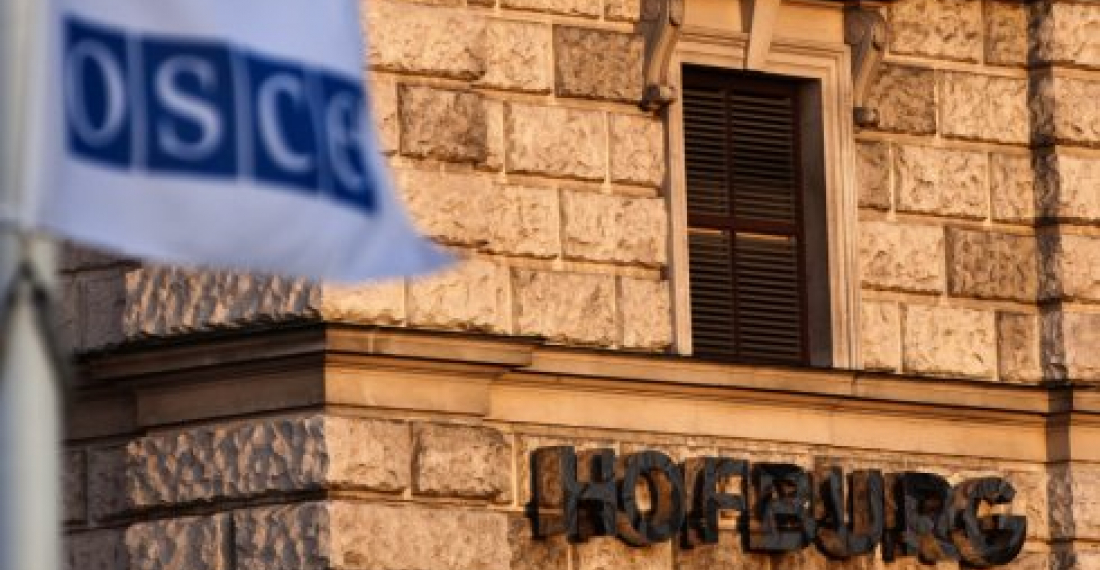
EU reiterates its support for peaceful resolution of the Karabakh Conflict

The EU delegate to the OSCE Permanent Council in Vienna on Thursday reiterated the committment of the EU to contribute towards a peaceful solution of the conflict through support for the Minsk Group, the work of the EUSR for the South Caucasus and initiatives such as EPNK.

The EU delegate was speaking at a meeting of the Permanent Council of the Organisation for Security and Co-operation in Europe (OSCE), which took place in Vienna on Thursday, 9 November. The Permanent Council heard reports from the co-Chair of the OSCE Minsk Process, the Special Representative of the OSCE Chairmanship and the Head of the High Level Military Planning Group dealing with the conflict.

In its statement to the Permanent Council the European Union reiterated its support for the Minsk Group and declared its full trust to the co-chairs in their work to advance the search for a political, equitable and sustainable solution of the Nagorno-Karabakh conflict, essential for the future of the region.

It added:

"We invite parties to take better advantage of the efforts deployed by the co-chairs. The European Union is following closely developments in the Karabagh region, which remains highly volatile. The past year has again seen far too many victims and there are almost daily violations of the cease-fire. Cases of heavy artillery use or targeting of the civilian population are of particular concern. We reiterate our condemnation of all use of force and call on the parties to avoid any action likely to fuel tensions. To this end, We call on the parties to strictly respect the ceasefire, in accordance with their commitments.

In general, the parties must observe restraint, both in the field and in their public statements.

The European Union welcomes the resumption of contacts at the highest level with the holding of a presidential summit on 16 October in Geneva. We consider very important, the agreement between the Armenian and Azerbaijanis on an intensification of the negotiation process, including at the ministerial level, as well as new measures to reduce incidents along the line of contact.

We continue to support the implementation of the confidence-building measures approved in 2016 at the Vienna and St. Petersburg Summits, including the expansion of the office of the Personal Representative, the humanitarian measure on exchange of data on the disappeared from the conflict under the auspices of the ICRC, and further discussions on the establishment of a mechanism investigation of incidents.

The European Union reiterates its commitment to a peaceful settlement of the Nagorno-Karabakh, on the basis of the fundamental principles of the Charter of the United Nations and the Helsinki Final Act. It recognizes the unsustainable and dangerous nature of the status quo and calls for the development of a comprehensive peace treaty. The European Union remains mobilized, through his Special Representative in particular, to provide support to conflict resolution efforts. It is engaged as part of its program for facilitating contact between societies divided by conflict - The European Partnership for the Peaceful Settlement of the Conflict over Nagorno-Karabakh (EPNK). It remains available for setting up other confidence-building measures in support and full complementarity of the Minsk Group.

The European Union wishes to thank on this occasion Ambassador Herbert Salber for the work done as Special Representative in the last three years and wishes a full success to his successor, Toivo Klaar.

Mr President, We wish to share our positive appreciation for the work done, sometimes in difficult security conditions, by the Representative of the Chairman-in-Office Ambassador Kasprzyk, and his team. The European Union attaches the utmost importance to the unimpeded pursuit of its ceasefire monitoring activities on the LOC and along the border between Armenia and Azerbaijan. We thank Ambassador Kasprzyk for providing other examples of the activities carried out by the Office, such as in the humanitarian sphere. All of these activities unquestionably contribute to reduce tensions in the region and are a valuable instrument for the implementation of confidence-building measures on the ground. The office of Personal Representative represents, since the closure of the mission to Yerevan, the only OSCE presence in the region. We encourage the good faith implementation of the decision to extend the Office of the Personal Representative, which should include: intensification of observation missions. This would be an important step for build trust between the parties and advance the process of conflict resolution.

Mr President, The European Union also reiterates its full support for the activities of the planning for the deployment of a peacekeeping mission conducted by the HLPG under the guidanceof Colonel Lampalzer. The deployment of a mission, however, will depend on the parties' on the basis of the principles identified for a peaceful settlement of the conflict under the auspices of the Minsk Group. We support the measures taken to improve the planning capabilities of the HLPG, such as participation of HLPG members in the monitoring exercises of the Personal Representative, the OSCE Global Approach (the "whole-of-OSCE" approach ") and continuing contacts with other international organizations working in the field of peacekeeping. The organization of a reconnaissance visit to the field, which was not possible for years, would be useful in this regard.

In conclusion, the European Union renews its full support to the Co-Presidents of the Minsk Group, Ambassador Kasprzyk, as well as the HLPG. These processes form essential components of the architecture for the peaceful settlement of the Nagorno-Karabakh conflict. The European Union also reiterates its determination to work closely with the Parties in promoting stability and prosperity, and the consolidation of democracy and the rule of law in the region, and to strenghten its relations with the region particularly in the framework of the Eastern Partnership.

The full text of the statement is available in the original French version here

source: commonspace.eu with the press service of the Mission of the European Union to international organisations in Vienna.
Related articles

Editor's choice
News
Council of Europe launches new International Claims Commission for Ukraine

Council of Europe launches new International Claims Commission for Ukraine

Thirty-four countries and the European Union have signed a new convention establishing an International Claims Commission for Ukraine at a diplomatic conference co-hosted by the 46-nation Council of Europe and the Netherlands in the Hague. The diplomatic conference was attended by leaders and high-level representatives from over 50 states, including the President of Ukraine, Volodymyr Zelenskyy, the President of the Republic of Moldova, Maia Sandu, and the Prime Minister of the Netherlands, Dick Schoof.  “Today marks a major step forward in ensuring accountability for Ukraine. The International Claims Commission represents justice and hope for tens of thousands of victims—our determination that those who have suffered will not be forgotten. I call for quick ratifications so we can get the commission rapidly up and running for the people of Ukraine,” said Council of Europe Secretary General Alain Berset. Ukrainian President Volodymyr Zelenskyy said: “We expect that every mechanism for compensation from the Register of Damage and Claims Commission to the actual payments – will start working and receive strong and sufficient international support, so that people can truly feel that any kind of damage caused by the war can be compensated. This war, and Russia’s responsibility for it, MUST become a clear example – so that others learn not to choose aggression.” “Accountability is about creating the conditions for peace that endures. And therefore, accountability is a condition of security – today and for the future. But accountability is not only about Ukraine. And it is not only about one aggressor and one victim. Accountability is about Europe. About every country in Europe. It is about whether Europe, as a whole, is willing to defend its peace,” said Maia Sandu, President of the Republic of Moldova, which currently holds the Presidency of the Council of Europe’s Committee of Ministers. The Prime Minister of the Netherlands, Dick Schoof, said: “Every day Russia is deliberately bombarding homes, destroying businesses and damaging infrastructure in Ukraine. Russia must compensate Ukraine for the damage caused. That is why we have launched the International Claims Commission for Ukraine and we are honoured to host it.” The International Claims Commission will be the second part of a comprehensive compensation mechanism related to Russia’s war of aggression, building on the existing Register of Damage for Ukraine. The claims commission will be established within the framework of the Council of Europe and will also be open to other countries. The Register of Damage for Ukraine, created in 2023, collects and records compensation claims submitted by individuals, organisations and public bodies in Ukraine. Forty-four states and the European Union have so far joined the Register, which has already received 86,000 claims. The International Claims Commission will review, assess and decide upon claims submitted to the Register of Damage for Ukraine and determine the amount of compensation, if any, which is due in each case. The convention establishing the commission will enter into force once it has been ratified by 25 signatories, as long as sufficient funds have been secured to support its initial work.

Popular

Editor's choice
News
Council of Europe launches new International Claims Commission for Ukraine

Council of Europe launches new International Claims Commission for Ukraine

Thirty-four countries and the European Union have signed a new convention establishing an International Claims Commission for Ukraine at a diplomatic conference co-hosted by the 46-nation Council of Europe and the Netherlands in the Hague. The diplomatic conference was attended by leaders and high-level representatives from over 50 states, including the President of Ukraine, Volodymyr Zelenskyy, the President of the Republic of Moldova, Maia Sandu, and the Prime Minister of the Netherlands, Dick Schoof.  “Today marks a major step forward in ensuring accountability for Ukraine. The International Claims Commission represents justice and hope for tens of thousands of victims—our determination that those who have suffered will not be forgotten. I call for quick ratifications so we can get the commission rapidly up and running for the people of Ukraine,” said Council of Europe Secretary General Alain Berset. Ukrainian President Volodymyr Zelenskyy said: “We expect that every mechanism for compensation from the Register of Damage and Claims Commission to the actual payments – will start working and receive strong and sufficient international support, so that people can truly feel that any kind of damage caused by the war can be compensated. This war, and Russia’s responsibility for it, MUST become a clear example – so that others learn not to choose aggression.” “Accountability is about creating the conditions for peace that endures. And therefore, accountability is a condition of security – today and for the future. But accountability is not only about Ukraine. And it is not only about one aggressor and one victim. Accountability is about Europe. About every country in Europe. It is about whether Europe, as a whole, is willing to defend its peace,” said Maia Sandu, President of the Republic of Moldova, which currently holds the Presidency of the Council of Europe’s Committee of Ministers. The Prime Minister of the Netherlands, Dick Schoof, said: “Every day Russia is deliberately bombarding homes, destroying businesses and damaging infrastructure in Ukraine. Russia must compensate Ukraine for the damage caused. That is why we have launched the International Claims Commission for Ukraine and we are honoured to host it.” The International Claims Commission will be the second part of a comprehensive compensation mechanism related to Russia’s war of aggression, building on the existing Register of Damage for Ukraine. The claims commission will be established within the framework of the Council of Europe and will also be open to other countries. The Register of Damage for Ukraine, created in 2023, collects and records compensation claims submitted by individuals, organisations and public bodies in Ukraine. Forty-four states and the European Union have so far joined the Register, which has already received 86,000 claims. The International Claims Commission will review, assess and decide upon claims submitted to the Register of Damage for Ukraine and determine the amount of compensation, if any, which is due in each case. The convention establishing the commission will enter into force once it has been ratified by 25 signatories, as long as sufficient funds have been secured to support its initial work.

